

The Local Search Association presented its 2019 forecast for the small business software industry at this week’s LOCALOGY ENGAGE: SaaS/SMB conference that suggests the future will be less about software as a service (SaaS) and more about software as a transaction (SaaT).
We took the position that small businesses will increasingly prefer to pay for software as a percent of the revenue that is generated by or the expenses that pass through the platform they are using. This is similar to how SaaS businesses close to the point of sale, for example Square or Shopify, are making their money.
While agreeing that there would be a shift away from SaaS, the audience discussion following the forecast presentation surfaced a view that the model may ultimately be a hybrid of transactions and consumption, depending on the type of software and the use case.
LSA advisor Neal Polachek argued that small businesses will increasingly resist paying high-fixed subscription fees in favor of a small percentage of associated revenue. For example, instead of paying a payroll SaaS business a monthly subscription or a per head fee, the payroll SaaS provider will simply extract a small percentage of the payroll it processes.
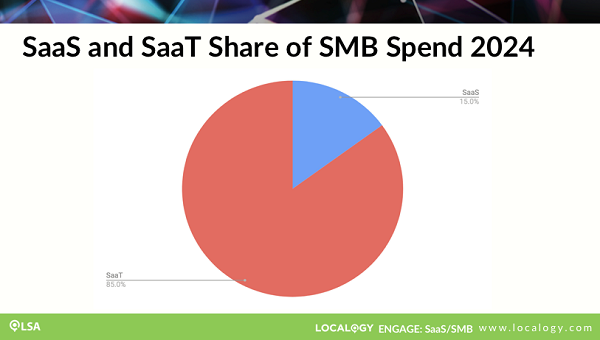
LSA’s 2019 forecast estimates that in 2019, small business SaaS will generate revenues of $14.0 billion, and will rise to $15.3 billion by 2024. That’s just 9.3% over five years. However, SaaT revenues will jump from an estimated $53 billion today to $87 billion by 2024, a 64% rise over five years. By 2024, 85% of SMB software revenue will be transaction based, vs. just under 80% today.
To put these numbers in some perspective, the combined SaaS/SaaT total equates to 0.72% of U.S. GDP, rising to 1.01% in 2024. The entire small business market currently drives about 46% of U.S. GDP.
The talk ended with a few takeaways. The key one being that the majority believe the future of small businesses software will involve a revenue model that is tied to value delivered, whether that is usage of the software or payment volume will likely depend on the nature of the software.




One Response
I think the bigger issue is integrations. There are so many SaaS programs and Apps that have to all work together that this is the challenge SMB’s are facing now and in the future. It is difficult for SMB’s to cobble these together and then there is the cost in doing so. The movement to full stack integrations that allows information to freely flow between applications and users is the key initiative in today’s digital space. SaaS programs will not be able to keep up on their own with the changes that are taking place and so having more open sourced API’s will be required so tools can be more freely developed and integrated to make communications and transactions work seamlessly. Especially as AI and automation moves into our every day life as helpers and initiators.