
AI search is increasingly the first, and sometimes only, source a customer checks before choosing a nearby business. But those AI-generated answers aren’t always accurate.
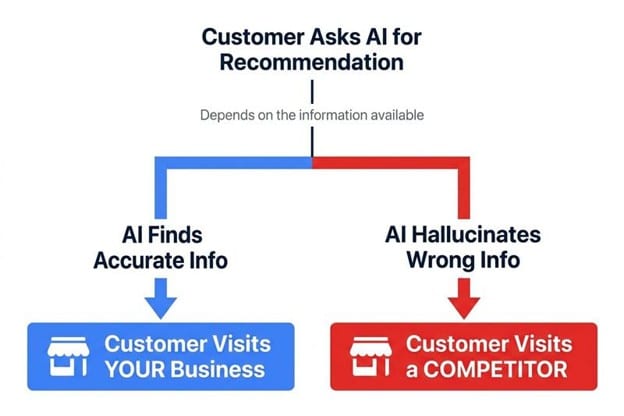
When AI is asked for local business recommendations, it synthesizes an answer from training data and information found publicly across the web in real time. If there are any gaps in that data, it may result in inaccurate information being presented to the user as fact, or what’s sometimes known as an AI hallucination.
What Are AI Hallucinations?
An AI hallucination is when a large language model (LLM) states false information with the same confidence it uses for accurate information. The AI model doesn’t “know” it’s wrong. It has no built-in way to verify anything against current reality, only patterns from training data and whatever it retrieves in real time. When those sources are thin or conflicting, the model may fill gaps with whatever sounds plausible, or by picking one of several possible options.
That gap-filling behavior has been described as a people-pleasing tendency: the AI model is designed to produce a fluent, satisfying answer, and a confident guess tends to read as more useful than admitting it doesn’t know. Given a choice between an uncertain non-answer and a wrong answer that sounds good, AI often defaults to answering incorrectly.
Why Local Business Details Can Get Hallucinated
Local business information is vulnerable to AI hallucinations and inaccuracies for a number of reasons. For example, because information like addresses, hours, phone numbers, and service areas change and get inconsistently updated across the web.
When current, consistent information isn’t available, an AI model doesn’t necessarily leave it out of an answer. It may generate its best guess based on the information it has access to and present it as fact.
One example that illustrates this is an AI assistant recommending a venue hours away by car in response to a clearly local query, something like where to watch tomorrow’s match in a specific city. The answer reads as a normal, confident recommendation to the person asking, even though it’s a completely unrealistic option.
This could have happened because the business moved locations and an outdated article still placed it in the original city, because the AI conflated two similarly named venues in different cities, because it associated an event with whichever venue in its training data mentioned that event most often, or because it defaulted to a larger, more documented city nearby when it lacked reliable data for the smaller one the user actually meant.
Whatever the specific cause, the result is the same: the AI had a gap in reliable, current information and filled it with something plausible, yet wrong. That’s the type of AI hallucination that local businesses need to worry about. It’s rarely a completely outlandish fabrication. Something as simple as a wrong address or service area, delivered with the same confidence as an accurate answer, can send a customer to a competitor instead.
How Common Are AI Hallucinations for Local Businesses?
There’s currently no research measuring how often local businesses specifically appear inaccurately in AI-generated answers. Most available studies look at AI hallucinations and businesses more broadly.
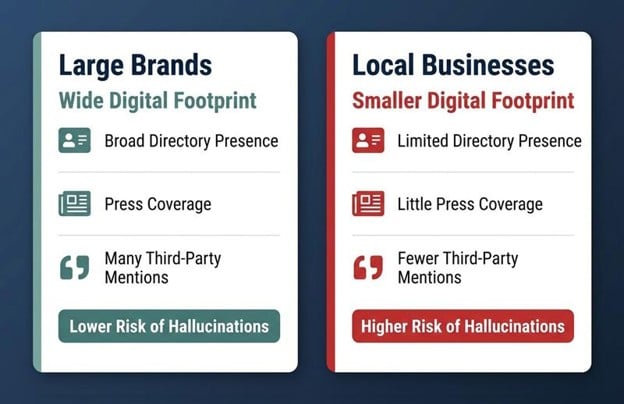
What some of that broader research does show is a gap between small and mid-sized businesses and larger brands. Recent studies testing AI-generated answers against verified company records have found more fabricated or missing facts, and more brand name confusion, for smaller companies than for large ones.
The likely reason for this isn’t anything specific to how AI treats small businesses. Larger brands tend to have a wider footprint of directory listings, press coverage, and other third-party mentions for an AI model to draw from. Brands with a smaller digital footprint, which includes many local businesses, give AI less to work with, and less to work with often means more best-guessing.
Reducing the Risk of AI Hallucinations for Local Businesses
Because hallucinations are most likely to form in the informational gaps AI is left to fill, the most effective way to prevent them is limiting how much guessing the model has to do.
Start with ensuring accuracy and consistency across the web. Business information should match exactly across the business’s website, Google Business Profile, other directories, and any other source an AI model might draw from. An outdated or missing address on even one listing introduces uncertainty a model may resolve incorrectly.
From there, monitor what AI is actually saying about your brand. Use a tool like Local Falcon to monitor AI visibility for the questions a customer would ask, across the platforms they’re likely to use, and check the answers the AI generates against reality.
When something’s inaccurate, identify the source the AI appears to be citing and correct it directly. If there’s no clear source at all, the business likely needs more third-party mentions and citations for AI to draw from going forward.
The Bottom Line
AI hallucinations and inaccuracies aren’t a reason for panic, but they’re not something to ignore either. The risk is that any gap in accurate, accessible information becomes an opportunity for an AI model to guess, and local businesses are more likely than large brands to have those gaps.
The businesses least likely to be misrepresented are the ones that keep their information accurate and consistent everywhere it appears, and that check in regularly on what AI is actually saying about them.