

Since AI took search by storm, dozens of AI visibility tracking and generative engine optimization (GEO) tools have launched, giving businesses and marketers a way to understand how AI talks about their brands.
However, most of these tools operate at a national or global level, surfacing broad AI visibility insights that might work well enough for brands doing business exclusively online, but aren’t specific enough for local businesses.
Any brand with a physical storefront, multiple locations, or a defined service area needs local AI visibility intelligence. Without it, you’re optimizing too broadly, especially when doing generative engine optimization (GEO) for multi-location businesses or enterprise organizations.
What Is Local AI Visibility and Why Does It Matter?
Local AI visibility refers to how AI-powered search experiences surface, describe, and recommend your brand within specific geographic areas, whether that’s broken down by country, region, city, or neighborhood.
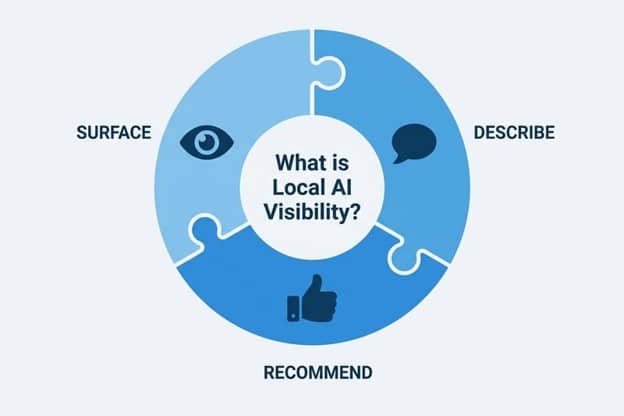
Just like traditional search factors in proximity and location for organic rankings, AI-generated answers and recommendations shift based on where the person asking is located or geographic details included in their prompt.
Google AI Overviews and AI Mode, ChatGPT, Gemini, and other generative AI answer engines don’t serve the same response to everyone. Location shapes what gets surfaced, how brands are described, and which sources get cited.
For local businesses and the SEO teams working to earn them more customers through AI-driven search, understanding that geographic variation is foundational to any effective GEO strategy.
Why Broad AI Visibility Data Falls Short for Local Brands
Global or national-level AI visibility data tells you something, but it rarely tells you everything you actually need to know to optimize for generative answer engines effectively.
Take AI citation tracking as an example. Knowing which sources AI cites when discussing your brand in general is useful, but knowing which sources it cites when someone in your actual service area or target market asks a relevant question is actionable intelligence.
The same principle applies to competitive positioning. A multi-location brand competing in a dozen markets isn’t competing against the same set of businesses in each one. AI visibility at the national level smooths over those localized differences. Local AI visibility data, on the other hand, lets you see exactly where you’re winning, where you’re losing ground, and to whom, within the specific areas that drive your revenue.
For multi-location brands, including franchises, service-area businesses, and regional chains, this kind of market-by-market breakdown is the key to an effective localized GEO strategy.
The Location Gap in AI Visibility Tools
Most AI visibility platforms were built with large enterprise and e-commerce use cases in mind. They’re designed to answer questions like “How does AI talk about our brand globally?” or “How do we compare to national competitors across AI platforms?”
Those are legitimate questions for the right business. But local businesses need tools that can answer questions like “How does AI describe my brand in Canada versus the U.S.?,” “How does my visibility in Pennsylvania compare to Ohio?, or “Am I being recommended in Chicago the same way I’m being recommended in Denver?”
Local Falcon’s generative engine optimization features are built to answer exactly those kinds of questions, giving local businesses and agencies the geographic granularity that more generalized AI visibility tracking tools can’t provide.
Local AI Brand Sentiment: A Layer Most Businesses Are Missing
Beyond visibility, there’s another dimension that gets lost in aggregated, high-level data: local AI brand sentiment.
AI doesn’t just mention brands. It characterizes them. The language AI uses to describe your business, whether it’s framing you as a trusted local option, flagging concerns, or positioning a competitor more favorably, shapes how potential customers perceive you before they’ve ever visited your site or walked through your door, and that sentiment varies based on geography.
For multi-location businesses especially, AI sentiment can change significantly from one market to another. A brand that AI consistently recommends with confidence in one region might be described more cautiously, or not recommended at all, in another. Those differences often reflect underlying factors: local reviews, regional press coverage, citation sources, or how well local landing pages communicate relevance for the area.
If your only view into AI sentiment is a high-level national summary, you won’t be able to pinpoint where the problem is. You might know sentiment is mixed, but you won’t know whether that means one market is dragging down an otherwise strong reputation, or whether there’s a widespread issue that needs broader attention.
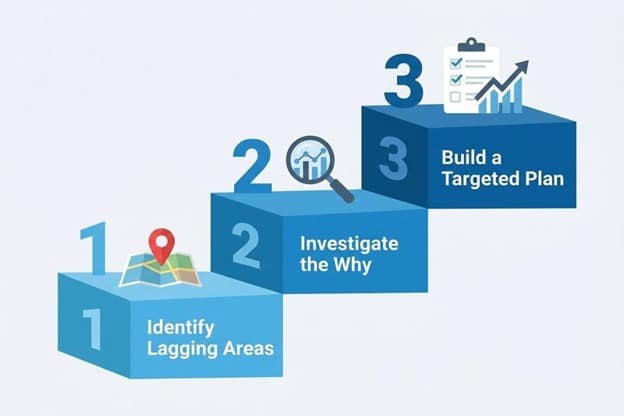
Local AI sentiment tracking gives you the power to tell the difference. When you can see how AI characterizes your brand city by city or region by region, you can identify specific areas where sentiment is lagging, investigate why, and build a targeted plan to improve it, whether that means addressing gaps in your local content, working to build citations in that market, or improving your local reviews.
Matching Visibility Strategy to How Local Customers Actually Search
When someone asks AI for a recommendation, location is part of the context, and the answer they receive reflects that.
Local businesses that understand granular AI visibility at the geographic level their customers actually operate in can make better optimizations to appear in those answers, and to appear in them positively.
Broad AI visibility data is a starting point, but for brands competing market by market, localized AI visibility intelligence is where real strategy stems from.