

The same business can show up across AI platforms like ChatGPT and Gemini, and still be described in completely different ways. One response might highlight standout reviews and must-try offerings, while another stays flat and purely factual. That inconsistency isn’t random; it reflects how each AI system sources, prioritizes, and interprets information. For brands and agencies, the implication is critical: visibility alone isn’t enough. How AI frames your business is increasingly what determines whether customers choose you.
Ask ChatGPT where to go for lunch in a nearby neighborhood, then ask Gemini the same question. You might see the same restaurant appear in both sets of results, but how each platform describes that restaurant, what it highlights about the menu, and how enthusiastically it recommends the place can be surprisingly different.
One platform might position a business as a neighborhood favorite with standout reviews and signature offerings, while another presents only basic, functional details. That difference reflects a sentiment gap driven by the fact that each AI platform is pulling from and prioritizing different data sources.
Every AI Platform Is Working From a Different Playbook
AI search tools like ChatGPT, Google’s AI Overviews, and Gemini don’t pull from an identical pool of business data. Sure, they have access to much of the same information and the sources they use can certainly overlap, but each one has its own preferred sources, its own integrations, and its own weighting of what counts as authoritative information.
Gemini, for example, has a direct integration with Google Business Profile. That means it can surface your hours, reviews, photos, and category data with a high degree of accuracy — assuming your GBP is up to date and optimized.
ChatGPT, on the other hand, has a partnership with Bing, which means Bing Places for Business data carries outsized weight in what it knows about a local business. If a business has a robust Google presence but has largely ignored Bing, ChatGPT may be working from a thinner or older data set.
Beyond those direct integrations, other factors shape what each AI platform knows about a business: the recency and breadth of the model’s training data, how well that business is represented across third-party directories and data aggregators, how much structured data appears on its website, and whether its name appears in editorial content — local press, industry publications, or community sites that the model treats as credible sources.
The same business can look very different from one AI platform to the next simply because its brand footprint is stronger across the sources that one platform weighs more heavily than another.
Different Sources Can Lead to Different AI Brand Sentiment
AI brand sentiment is the tone and character of how an AI platform describes or recommends a business, and it varies more than most businesses realize.
Because each AI platform is drawing from at least partly different inputs, they can potentially arrive at different impressions of the same business, resulting in varying brand sentiment. While this may seem like a technical curiosity, it can become a real business problem.
A business with strong, persuasive sentiment on one AI platform is likely to generate genuine customer interest every time it appears in responses. On the other hand, if the business has weak or neutral sentiment on another AI platform, it may technically be showing up in results but failing to move anyone toward actually picking up the phone or paying it a visit.
For example, one platform might describe a restaurant as a neighborhood staple with enthusiastic reviews and a standout dish worth seeking out. Another might describe the same place in entirely neutral, functional terms: it exists, it serves this type of food, it is located at this address. That difference in sentiment can influence potential customers to choose your business or not.
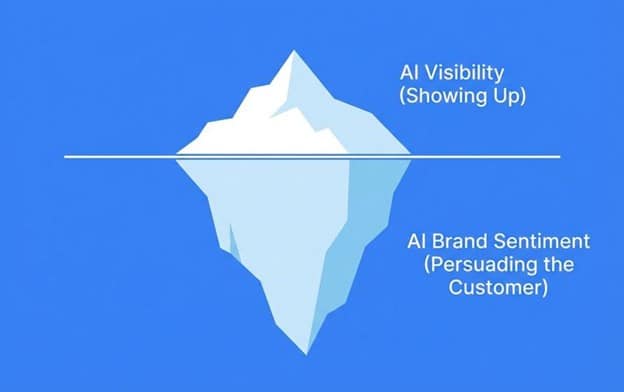
In short, having good AI visibility without strong persuasive sentiment doesn’t actually mean customers are choosing your business over your competitors. The platforms where your sentiment is strongest are the ones actively driving business, while the platforms where it’s weakest are not contributing meaningfully to growth — even if your name is technically appearing.
Why Cross-Platform AI Sentiment Tracking Is No Longer Optional
Most businesses — and even many agencies managing local SEO — are still thinking about AI visibility as a measurement of success with two possible outcomes: either you’re showing up in AI or you’re not. But that framing misses the more consequential question: how is AI describing your business when you do show up?
A business could have excellent AI visibility on Gemini and a weak, forgettable presence on ChatGPT. If that business’s target customers skew toward ChatGPT users, that imbalance has a direct effect on leads and revenue.
Tracking both AI visibility and brand sentiment across platforms gives businesses and their marketing teams a clearer picture of where their digital reputation is actually working when it comes to AI-driven search experiences. It surfaces discrepancies that would otherwise go unnoticed and creates a roadmap for where to focus effort.
What To Do About It
For businesses and agencies that want to get started with optimizing AI brand sentiment, the first step is knowing where you stand.
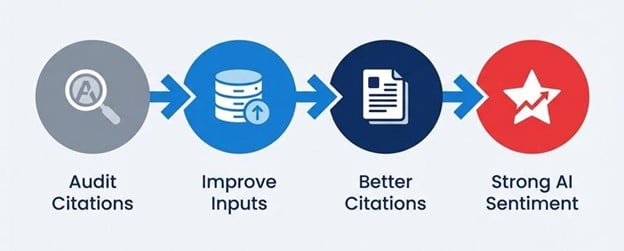
Using a tool like Local Falcon, audit how major AI platforms, like ChatGPT, Gemini, Google’s AI Overviews, Google AI Mode, and others, are actually describing the businesses you manage.
Where sentiment is weak, look closely at what sources that platform is citing. Those citations tell you exactly where your reputation is falling short and, more importantly, where to focus your optimization efforts. Improve the inputs and you improve what AI says about your business.
Ultimately, the brands that track and proactively work to improve AI sentiment won’t just show up in AI search — they’ll actually win business from it.