
The conversation around search and AI visibility has largely been focused on one question: is a business showing up in AI? But as AI-powered search becomes a primary discovery channel for local businesses, a second and arguably more important question is starting to demand attention: when AI does mention the business, what exactly is it saying?
Visibility and Sentiment Are Not the Same Thing
Unlike traditional local search, AI visibility is not defined by rankings. Either the local business appears in an AI-generated response to a relevant query, or it doesn’t. When someone asks AI for recommendations in their local area, do they make the list? That’s a visibility question.
AI sentiment, on the other hand, is about the quality and character of what’s being said when your business does appear. It’s the difference between AI describing the SMB as a “well-reviewed, locally trusted service provider with transparent pricing” versus flagging that customers “frequently mention long wait times and difficulty reaching someone on the phone.” Both responses technically include the SMB. Only one of them is actually selling it.
When a potential customer asks AI for a recommendation, they aren’t just looking for a list of businesses — they can use Google Maps for that. Instead, they’re looking for a conversational nudge in the right direction, and the language AI uses to describe a business is often that nudge.
Making AI Search Performance Measurable
Because AI responses are generated dynamically and vary greatly across queries, locations, and platforms, neither AI visibility nor sentiment is easy to measure without the right tools, but both can be quantified using the right metrics.
AI visibility is best tracked through a metric called Share of AI Voice (SAIV), which measures how frequently a business appears across a range of relevant AI-generated responses in a specific area. The higher the SAIV, the more consistently the SMB is part of the conversation when potential customers are asking AI for recommendations.
Sentiment, on the other hand, can be categorized as positive, negative, or neutral based on the language AI platforms use to describe a business. Phrases like “highly rated,” “family-owned,” or “affordable” on the positive side, versus “inconsistent service” or “hard to get an appointment” on the negative. But sentiment can also be quantified more precisely through a metric like Local Falcon’s Buyer Persuasion Score (BPS), which measures how strongly AI is actually recommending the business to potential customers, on a scale from strongly discouraging to strongly advocating.
BPS moves beyond whether the language is positive or negative in a general sense and asks a more commercially relevant question: is the way AI talks about the business actually persuading someone to choose it?
The Gap Between Presence and Persuasion
Here’s where it gets interesting — and where a lot of businesses are unknowingly leaving an opportunity on the table. You can have a high SAIV and a poor BPS at the same time.
Imagine a restaurant appears in 70% of AI responses when someone in a city asks AI where they should get lunch nearby. That sounds like a win, but if AI is consistently describing the SMB with neutral or lukewarm language — mentioning it exists without any real enthusiasm — they are getting visibility without conversion momentum. In other words, they are in the room, but not really making a good first impression.
Conversely, a business with lower SAIV but strong BPS may be appearing in AI-generated answers less frequently, but when it does show up, AI is actively championing it. That business is punching above its weight in AI search.
The goal, obviously, is to be strong on both fronts — both present and persuasive. Using SAIV and BPS together gives local businesses and agencies a more complete picture of AI search performance, one that helps them understand the actual impact of AI on customer acquisition.

Influencing What AI Says
So, if they are visible in AI, but AI sentiment isn’t working in their favor, what can you do about it?
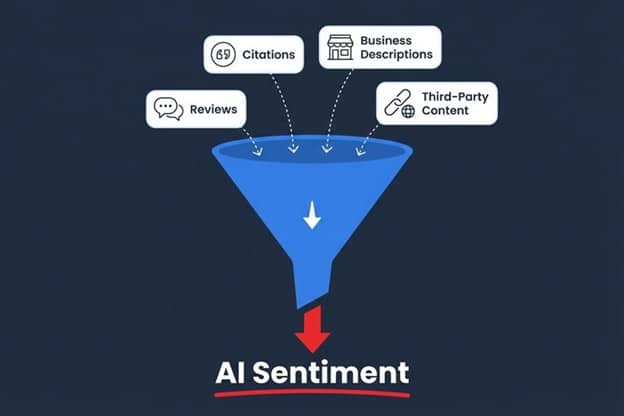
The key thing to remember is that AI models synthesize language from a wide range of inputs — reviews, citations, business descriptions, third-party content, and more. This means that influencing AI sentiment isn’t fundamentally different from building a strong digital presence, though it requires a more deliberate approach.
Accumulating consistent, detailed reviews that use the kind of language you want AI to echo, maintaining accurate and rich business listings, and earning mentions in credible online publications all feed into AI sentiment.
Digital PR, in particular, is an underrated tool here. Earning coverage in local or industry-relevant outlets doesn’t just build backlinks — it puts authoritative, positively framed descriptions of s business into the sources AI models often directly reference. It’s one of the more direct ways to shift the narrative that AI builds around the brand.
A New Standard for Local AI Optimization
Most businesses understand that they need to optimize for AI search, but optimizing only for visibility — only for the question of whether you appear — is only half the job. The businesses that figure out how to earn not just an AI mention but an AI recommendation are the ones that will have a true advantage in AI-powered local search.
This means monitoring AI search performance in terms of both visibility and sentiment, understanding what’s driving each, and making deliberate operational and strategic decisions to improve them. Presence matters, but persuasion is what drives the call!