
One of the effects of an evolving digital landscape is to spark new user behaviors. That includes local business discovery and how consumers evaluate businesses before deciding where to go or what to buy. And with one of the biggest transformations in decades now underway – yes, we’re talking about AI – local search and discovery habits are being upended.
To define these behaviors, SOCi has published a report that surveys 1000+ consumers on their current patterns and practices. Known as the 2026 Local Discovery Index (LDI), the report is in its third edition and follows SOCi’s recent LVI study. In this edition, it zeroes in on what it calls the Verification Loop.
What is that exactly? We’ll dive into all the details below, but the short version is that search has ceded some of its traditional ground as the web’s front door. And it’s not just the common refrain that AI is stealing its thunder. Social apps and review sites are ratcheting up, helping users verify before they buy.
The end result is that the already convoluted path to purchase – weaving in and out of digital channels and offline transactions – is more fragmented than ever. And that fragmentation is inflicting the top of the funnel, where search has traditionally dominated, in addition to downstream verification stages.
“Search remains the anchor,” SOCi CEO Afif Khoury told Localogy Insider. “What changed is the width of the journey: consumers now use more channels than in any prior year.”
Elements of Influence
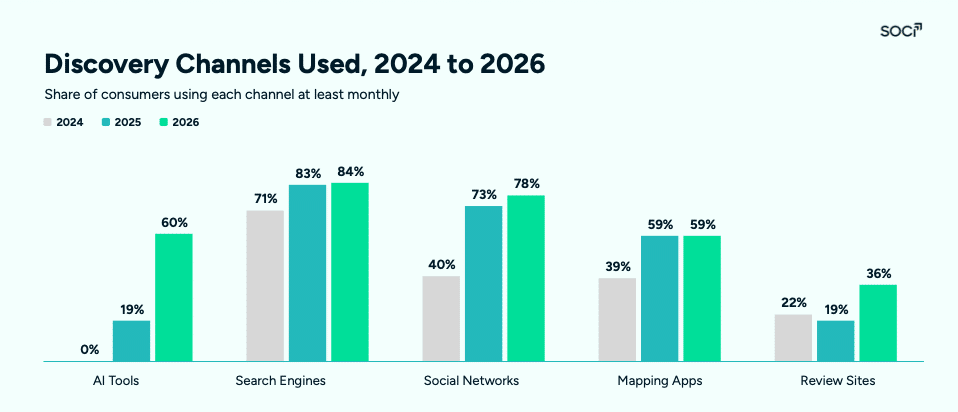
Diving into the numbers, one of the first things that jumps out from SOCi’s study is the growth of emerging and alternate local business discovery channels while search remains flat. AI’s usage share has grown from zero to 19% to 60% over the past three years, while social has grown from 40% to 73% to 78%.
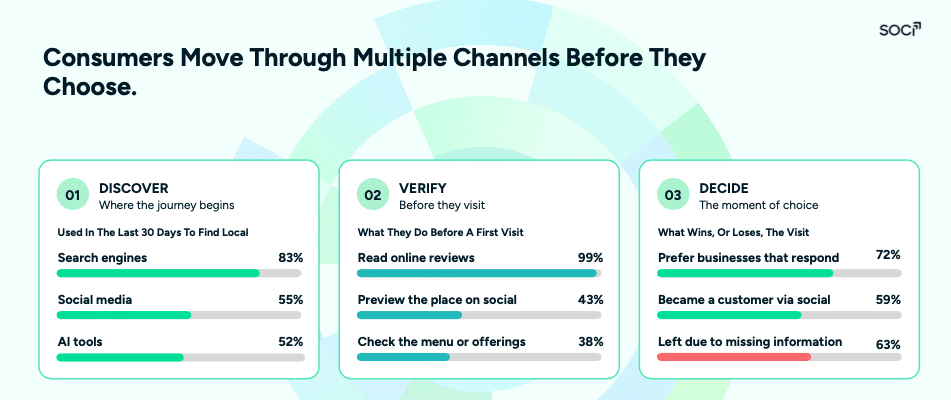
The result, as noted, is more fragmentation. But what that practically means is that the traditional funnel has morphed into a loop. Consumers discover a business in one place, verify it in another, then decide – often within a few minutes, and across multiple channels, says SOCi. This is the verification loop.
To map this new construct, SOCi looks at three stages: discover, verify, and decide. Though these resemble the traditional funnel, their elements of influence are more complex. For example, in the discover phase, search still leads but social media and AI tools are gaining ground (see graphic below).
Meanwhile, in the verify stage, online reviews are dominant while social content and reviewing menus are prevalent. And in the all-important decide phase, the most influential factors are businesses that respond to queries, and those that provide complete information. The latter is a kiss of death if neglected.
Trust Issues
Zeroing in on AI usage, it is clearly growing, which isn’t surprising to anyone. But the more important finding is how it’s growing. As we theorized in a recent analysis of AI usage data, AI engines are increasingly engaged with commercial intent, as opposed to curiosity or educational intent.
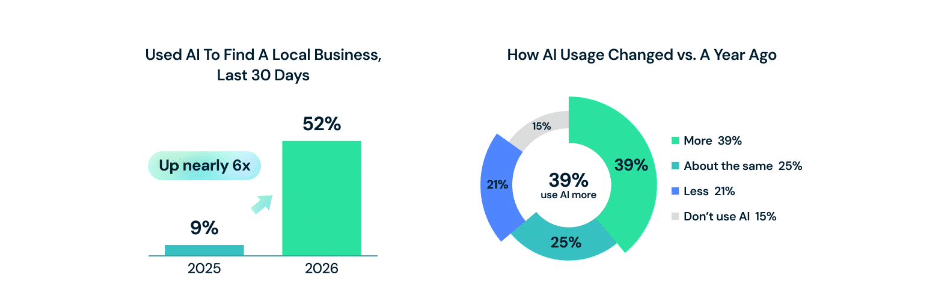
Specifically as it relates to this study, 39 percent of respondents report using AI more than they did last year. But when asked about their AI usage forlocal business discovery in the past 30 days, 52 percent answered affirmatively. That’s up from 9 percent in last year’s LDI, which is a nearly-6x jump.
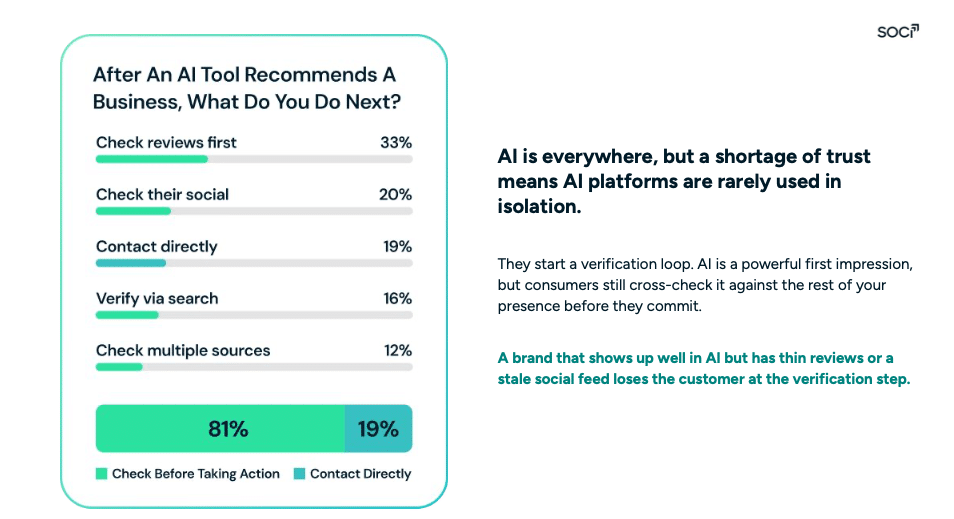
But despite greater commercial intent, consumers largely don’t trust AI. 67% report receiving incorrect local business info; 30% report inconvenience from those errors; and 73% haven’t increased their trust of AI in the past year. Practically, this drives them to double check info in social, search and reviews.
So if everyone uses AI, but no one trusts it, what’s the takeaway? Among other things, all those other channels will be elevated in value as they occupy a verification role. This aligns with the findings above regarding expansion – rather than contraction – of channels, apps and tools in the verification loop.
Surface Area
So how does all of this boil down to tactics? Because the verification loop is fragmented and convoluted, digital marketers have to be present and optimized in all of its expanding components. That makes marketers’ jobs harder… but it’s also an opportunity to jump ahead as the herd is culled by new rules.
“Winning is not about dominating one channel,” said Khoury. “It is about being present, accurate, and consistent everywhere the loop touches.”
One reason this takeaway is notable is that it’s aligned with conclusions from SOCi’s aforementioned LVI report. That report – seeing online visibility and corresponding offline conversions influenced by an expanding set of channels – concluded that digital marketers’ surface area is the name of the game.
So with additional validation from LDI, this strategic takeaway has even more wood behind the arrow. But that doesn’t mean the analysis is over. The evolving art of online visibility – and the fusion of AIO, SEO and other Os – will be a moving target. We’ll be defining and refining this playbook for years to come.