Search and social visibility powerhouse SOCi has released its 2026 Local Visibility Index. The wide-reaching report reveals tactics that multi-location brands should execute to boost local search visibility. But importantly, ‘local search’ has expanded from search engines and rankings to conversations.
That environmental backdrop colors the state of local search today, as AI engines like ChatGPT increasingly take market share and consumer mindshare from traditional search engines. And that statement applies to the work Google is doing to canibalize itself with AI Overviews and AI Mode.
In short, consumers are searching differently, so businesses need to optimize their digital presence differently. The rules have changed, and it’s not just about following traditional ranking factors. Showing up in AI engines, though it’s often framed as an extension of SEO, is an entirely different ballgame.
“The real shift isn’t AI replacing search…it’s AI reducing choice,” SOCi CMO Monica Ho told Localogy Insider. “Traditional search still exists, but AI chat often delivers a short list instead of a results page. That changes the economics of visibility. If your brand isn’t trusted, accurate, and consistently present across the signals AI pulls from, you don’t fall down the rankings…you fall out of consideration entirely.”
It’s Hard Out There
Going deeper, how do report findings lead to the above conclusions? First, let’s contextualize the report itself, including goals and methodology. LVI analyzed 350,000+ locations across 2,751 multi-location brands to score them in 120 performance metrics like Google 3-pack presence and AI engine results.
The goal is to benchmark practices that land businesses in these coveted spots. Who’s most visible? And more importantly, what are they doing right? This was tracked in an overall sense, and within 5 major vertical categories – further broken down by 42 subcategories, from coffee shops to mortgage brokers.
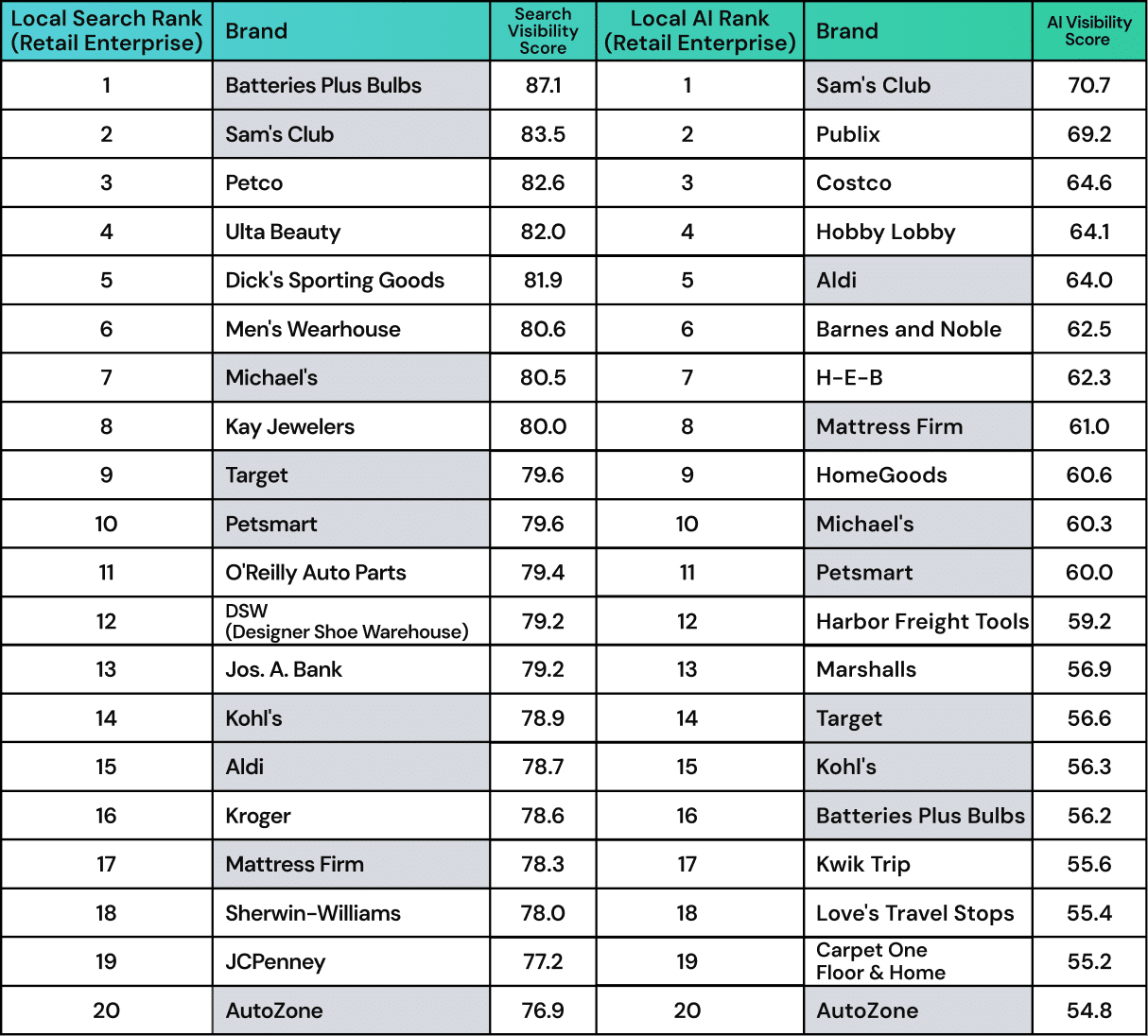
From that analytical rigor, Soci uncovered a few notable findings. First, to quantify the “AI playbook is different” conclusion teased above, there was only a 45 percent overlap in the retail category for brands that showed up in traditional search and AI-engine queries. Similar results were seen in other verticals.
One reason for this disparity is that AI engines are simply more discerning, as we recently examined. For example, ChatGPT recommends 1.2% of brand locations, compared to an average 35.9% appearance rate in Google’s local 3-Pack. This makes AI visibility ~30x more selective than traditional local search.
The practical takeaway is that it’s hard out there for local businesses. Another way to say that is that the selectivity imposed by AI engines means there’s less room for error, and the stakes are higher than ever for not optimizing one’s presence. The impact of that statement amplifies as AI engines grow in usage.
Highlight Reel
Beyond the above high-level findings from the LVI report this year, there were several strategic implications that branch from there. In the interest of brevity, we’ll extract a few of our top takeaways to save time for Localogy Insider readers. Here’s our highlight reel, in no particular order.
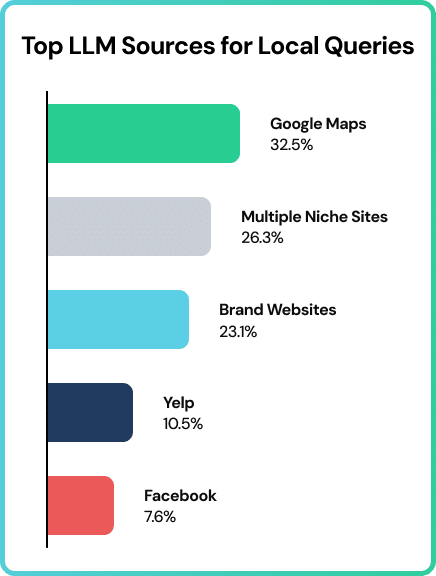
- Source Material: AI engines synthesize information from multiple places, such as Google Maps, Yelp, Facebook, and other high-traffic sources. They combine and interpret these signals to produce one final recommendation. That contrasts traditional local search, where one platform (often Google’s own properties) serves as the primary reference point.
- This has a few results and consequences.
- Google Ranking isn’t a Silver Bullet: While Google operates as a relatively closed ecosystem, AI systems pull signals from many sources. For example, locations with strong Google rankings but weaker presence on Yelp, Facebook, or their own websites often lose visibility in AI recommendations. Correspondingly, brands with slightly lower traditional rankings but more consistent trust signals across platforms are often elevated in AI search.
- Cover all Bases: Because AI engines synthesize signals across Google Maps, Yelp, Facebook, and brand websites, comprehensiveness is the name of the game. Brands that get those scarce AI mentions noted above are covering all bases. Strength in one channel won’t cut it.
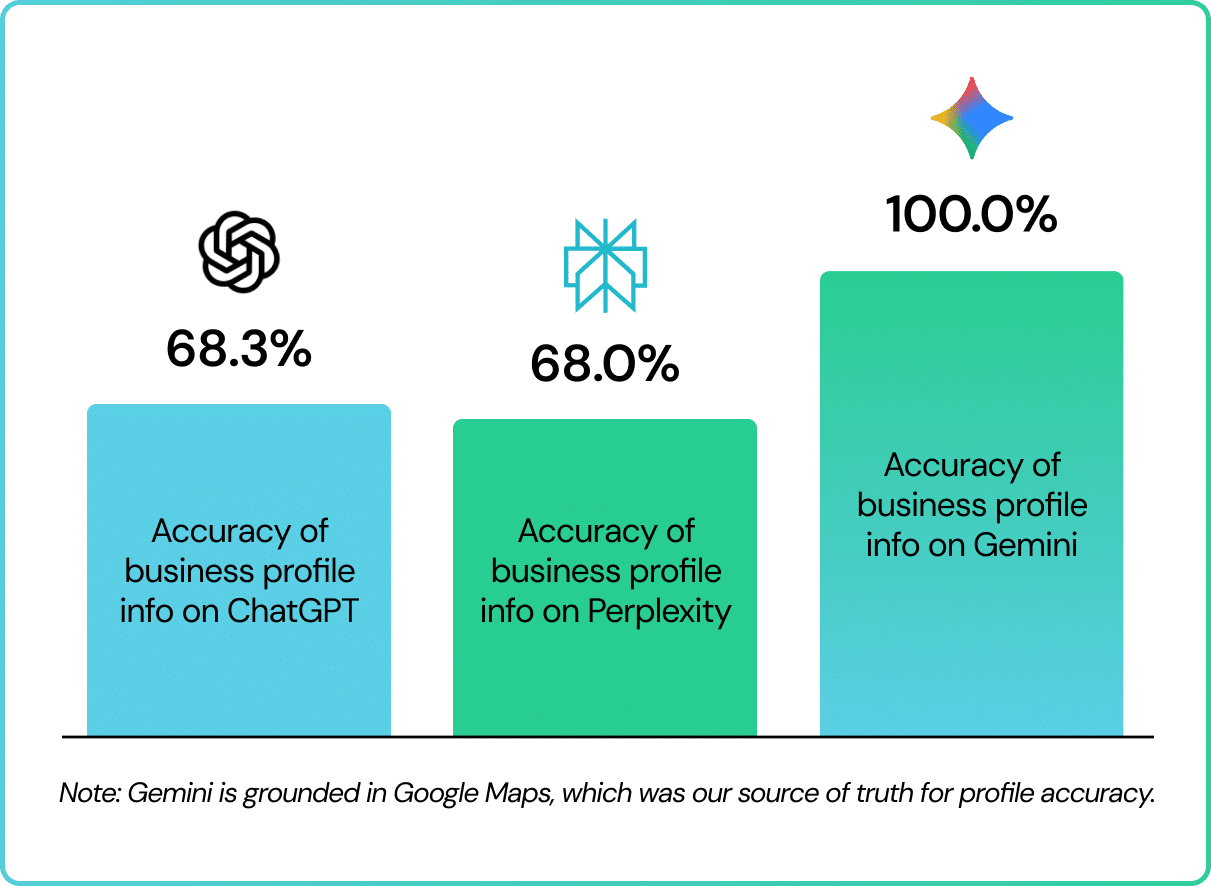
- AI Engines Aren’t Perfect. Data accuracy flaws (e.g., incorrect hours, addresses, etc.) were uncovered by LVI for AI engines, especially ChatGPT and Perplexity. One likely reason is that these platforms lack a centralized source for location information (as opposed to Gemini, which relies solely on Google Maps). Because they’re casting a wider net of first and third-party sources across the web, they tend to be less accurate. The takeaway for marketers is a need to resolve such data discrepancies in the sources that these platforms reference.
- Consumer Sentiment is King: Consumer sentiment, such as ratings and reviews, is one of the strongest AI-engine factors of influence. Specifically, locations recommended by ChatGPT averaged 4.3-star ratings. That’s good news in a sense because it’s something that businesses can actively influence. But this reality can equally hurt businesses if they fall below the threshold.
- Margin of Error: Though AI engines generaly draw from similar sources as traditional local search, and they rely on longstanding SEO fundamentals (accurate listings data, reputation signals), they apply those qualifiers more aggressively. The margin of error is less forgiving, as small mistakes (think: inconsistent or incomplete listings) can disqualify brands from AI-engine consideration.
- No Fallback: In addition to a less forgiving margin of error, there’s no fallback or long tail in AI search. One answer to one question means that there’s no page 2 of Google. You’re either mentioned in the AI answer… or you’re not.
New World Order
All the above findings are valuable not just in their data-backed validity but in their challenge to previous industry assumptions. For example, though it’s been an open question, there’s been some degree of consensus that optimizing a given business for AI SEO (a.k.a., GEO), flows from a strong SEO foundation.
LVI shows that SEO basics do indeed prime a given business for AI-engine visibility. But any company that relies on that alone – specifically in the art of local visibility for multi-location brands – will be left behind in the AI era. The new world order involves a mix of traditional SEO and an AI-native playbook.
For example, AI engines are conditioning users to search in more conversational ways (read: full sentences). This engenders a departure from the caveman-speak of traditional keyword search (e.g., “fast food near me”). So the granularity in queries needs to be met with granularity in listings data.
We’re talking about comprehensive business descriptions and depth of detail – everything from frequently-updated happy hour menus to dog policies to kid-friendliness to nut-allergy options. That’s always been the case in the SEO realm, but it’s now more pronounced, and the stakes are higher.
As for tactics and takeaways from LVI, all the above only scratch the surface. So we’re committing to extract more findings throughout the nooks and crannies of the LVI’s extensive data banks. Check out the full report, and stay tuned for more coverage, including our report series that will dive deeper.