
One of the most prevalent hot takes in the backlash to AI search is the medium’s tendency to reduce traffic for publishers and website owners. And it stands to reason: answering questions with greater granularity – as opposed to search’s traditional intermediary role – will naturally intercept traffic.
This accelerates a decades-long trend, as Google increasingly preempted click-throughs with greater levels of information (e.g., knowledge panel results) and functionality (e.g., transactional buttons) in its SERPs. In that light, the new zero-click enemy – though it includes Google – takes some heat off Google.
In any case, the result is traffic declines throughout the land, which has incited grievances from major publishers in the news media and other verticals, not to mention some legal action. Meanwhile, pundits and pragmatists assert a “can’t beat ’em, join ’em” narrative in getting aboard the AIO and GEO train.
That last part will be the inevitable answer, though some are learning it sooner than others. But in the meantime, a key question looms: How much publisher traffic is being siphoned off by AI engines? More importantly, do these engines offer value in return, such as net-positive citations or higher-quality traffic?
The Bad News
New first-party data from Brainlabs, published by Digiday, starts to answer these questions. The firm aggregated traffic data from 54 high-traffic clients and compared the time period after the launch of Google AI Overviews with traffic benchmarks prior to that period. The results were mixed but telling.
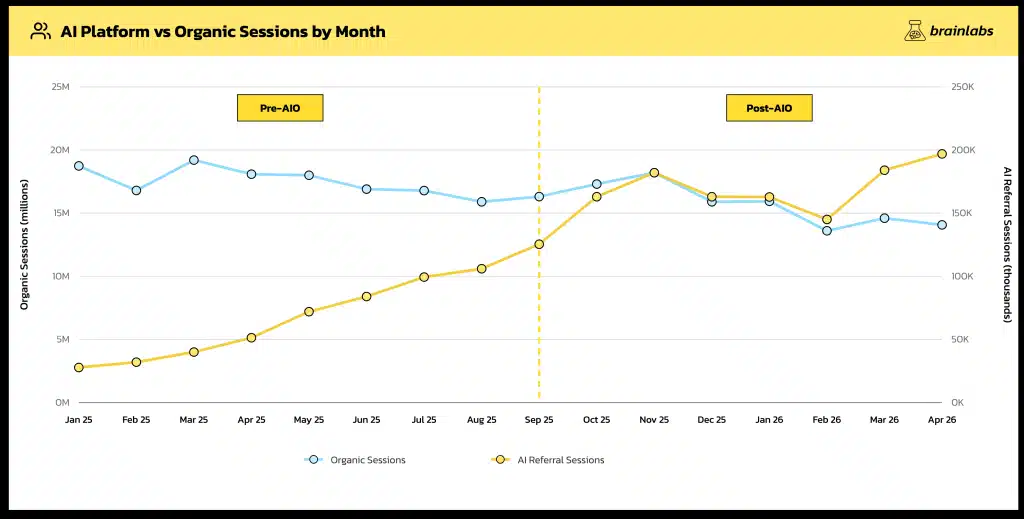
First, the bad news. Across these sites, there was an average 10 percent decline in organic traffic. But it’s important to note that the largest impact occurred at the latter half of the study’s timeframe (see above). That’s simply because declines are a function of AI Overview penetration, which continues to grow.
In other words, it will only get worse. For example, Overviews started appearing on 30 percent of Google search results in September of last year, after which an inflection occurred in traffic declines. In total, organic traffic across this sample fell from about 20 million sessions per month to about 15 million.
At the same time, AI referral traffic from sources like ChatGPT and Gemini grew to about 200,000 per month across the sample. From there, it’s easy math to see a net decline of about 4.8 million sessions. In other words, the traffic from AI engines doesn’t come close to offsetting organic search traffic declines.
The AI Search Good News
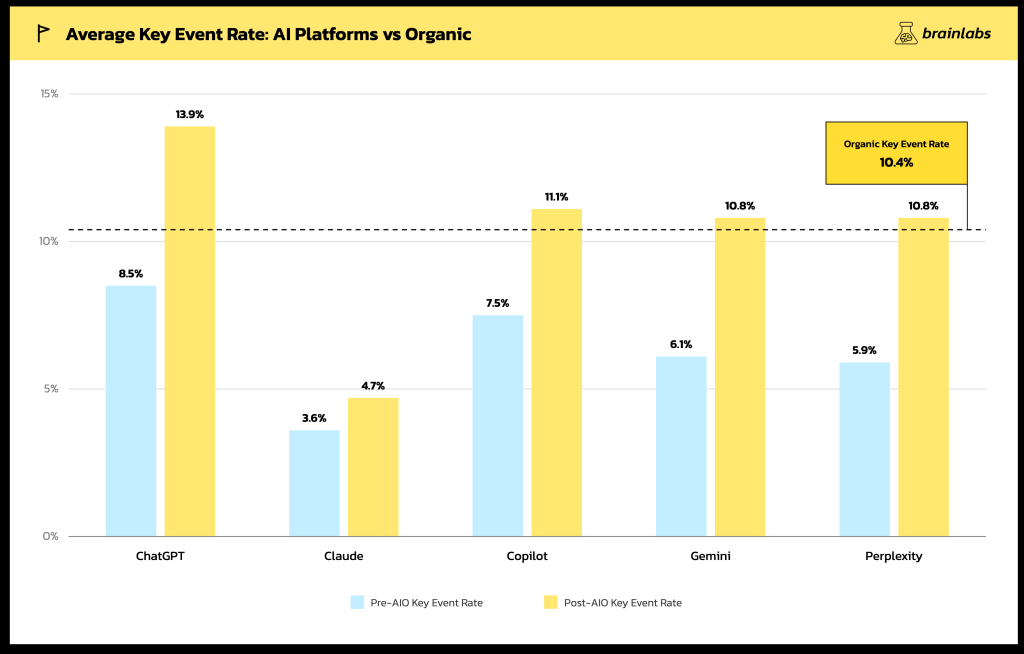
So what’s the good news? Despite traffic declines, there isn’t a pronounced decline in commercial effects and outcomes. In other words, conversions and KPIs are being upheld on average, despite traffic declines. So if there’s less traffic but unaffected outcomes, what does that mean? Higher-quality traffic.
Specifically, Brainlabs tracked conversions across the sessions in this study. These included purchases, newsletter signups, or scrolling all the way to the bottom of a page. For the traffic that came from AI engines, these events grew 335 percent, representing a 1.5x conversion rate over the benchmark.
Brainlabs theorizes that this signals an evolving persona for AI searchers. Initially representing casual or education-oriented intent, AI search is increasingly used in commercial-intent contexts. If true, that trendline could mean that things will only get better – the inverse of the above longitudinal conclusion.
The takeaway – at least in this study – is that AI engines inflict net declines in traffic… and big ones at that. But the growth in quality (converting) traffic offsets declines in quantity of traffic. So the net effect that matters most – revenue impact – represents a silver lining amidst all the AI doomsday narratives.