
There’s been a lot of advice about optimizing websites for AI search circulating on the web lately, some of it good, some of it not so good, and virtually none of it coming from the companies behind AI search themselves.
So, it was a welcome surprise when Google finally released its own guide to optimizing websites for generative AI features on Google Search, especially since it addresses optimizing for local AI search specifically, on top of all the more general advice.
Core Google AI Search Concepts To Understand
One of the biggest takeaways from the guide to optimizing for generative AI features on Google Search is that, from Google’s perspective, terms like “generative engine optimization (GEO)” and “answer engine optimization (AEO)” are just different aspects of SEO as a whole. In other words, Google considers optimizing sites for Google’s AI search features to now simply be an SEO best practice.
Google also explains in the guide exactly how its AI features, namely AI Overviews and AI Mode, actually search Google’s index for content to draw from and highlight in synthesized answers. The two primary Google AI search techniques to understand are:
- Retrieval-augmented generation (RAG): Google’s generative AI search features use the platform’s core search ranking systems to retrieve relevant, up-to-date web pages, then review the information found to generate helpful, accurate responses supported by navigable links.
- Query fan-out: Google’s AI simultaneously runs related queries to find as much additional relevant information for a given search query as possible, addressing the user’s intent from multiple unique, related angles for a more comprehensive response.
How Google Says To Optimize for AI Search Features
Overall, the guide focuses on reframing traditional SEO best practices in terms of what matters most to Google’s AI. Here’s a summary of a few of the most important things to keep in mind when optimizing a website for generative AI features on Google Search.
Prioritize Creating Useful Content
Throughout the guide, Google reiterates the importance of creating truly useful, valuable content if you want it to get surfaced by Google’s AI. This means providing a unique point of view, creating non-commodity content, organizing your content in a helpful way, and adding high-quality images and videos.
What exactly is non-commodity content, you ask? Well, Google states that this is content which is helpful, reliable, and people-first, rather than content based on common knowledge that lacks unique insight. Think in-depth, expert perspectives instead of thin listicle-style articles that are a dime a dozen.
Build and Maintain a Strong Technical Foundation
In order for Google’s AI to access and use your site’s data, it must first meet Google’s Search technical requirements and be indexed.
It should also follow other technical SEO best practices, including:
- Being publicly accessible and fully crawlable
- Using semantic HTML wherever possible
- Implementing JavaScript SEO best practices if applicable
- Providing a good page experience for site visitors
- Reducing duplicate content
What the Guide Says About Local Businesses
When it comes to local businesses, the guide emphasizes the importance of Google Business Profile (GBP) optimization for ensuring your products, services, and business details are visible in AI-generated responses.
Google’s AI relies heavily on GBP for local business details when providing recommendations. So, if your hours or address are wrong, or you’re missing categories or have the wrong primary category selected, it can hurt your AI visibility on Google, ultimately reducing your potential to attract customers via Google’s AI search features.
Tying It All Together for Local SEO
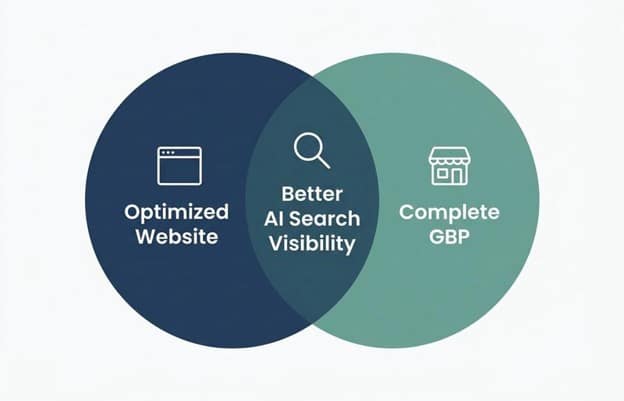
If we look at the guide holistically, for a local business, the path to better visibility in Google’s AI-generated results comes down to aligning two things: a correctly optimized website and a complete, accurate Google Business Profile.
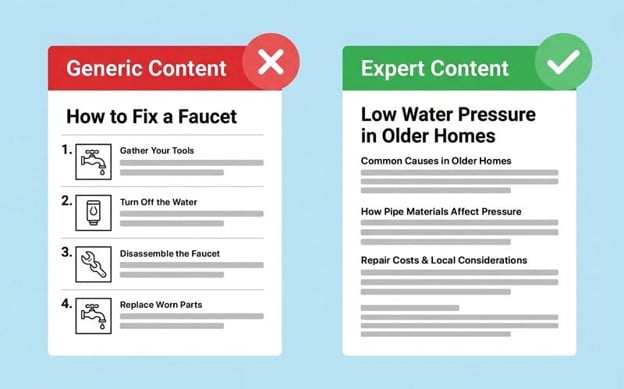
Consider a local plumber. On the content side, rather than publishing generic “how to fix a leaky faucet” content that mirrors a thousand other sites, they’d be better served publishing detailed guides drawing on real job experience, covering topics like what causes low water pressure in older homes in their specific city, or how local pipe materials affect common repair costs. That kind of non-commodity, experience-backed content is exactly what Google’s AI is built to surface, because it provides unique value a user can’t find just anywhere.
Paired with strong content, technical fundamentals still matter. That same plumber’s site should load quickly, use clean semantic HTML to label services, locations, and contact information, and be free of duplicate pages for different service areas.
On the GBP side, every field is an opportunity. A complete profile means the right categories, accurate service areas, up-to-date hours, current photos, and a detailed services list. When a potential customer asks Google’s AI to recommend an emergency plumber nearby, it pulls directly from GBP data to populate its response, and an incomplete or inaccurate profile can mean not showing up at all.
Finally, none of this optimization effort is useful without measurement. Tracking your AI visibility across AI Overviews, AI Mode, and Gemini with a tool like Local Falcon helps you understand your Share of AI Voice (SAIV) on Google, what sources Google’s AI is citing, where competitors are appearing instead of you, and which content or GBP updates are actually moving the needle. Treating SAIV as a core metric of local SEO success is how local businesses stay visible as Google’s AI search features continue to evolve.