

Modern local visibility consists of two components: Google Maps rankings and AI-generated search visibility. Multi-location businesses that track only the local pack are measuring only part of their total discoverability.
Google’s local pack remains a primary visibility surface, but AI search platforms now generate recommendations and summaries that influence which businesses customers see first. These AI-generated results aggregate signals from Google Business Profile data, reviews, website content, citation consistency, and brand authority. As a result, a location may rank well in Google Maps yet fail to appear in AI-generated summaries — or surface in AI responses despite weaker traditional rankings.
Why Both Local Pack and AI Visibility Matter
Appearing in the local pack — the three businesses featured at the top of Google Search results — remains a critical measure of local search success. It signals Google Business Profile authority, relevance, and trust at the local level, and it continues to drive meaningful customer action.
At the same time, AI-driven discovery has expanded how and where customers find local businesses. AI search platforms aggregate information from multiple sources to generate summaries and recommendations that may surface your locations differently — or leave you out of the conversation entirely.
Measuring only local pack rankings underrepresents total visibility because AI-generated recommendations operate as a parallel discovery layer. Measuring both the local pack and AI visibility provides a more accurate representation of total discoverability. Together, these channels shape how often, where, and why customers see your brand. But visibility across both environments can’t be improved if it can’t be measured accurately.
Building Network-Wide Visibility Through Hyperlocal Insights
Strong local performance across multiple locations requires more than broad SEO tactics or high-level reporting. It requires hyperlocal visibility insights. Hyperlocal visibility intelligence measures how each individual location performs across geographic grids in both Google Maps and AI-generated search environments.
Each location operates within its own local search market, shaped by proximity, competition, and other localized signals. Without hyperlocal insight, many businesses rely on ranking averages, single-pin checks, or brand-level summaries that flatten performance and hide meaningful variation. That makes it difficult to understand why certain locations surface consistently — or why others struggle to appear at all.
Hyperlocal visibility insights change that, allowing businesses to see exactly how each location performs across both Google Maps and AI-driven search, making it possible to take targeted action that strengthens network-wide visibility over time.
How Hyperlocal Visibility Intelligence Works
Consider a regional gym with ten locations. Hyperlocal visibility intelligence can reveal:
- Which locations appear in the local pack for high-intent search terms
- How visible each location is within AI-generated summaries and recommendations
- Where inconsistencies in listings, reviews, or content may be limiting discoverability
When viewed together, these insights highlight patterns that traditional reports miss. Business owners can quickly identify where visibility is strong, where it’s weak, and where improvements will have the greatest impact.
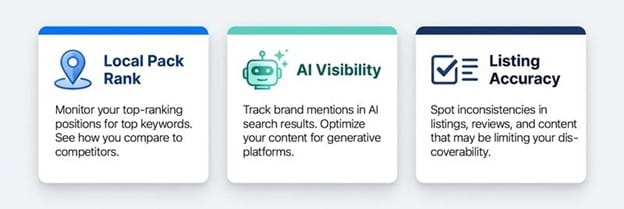
This is where visibility intelligence becomes actionable. Local Falcon measures both Share of Local Voice (Google Maps visibility) and Share of AI Voice (AI-generated search visibility) at the individual location level. That clarity allows businesses to optimize individual locations in ways that compound into stronger brand authority across the entire network.
Best Practices for Scaling Local Visibility Across Locations
Multi-location businesses face the challenge of balancing standardized branding with local relevance at scale. Hyperlocal visibility intelligence makes that balance achievable.
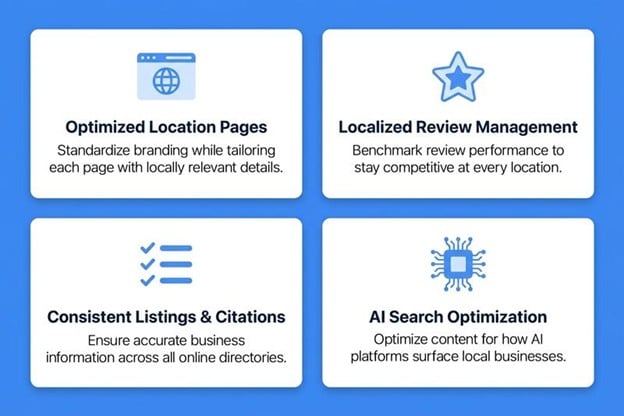
Optimized Location Pages
Standardize core elements across location pages while incorporating locally relevant details such as services, special offers, neighborhoods, and landmarks. This helps both Google and AI understand where each location is most relevant.
Localized Review Management
Reviews don’t work in isolation, and they don’t work equally everywhere. Category benchmarks establish the minimum threshold for visibility, while localized review performance determines whether a location merely appears or actually competes.
Consistent Listings and Citations
Inaccurate or inconsistent business information can quietly undermine visibility. Tracking performance at the location level helps ensure uniformity across platforms and markets, strengthening trust signals for both traditional and AI-driven search.
AI Search Visibility Tracking and Optimization
Understanding how AI platforms surface local businesses — including which sources they rely on — allows teams to tailor content and citations accordingly. Optimizing for both traditional and AI-driven discovery increases the likelihood that customers find your locations regardless of how they search.
The Two Core Visibility Metrics
Share of Local Voice measures how frequently a location appears in Google Maps and local pack results across a defined geographic grid.
Share of AI Voice measures how often a location appears in AI-generated search summaries relative to competitors.
Measuring Success Beyond Traditional Rankings
For multi-location businesses, visibility is no longer defined solely by local pack placement. Network-wide performance depends on how consistently locations appear across both Maps and AI-driven results.
Tracking metrics like Share of AI Voice (AI visibility) and Share of Local Voice (Google Maps visibility), as well as analyzing location-specific coverage patterns, provides a clearer picture of how customers are actually discovering your brand. These insights make it possible to connect local optimizations to broader outcomes and prioritize actions that strengthen visibility across the entire network.
Location-by-location visibility intelligence helps bridge the gap between local execution and brand-level growth, ensuring every location contributes meaningfully to overall discoverability.
The Future of Multi-Location Local SEO
Success in local search now requires a comprehensive approach that accounts for both local pack performance and AI search visibility. Multi-location businesses that invest in hyperlocal, multi-platform visibility intelligence — and act on what it reveals — will ensure they remain competitive as local search continues to evolve.