
Snap has taken the latest step in its mapping evolution with new loyalty badges. By gamifying local business engagement, Snap is hoping to boost map usage, offline foot traffic, and ultimately monetization via Promoted Places. This all rests under its broader revenue diversification play.
Before getting into all of those strategic drivers and moving parts, what’s the latest feature all about? Carrying early Foursquare vibes from 15 years ago (that makes us feel old), the new “Place Loyalty” badges will show users when they’re among the top 25 percent of Snap users who visit a location.
These accolades will take shape in bronze (top 25 percent), silver (top 10 percent), and gold (top 1 percent) badges. When you reach one of these milestones, you’ll get an alert from Snap with calls to action to share the news with friends and boast status. It’s all about making things gamified and viral.
Notably, Snap will aggregate your visits across locations in the case of a multi-location brand or chain. This will make it easier for users to rack up loyalty status at places like Burger King and Starbucks, which could have implications for multi-location (MULO) brand marketers to target super users on Snapchat.
In fact, that last part is the endgame. Snap’s efforts to boost engagement among Snap Map’s growing user base is partly about product traction but mostly about monetization. Snap continues to push Promoted Places for SMBs and MULOs. Gamifying local foot traffic is one way to support those efforts.
Social Layer
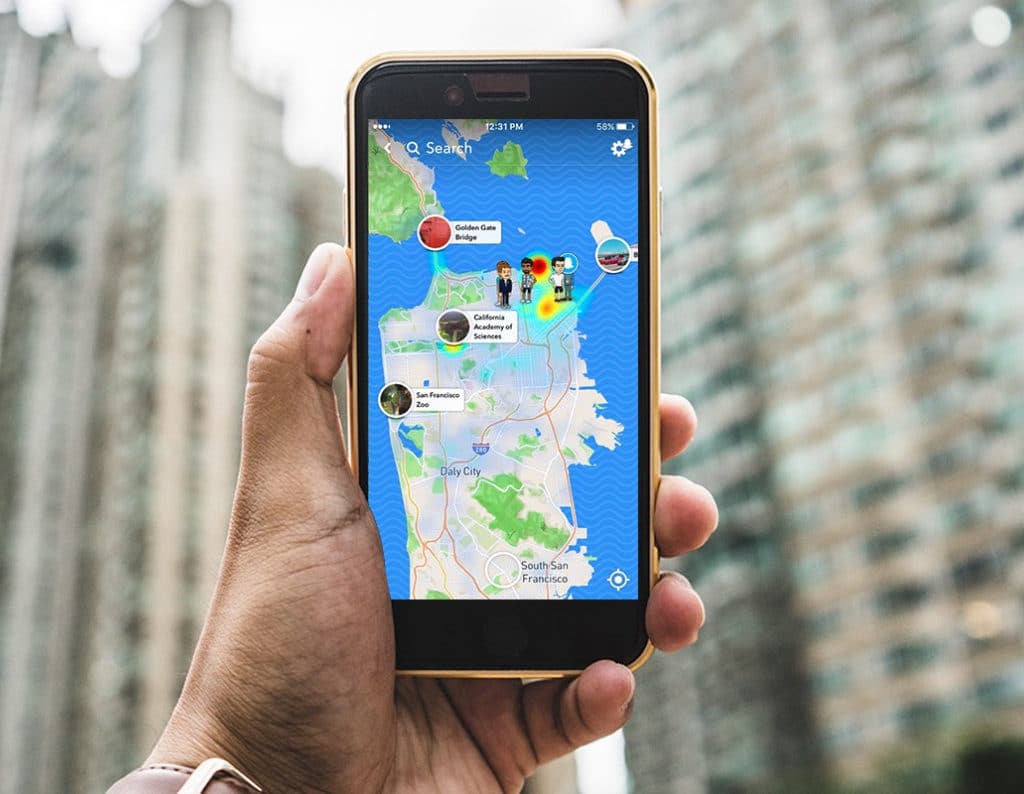
Backing up, how does this fit into Snapchat’s broader evolution and, as noted, its revenue diversification play? Starting with Snap Map basics, it launched in 2017 as a way to fuse Snap’s social engagement with offline activity – such as discovering when friends are nearby and sparking serendipitous meetups.
The product has grown to 450 million users, many of whom are demographically-attractive and active Gen-Z users. Moreover, local mapping engagement that’s driven by a social layer is something Google Maps has tried, and failed, to build – giving players like Snap Map and Instagram Map an edge.
But all that engagement was only the first step. As noted, Snap has made efforts to monetize the experience and the primary vessel so far has been Promoted Places. This lets local business’s pay to have elevated or highlighted presence on the Snap Map interface when users are nearby.
According to Snap during its last few earnings calls (see our Q1 coverage), Promoted Places is growing quickly, with SMBs representing the fastest growing revenue source. Specifically, they now account for 30+ percent of global ad revenue and the fastest growing segment for the seventh consecutive quarter.
That brings us full circle to Snap’s diversification play. With a challenged, fragmented and saturated advertising market, Snap is blitzing revenue diversification opportunities, including its $1 billion run-rate subscription business. SMB ad revenues are a key part of that effort, with plenty of headroom to grow.