Amazon has forged a deal with Grubhub’s Dutch parent company Just Eat Takeaway which is threatening to upset the balance of power in the local food delivery space.
The deal gives Amazon options for equity in Grubhub (which Just Eat Takeaway acquired in 2020) in exchange for a deal allowing Amazon Prime Members to sign up for a free one-year Grubhub+ membership.
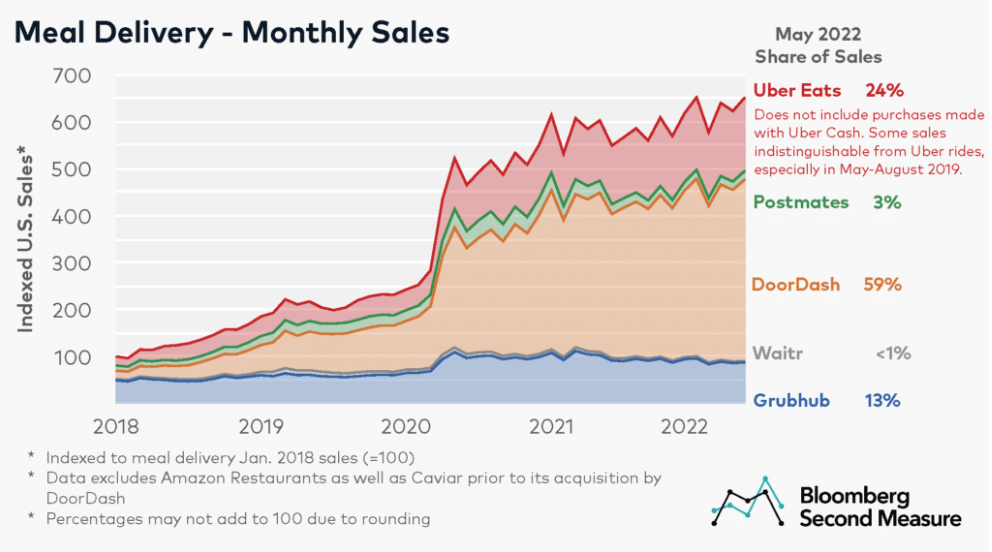
This could be a game-changer for Grubhub, which currently sits in third place among U.S. delivery apps at 13% share. DoorDash reigns supreme (for now) at 59%, followed by UberEats at 24%.
Grubhub+ is Grubhub’s premium service, which waives delivery fees on eligible orders. Most delivery apps have a similar offering. For example, DoorDash’s DashPass offers zero fees on delivery orders and 5% back on pickup orders.
Specifically, the deal gives Amazon warrants (exercisable at a de minimis price) over 2% of Grubhub’s fully-diluted common equity. Amazon also gets warrants for an additional 13% exercisable based on an agreed-upon formula. That formula is based largely on the number of new consumers delivered through the commercial agreement.
JustEat Takeaway doesn’t expect the deal to have a neutral impact on Grubhub’s 2022 earnings and cash flow. But the company does expect the deal to boost Grubhub’s earnings and cash flow from 2023 onwards.
Uber, DoorDash Take a Hit
So today’s news appeared to impact both Uber and DoorDash. Uber closed down 4.5%. Meanwhile, DoorDash was down 7.4% for the day. Both stocks have gained some of the losses back in after-hours trading. The Dow, Nasdaq, and the S&P 500 all closed in positive territory today. So the performance of these stocks today seems directly tied to this announcement.
Grubhub’s CEO naturally seemed pretty pumped by today’s news.
“I am incredibly excited to announce this collaboration with Amazon that will help Grubhub continue to deliver on our long-standing mission to connect more diners with local restaurants,
” said Grubhub CEO Adam DeWitt.
“Amazon has redefined convenience with Prime and we’re confident this offering will expose many new diners to the value of Grubhub+ while driving more business to our restaurant partners and drivers.”
Grubhub is an OG food delivery app. It was founded in 2004 in Chicago by Jason Finger, Matt Maloney, and Mike Evans. By contrast, DoorDash came along in 2013. And Uber launched Uber Eats a year later.
Being early is no assurance of victory, however. San Francisco-based DoorDash raised nearly 10 times the capital that Grubhub raised. So Grubhub, similar to Postmates, needed to find a deep-pocketed parent in order to stay in the game. UberEats acquired Postmates in mid-2020. This was just a month after JustEat Takeaway scooped up Grubhub.