
The last two years of AI’s rise have been marked by a chorus of punditry that goes something like: “AI is here, and it changes everything.” It’s a familiar tune in hype cycles that eventually morphs into “XYZ will change some things.” So jumping ahead, it’s a question of where AI works… and where it doesn’t.
When it comes to SMB SaaS – Localogy’s Jam – those same questions apply, but the answers differ. We’ve been saying for a few years that AI will resonate wherever it can solve SMBs’ longstanding pain points and speak their language. That includes things like saving them time and tech headaches.
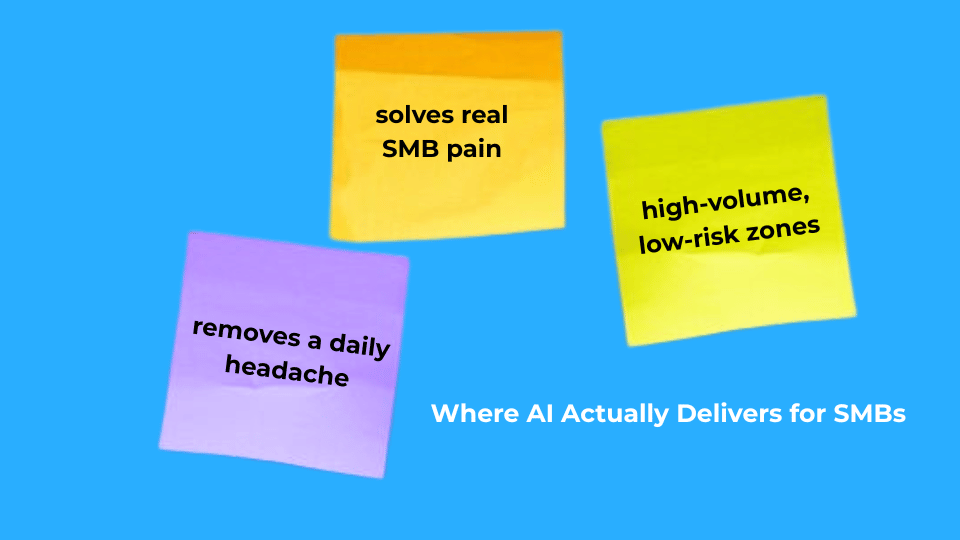
That basic litmus test for AI applicability sounds obvious, but often isn’t practiced. So to make it a bit more specific and concrete, we’ve observed three criteria that often define AI’s applicability to SMB marketing or operational functions. It’s a developing list, but here’s the basic framework today.
1. Product/market fit? Is AI actually good at the thing it’s being applied to? Despite all the promises, it’s not a silver bullet… It’s better at writing email-marketing subject lines and web page meta descriptions than training new employees. It should be applied where it works.
2. Is it an SMB pain pill? Does it address SMB pain points, and save them from the work they hate doing? SMBs want to be roofers, dentists, and nail artists, not marketing pros. Take rote things off their plate that they dread, such as writing promotional newsletters and SEO busy-work.
3. Keep it low stakes (for now). AI still has trust issues, according to our survey data. Most SMBs today are comfortable unleashing it on low-stakes things like marketing copy (with human approval/ oversight)… but not so much running payroll or doing their taxes. That list could change fast.
Automated Lead Response: The Fastest-Growing AI Use Case in SMB SaaS
Executional Examples
Given the above criteria, what are some executional examples of where AI has been successfully integrated in SMB SaaS?
One AI application that checks these boxes is automating lead response for SMBs. This function checks criteria #1, while it offloads a dreaded task (#2) and offers enough human oversight to satisfy criteria #3. And several SMB SaaS players have recognized this, judging by recent product rollouts we’re tracking.
As we examined last week, these include recent launches from Vendasta, Thryv, and Yelp. In all cases, the goal is to take lead optimization off SMBs’ plates. Not only does it free them up in the above ways, but it’s more effective, given that AI ensures faster response time – a key factor for time-sensitive leads.
Another area that checks the boxes for AI applicability is writing things, broadly speaking. We’re talking everything from website pages to image captions, email marketing campaigns, and page meta descriptions for SEO. SMBs generally don’t like writing (criteria #2), while AI is fairly good at it (#1).
Moreover, AI writing is low stakes (criteria #3) as it often lets SMBs review and edit the final product. This handles heavy lifting while still allowing some SMB control and agency. In fact, this principle of human/machine balance joins all the above criteria as a key consideration in AI integrations.
Finally, it’s worth noting that all the criteria above represent a point in time in AI’s lifecycle. We’ll likely see the list evolve rapidly. Among other things, that will include advancement of the tech itself, as well as SMB aptitude and acclimation to it. We’ll continue to watch and document that evolution as it unfolds.
Header image credit: Paper Textures on Unsplash