
Data Scout is Localogy’s series that curates and draws meaning from third-party data. Running semi-weekly, it adds an analytical layer to the industry data that we encounter in daily knowledge building. For Localogy original data, see the separate Modern Commerce Monitor™️ series.
Location-based advertising company GroundTruth has released new first-party data that signals the impact that location-targeting ad campaign strategies have on foot traffic. Because foot traffic is more relevant in a pre-Covid (and post-Covid) world, the study also measures the impact of these strategies on online purchases.
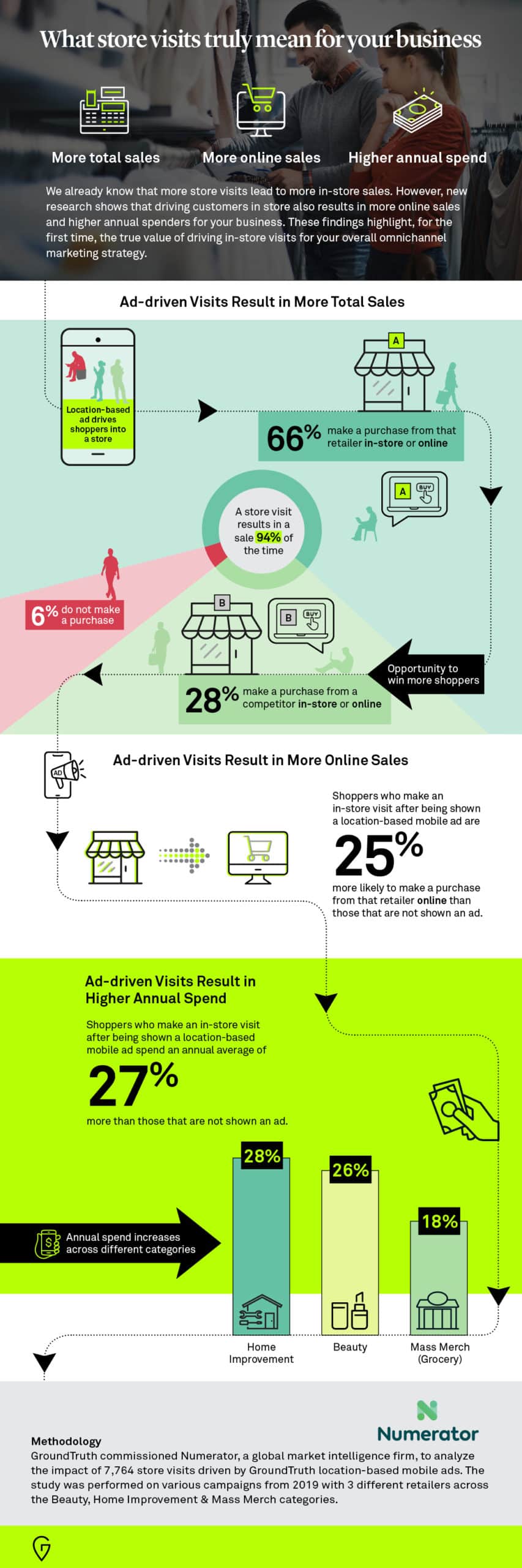
So what did the study find? First, 66 percent of shoppers end up making a purchase after seeing a location-based ad. This includes both online and offline conversions, as long as the ad itself had a location-targeted component. That can mean geo-targeted placement/distribution or geo-relevant ad copy and creative.
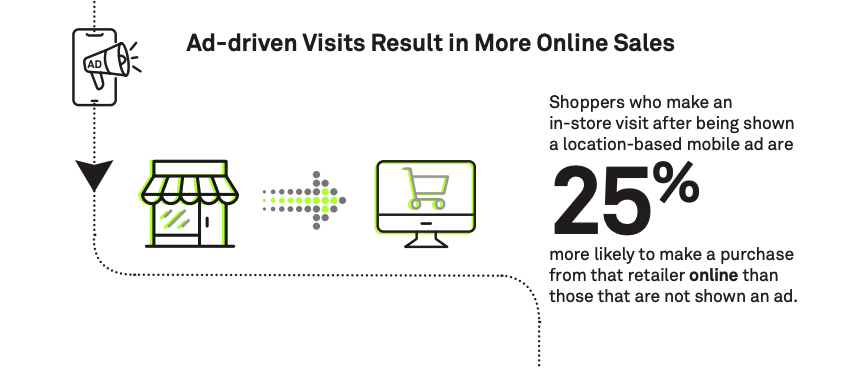
Segmenting the data by brick & mortar shoppers, those who make an in-store visit after seeing a location-targeted ad are 25 percent more likely to make a purchase, compared to those who visit a store without having previously seen a location-targeted ad. The ad exposed group also spends 27 percent more.
These figures tell a fairly strong story for the power that location targeting can have on purchase behavior. The figure that stands out the most is probably the fact that two-thirds of shoppers will make a purchase after seeing a location-based ad. There are few ad modalities that have conversion rates this high.
“We all know that a store visit driven by a location-based ad has a large impact on in-store sales,” GroundTruth head of marketing Dan Silver,” told Localogy Insider. “But an area we were really curious about was understanding the true value of a store visit as it relates to online sales as well. What we’ve uncovered in our groundbreaking research, is that purposely visiting a retail store as a result of a location-based ad actually has a profound effect on e-commerce transactions and is something marketers need to consider in their omnichannel strategies.”
Such stellar results of course begs the question of methodology, which does seem trustworthy in that its first-party data, executed by a third-party firm. Specifically, GroundTruth enlisted research firm Numerator to analyze the impact of 7,764 store visits that were driven by GroundTruth location-based mobile ads.
To keep the results focused and consistent, the study examined these consumer visits and buying patterns at 3 major retailers. These weren’t mentioned by name but were specified as being in the beauty, home improvement, and mass-merch categories. The varied set is meant to draw out broadly relevant findings.
It’s also worth noting that the study was done pre-Covid, which is a double-edged sword. It’s valuable in that it provides baseline data that isn’t skewed by Covid-era shopping dynamics. That makes it hopefully more representative of longer-term marketing strategies, though the “next normal” will be a hybrid world.
The report’s infographic is below to further peruse and draw out strategic findings. We’ll keep watching GroundTruth and the rest of the location intelligence sector as it continues to pivot in a Covid-world, including continued consolidation. For more on this topic, consider attending Localogy 20/20.