

Location data has come a long way in a relatively short period of time. From the “Starbucks Coupon” fantasy of early mobile-location targeting to new predictive use cases, xAd Chief Product Officer Shashi Seth provided insights into the past, present and future of location at LSA17 this morning. Here is a brief recap of some of Shashi’s remarks.
4 out of 5 mobile phone users in the US have a smartphone and with ownership nearing ubiquity, we are able to unlock customer stories based on the places they visit.
Often equipped with GPS, compass and accelerometers, mobile phones contribute to the location information of its users. Couple a device’s built in features with frequently used apps like Uber, Tinder and Yelp that rely on a user’s current location, mobile phones allow us to paint a very accurate picture of a user’s life journey.
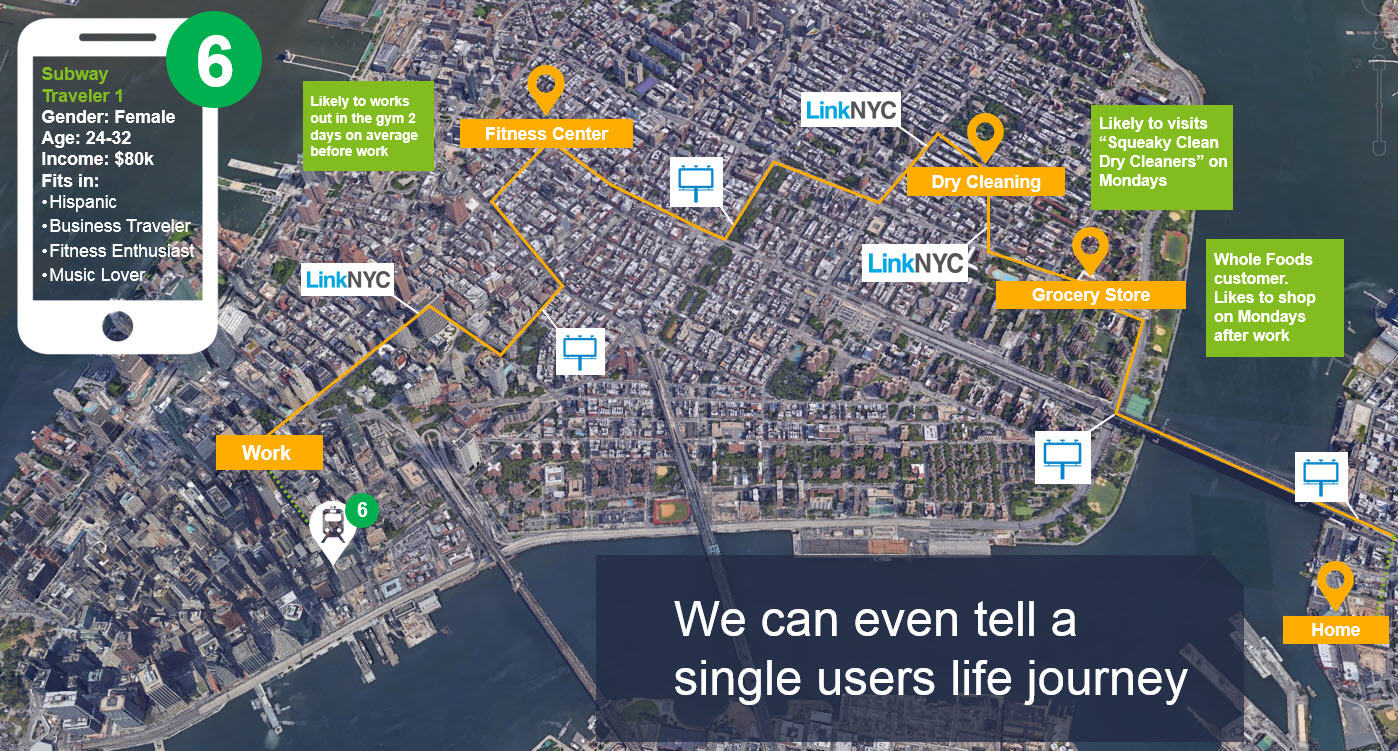
Being able to observe the places that a user visits (above) allows us to make meaningful inferences into the type of audience, that this individual can be bucketed in. For example, if we notice that a particular device ID has been to a fast food restaurant multiple times over the course of a month, we can say with confidence that the owner of the mobile phone is a “fast foodie”. Applying that same logic to other visitation behaviors, we can identify device IDs as “millennials,” “young working moms” or “auto intenders.”
Similarly, we can take a point of interest – such as a busy commuter hub like NYC’s Grand Central Station – and uncover important insights and attributes about the commuters that pass through. We’re able to see the neighborhoods commuters are commuting from, as well as peak and off-peak congestion times.
With these two use cases – the individual and a point of interest – it’s clear that the power of location intelligence can unlock meaningful stories about your customer. To learn more about how xAd is leading the location conversation, check out https://info.xad.com/blog.