
Word of mouth is one of the most powerful forms of marketing for any brand or small business. Online reviews and ratings in many ways is word of mouth for the masses. As a result, it’s no surprise reviews are influencing purchase decisions for the majority of consumers.
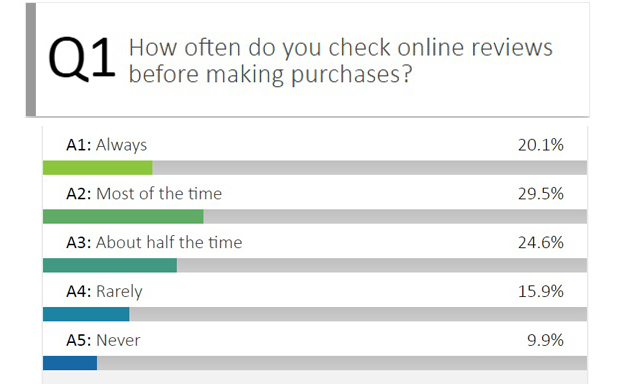
According to a recent Ask Your Target Market (AYTM) survey, 20% always consult online reviews before making a purchase decision and 30% consult them most of the time. Overall, roughly 90% of consumers use reviews in some capacity before a purchase with only 10% saying they never do.
According to a recent LSA study, 43% of consumers used ratings and reviews to find, select and/or engage with a local business within the past month. Extending to the past year, that number reaches 55%. However, the 55 and 90% separation between the studies is difficult to resolve, but may be a function of sample sizes and respondent demographics.
The most interesting takeaway from AYTM’s study was the disparity between the amount of people who use reviews and the amount that write them. While the majority consult reviews “most of the time” (30%), the majority “rarely” write them (35%). Another way to interpret the data is to say that about 50% are highly active users of reviews, while only 20% are highly active contributors.
This represents a large portion of customer experiences that aren’t being represented through online reviews. 2014 Yelp data found that the majority of reviews were positive with about 67% being four or five stars. It is likely that a large portion of positive experiences aren’t getting posted online.
Ted Paff, CEO of Customer Lobby, said that most businesses are passive and don’t ask for reviews because they’re fearful of inviting negative reviews. But he argues that the large majority of reviews that come in will be positive.
Whatever the method, there is an opportunity to get more customer experiences to show up on prominent review sites like Yelp. Good and bad, these experiences help to create a more authentic view of a business for consumers.