In comparing the results from two separate surveys, one directed at industry and one directed at SMBs, it’s apparent that there’s a broad discrepancy between what marketers think SMBs need and what SMBs really want.
Over 82% of those in the industry felt that an effective local marketing strategy must address every stage of the customer funnel – attract, convert, and retain customers. While not directly contradictory, only 32% of SMBs felt that all stages were equally important. From a marketing standpoint, 75% of SMBs emphasize attracting customers with their marketing.
Part of the disconnect is the sheer volume of marketing solutions and providers that fill the funnel. The below chart illustrates that providers’ product offering doesn’t even always mirror what they believe to be needed by their clients or SMBs.
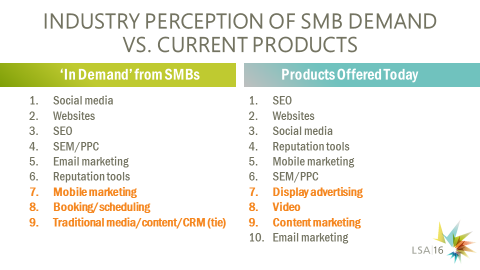
The panel had a fascinating discussion about the problem of perceived demand, product offering and what SMBs really want. Bernadette Coleman from Advice Local, Brad Kime from Signpost, Ziv Koren from Camilyo and Dan Tyre from HubSpot debated whether true one-stop integration of marketing products and services was possible.
And by the end of the discussion, there wasn’t really a consensus on anything except that the marketplace is just “too damned complex”. Nevertheless, the reason there is so much “thrashing” in the marketplace is that there is so much opportunity.
Here’s a few soundbites from their discussion:
- SMBs are asking for integration to help manage the increasing volume of marketing solutions. But resellers need help with integration too.
- Integration is complicated by the need for increased nuance and customization between vertical and audience.
- While some are integrating, some expertise is being increasingly concentrated in boutique or “silo’d” practices.
- DIFM vs DIY is not exclusive – you can do the heavy lifting for difficult things but allow DIY for those things the small business can handle. An integrated system needs a hand-off between the two.
- Smbs are not always doing what they need. Rather they are doing what they can afford or what they understand and feel comfortable working with on a DIY basis.
- Providers like to segment by product whereas SMBs are most focused on results.
- A comprehensive offering doesn’t mean the pieces are all integrated.
- New technology will constantly muddy the waters and fracture integration. E.g. Internet of things, augmented reality, virtual assistants
- One potential solution may be to have several more specialized providers collaborate under one umbrella.
All in all, integration appears to remain conceptual in application for local marketing at this point.