

ChatGPT’s ad program is one of the most exciting things to happen to digital marketing in recent history. But though it has ample potential and piggybacks on a momentous product – AI chat and search – ChatGPT ads continue to feel growing pains. New evidence suggests they have a ways to go.
This latest evidence comes from GrowthLine Marketing, a New York-based search and marketing agency. In a recent discussion with Localogy, principals Bob Sheehan and Brian Seskin characterized ChatGPT ads as showing poor return on ad spend. They admit this is a limited sample, but it’s still telling.
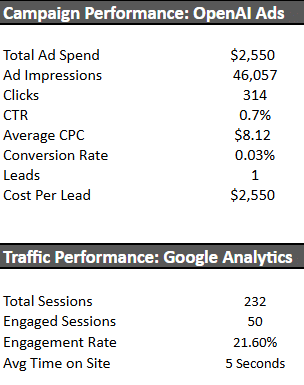
Specifically, ChatGPT ads don’t convert well, says Sheehan and Seskin. Traffic volumes aren’t necessarily lacking, but once traffic lands in a desired place – such as an advertiser’s domain or landing page – bounce rates are high, and time on site is low. Most importantly, attributed revenue is low.
Putting some numbers around those claims, GrowthLine’s recent client work with ChatGPT ads resulted in a $2,550 cost per lead. That comes from a rather suboptimal funnel consisting of 46K+ impressions, 314 clicks (.7%CTR), with an average CPC of $8.12, a .03% conversion rate, and only one lead in the end.
Inherent Flaw
The big question that emerges from these results is why? For an ad format based on such a high-intent medium – similar to search but with even greater intent inferencing – it should presumably convert better. One reason could be that ChatGPT is still working on its ad placement and targeting mechanisms.
This would make the situation a classic case of a new hot company barreling into a new revenue stream, then quickly realizing they don’t know what they’re doing. The classic historical example that comes to mind is Apple Maps. It was a disaster out of the gate (a la ‘Mapgate’), but Apple eventually figured it out.
Compared to Google’s 25 years of experience in finely tuning its ad relevance and targeting algorithms, OpenAI’s efforts are still in the cradle. That’s more of a compliment to OpenAI than it sounds. In other words, performance will only improve. This will happen through both learned competency and hiring.
Meanwhile, Sheehan & Seskin theorize more insightful reasons for the underperformance. For example, ChatGPT’s paid users – the most affluent, tech-forward, and advertiser-coveted demographic – aren’t seeing ads because they’re paid users. Ad impressions are conversely student and free-user centric.
That last part may represent an inherent flaw in OpenAI’s model that tries to accomplish both ad and subscription revenue (the same can be said for Netflix and others in this boat). But like the ad targeting mechanisms and other aspects of OpenAI’s advertising effort, it will evolve and optimize over time.
How Did We Get Here?
Backing up for context, how did we get to this point? It all started in early 2026 when OpenAI announced plans to integrate advertising into ChatGPT. With a rumored IPO on the horizon, this is meant to monetize users’ high-intent ChatGPT questions, again built on the longstanding principles of paid search.
But after the program was announced, it quickly began to stumble with unpopular decisions like limited formats and exorbitant pricing. For example, the campaign spending floor was set at $200K. Similarly, CPMs in the program’s early days hovered around $60, and performance-based formats weren’t offered.
To OpenAI’s credit, it quickly revised some of these early limitations, including lowering campaign minimums and launching performance-based options. And it partnered with third-party ad-tech players to integrate ChatGPT ads into familiar ad managers, thus meeting brand marketers where they live.
But even with modifications, ChatGPT ads may not be landing well. eMarketer reported that they’re pacing well below OpenAI’s projected $2.5 billion in ad revenue for this year and $100 billion by 2030. In fact, that 2030 revenue projection is ~20x the entire market that eMarketer projects for AI-engine ads.
Rounding out the evidence is GrowthLine Marketing’s recent work. It’s a real-life case study and one of the few pieces of real evidence for ChatGPT’s ad performance.
Header image credit: BoliviaInteligente on Unsplash