From the department of expected outcomes, OpenAI has announced what everyone knew was coming at some point: ads in ChatGPT. The company will begin testing ads in the U.S. in its free tier and the $8 per month “Go” tier. ChatGPT’s Pro, Plus, Business, and Enterprise tiers remain ad-free for now.
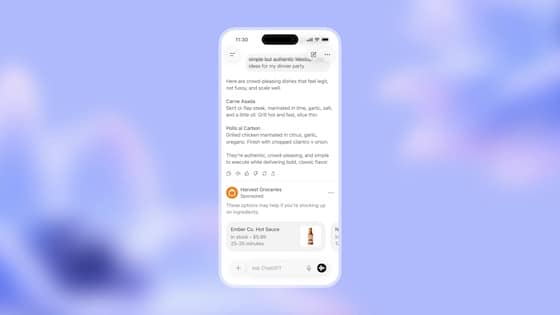
As for what users can expect in terms of UX and ad density, they’ll appear at the bottom of user conversations as small text and image ad units that resemble paid search (see screenshot above). They’ll primarily be targeted based on the topic being discussed (contextual) and user history (behavioral).
Users will have some degree of control over the ad experience, at least at the onset, such as the ability to dismiss any single ad. They can also see explanations for why they’re being shown a given ad, which is likely a way to avoid creeping people out – a smart move for a technology mired in trust issues.
To that end, ChatGPT will let users turn off ad targeting and personalization if they end up feeling creeped out by the ads. OpenAI is also emphasizing other trust-building measures, such as committing to never sell personal data, nor serve ads to users that it believes are under the age of 18.
More importantly, OpenAI is laying the groundwork to preempt any further trust issues by stressing that ChatGPT will maintain “answer independence.” That’s a fancy way of saying that stepping into the realm of ad support doesn’t mean that the organic answers given by ChatGPT will be sponsor-influenced.
Big Game
When you sift through all the above, it starts to sound a lot like search and its chosen monetization path. This isn’t surprising in that it’s a logical step for ChatGPT and that everyone knew was coming, as noted. But it flies directly in the face of comments made by Sam Altman about the pitfalls of paid search.
Specifically, he has spoken out on a few occasions to say that putting sponsored results next to search results erodes trust in the underlying objectivity of the engine. He offered an alternative prospect of cost-per-action models and affiliate revenue for e-commerce that’s driven by ChatGPT incidentally.
Those statements were likely just virtue signaling and an opportunity to slam a competitor. In the end, all these monetization models are the same on broad levels in that high-intent user queries are auctioned off for paid visibility. ChatGPT, though it talks a big game, likely won’t be any more altruistic than Google.
What we’ll likely end up seeing is that the challenger slowly morphs into the incumbent, doing all the things it once spoke out against. There are countless historical examples of this, but one that comes to mind is YouTubeTV – once the anti-cable TV – that has become just like cable, including pricing.
Still, OpenAI has couched this move into ad support with claims of altruism. At one point in its announcement, it attempted to spin its pursuit of ad monetization to align with its mission for artificial general intelligence (AGI) that “benefits all of humanity.” Adam Neuman called… he wants his line back.
Meanwhile, ChatGPT ads will start rolling out this month on an experimental basis. We’ll look out for them and report back with any developments, especially those involving local ads.