Last October I covered how Facebook had expanded the use of its ad service, Audience Network, to display Facebook ads in apps outside of Facebook. The move significantly increased ad space inventory and reach for its 2.5 million advertisers while utilizing the same creatives, content and targeting of existing Facebook ads.
The open question remained where would Facebook expand to next? That was answered as Facebook announced ads on its Audience Network are now available to be published on mobile websites.
In other words, an advertiser can format and design an ad for use on Facebook and specify how it wants that ad to be targeted using Facebook’s rich user profile data. That ad can now be displayed on 3rd party publisher apps and 3rd party publisher mobile websites without any more work on the advertiser’s part except to presumably set parameters for the ad’s distribution.
On the publisher side, the move brings in 2.5 million more potential buyers of ad space on their mobile site even if they don’t have a standalone app. Implementation is much easier too as no SDK integration is needed – instead Facebook supplies code that is added directly to the mobile site’s page.
Here’s some examples of how everyone will benefit from the expansion:
- Publishers get more advertising dollars. Facebook shared that the rate of advertising spend for Q4 of 2015 through Audience Network was $1billion a year. While Facebook gets a cut of that ad spend, most of it goes to publishers. With the number of mobile websites exceeding apps by 3.5 times and mobile web audiences growing even faster than that of mobile apps, ad revenue should only grow with this expansion.
- Advertisers get better performing ads and exposure to a broad mobile audience. Advertisers should expect even better results than what they reported in using Facebook targeting and native formats in apps with Audience Network. Music app developer Shazam reported a 37% increase in ad revenue. Walgreens improved CTR’s by 4 or 5 times. And HarperCollins increased ad impressions by 16%. That performance should continue or even improve on mobile web.
- Facebook has an incentive to continue to drive success for publishers and advertisers on its platform as it takes a cut of all ad spend.
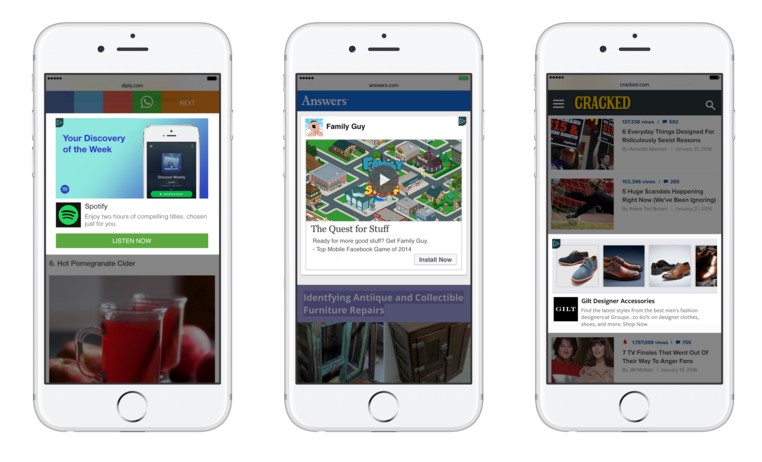
Facebook currently is focusing only on native formats on mobile web, but with good reason. 80% of impressions on the Audience Network are from native formats and those ads perform 7 times better than banners.
However, it is likely that Facebook will continue to search for even more opportunities to expand Audience Network. Stay tuned for more developments.