

Last week, the IAB published a report on the “local” space that seeks to be the “definitive industry guide for anyone who wants to learn about using digital to advertise to local audiences.” The objective is to help buyers and sellers alike realize the importance of various local and location based advertising tactics.
Though the report focuses primarily on digital’s impact on local, it begins by emphasizing the importance of an omni-channel (traditional and digital) approach. The report reads:
While this guide will focus on building expertise in online display, mobile, search, social, and video, those media can and should be planned and executed in tandem with local broadcast and local cable TV, print, outdoor, and the other media that have always played a role in local advertising. Mastering interactive local is a great goal, but it’s just a stepping stone on the way toward thinking omni-channel with your local marketing.
While correct in identifying the importance of a multi-channel approach to local, the discussion in the report is really aimed at brands and sophisticated larger marketers and not the roughly 25 million small and medium-sized businesses (SMBs) in the United States. First and foremost, most SMBs lack the budgets to fully implement an omni-channel local strategy.
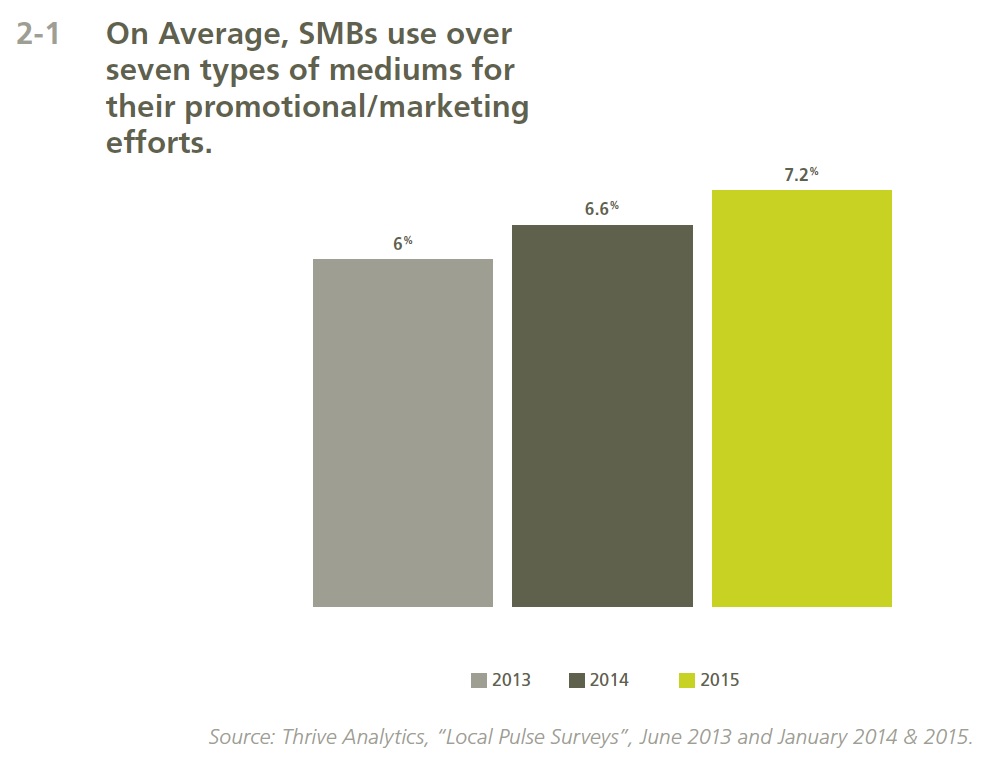
The study focuses predominantly on advertising; however a majority of SMBs are more focused on marketing tactics that don’t involve media buying. Yet many already have a de-facto omni-channel approach with websites, social media (Facebook), SEO and some paid media efforts (e.g., AdWords).
Despite not directly addressing the issues of the SMB audience, the report does offer interesting and potentially useful discussion of the distinctions between “local,” “location,” “geo-targeting,” and “location-based.”
The IAB argues that while “location” refers to a place, and can be very precisely defined, “local” refers to people, as well as the place or places that constitute their typical surroundings. Geotargeting can be even more granular, but this crosses from “local” into the “location-based” category.
The IAB proposes that the challenges preventing both large and small marketers from deploying local or location-based campaigns include the challenge of proving ROI, scaling issues and a need for better education about how businesses can better reach local consumers.
Brands may be in a similar boat to SMBs when it comes to creating and executing successful local campaigns. Though brands typically have more money they’re often just confused, and bogged down in organizational inertia. Numerous studies also show they have numerous internal, organizational challenges operationalizing local advertising campaigns at scale.
But as technologies improve, ROI and other data become more available and actionable and automation and dynamic creative enable location-based campaigns to more easily scale, the promise of “local” is finally coming into focus.