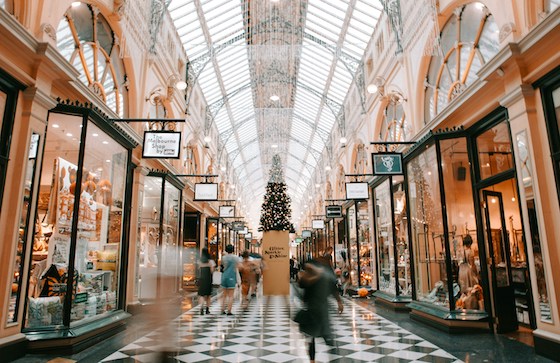
The role of the Shopping Mall – once a defining venue of American culture in the 1980s and 90s – continues to transform. Despite the bloodletting of “retailpocalypse,” the shopping mall hasn’t gone away. But it has morphed considerably in both form and function according to a new report from Yelp.
For example, the retail makeup of shopping malls has been shaken up over the past decade. Once shopping-centric with horizontal rows and vertical stacks of apparel shops, they’ve become more experience-centric. This includes prioritizing atmosphere over transactions, and a focus on food.
That last part is a key takeaway from Yelp’s research. It reports that over the past five years, consumers are increasingly visiting malls for dining experiences. That compares with the previous paradigm where food was a secondary element to fuel shoppers and keep them in the building longer to spend more.
“With the rise in preference for online shopping, retail establishments at malls are becoming less top-of-mind for consumers,” Yelp Head of Restaurants Alison Lin told Localogy Insider. “In turn, malls have adapted by leaning into dining and experience-first businesses to attract shoppers. That means that purchases might start to feel less planned and more like impulse buys while enjoying a meal out.”
Power Balance
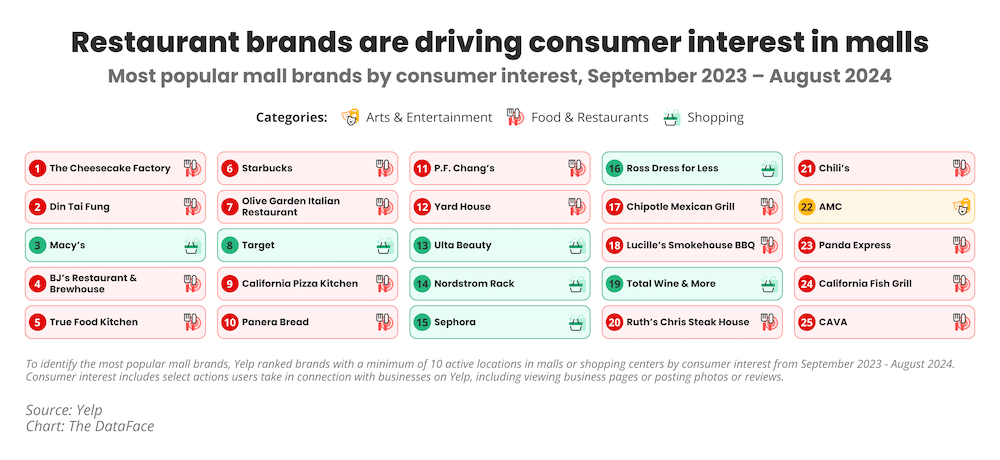
Lin’s comments reveal a shift in the mall economy’s power balance: Dining is now a primary destination in the mall pecking order, rather than a secondary support function. One data point from Yelp’s report that backs up this claim is that 17 of the top 25 mall brands are restaurants (see graphic above).
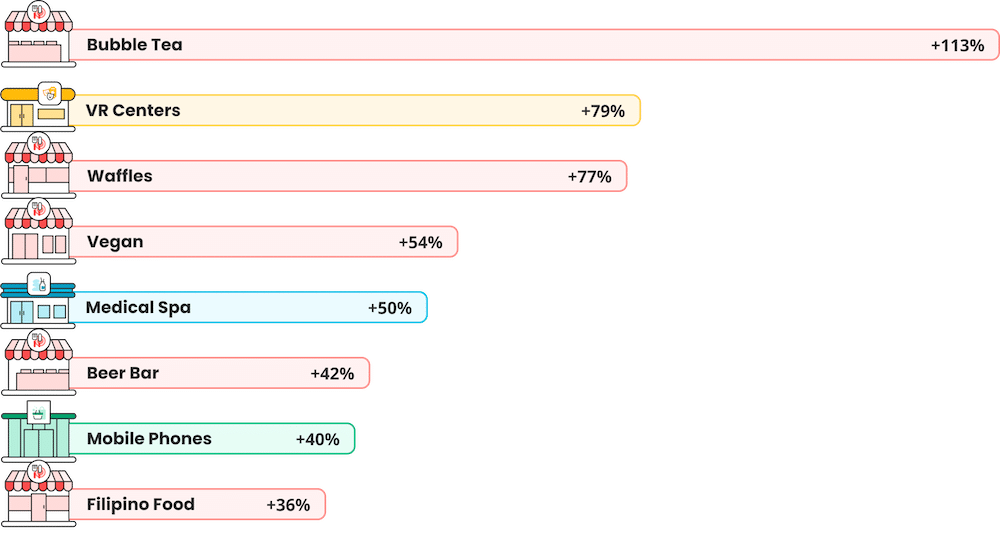
Going deeper, food and restaurant-based businesses grew by 7 percent in volume between 2019 and 2024. The fastest-growing category is Bubble tea, with a whopping 113 percent growth in the number of stores. Traditional tea businesses are notably down 49 percent as bubble tea takes over.
Other top performers in Yelp’s report include waffle restaurants – up 77 percent in number of stores during the above time period. Vegan restaurants are meanwhile up 54 percent and Filipino restaurants are up 36 percent. One quality that jumps out from this list is its diverse mix of cultures and cuisines.
The growth in these restaurants is also notable because it occured despite attrition in overall mall popularity. There, Yelp reports a 13 percent year-over-year decline (and an 8 percent decline since 2019) in searches for shopping malls on its site and app. Malls in the Northeast have seen the least attrition.
Techy & Thrifty
Outside of dining, the question that remains is how all the other categories are doing. Though dining has floated to the surface as a primary mall activity among consumers, not all non-dining categories are declining. Tech and value retailers are two standout categories that appear to be growing.
For example, VR arcades are the second-fastest growing category behind bubble tea, up 79 percent. This growth can be attributed to starting from zero (the category didn’t exist before 2017) but is still notable. Med spas are meanwhile up 50 percent and mobile phone stores are up 40 percent.
As is logical and congruent with macroeconomic trends, thrift stores have grown 29 percent in volume since 2019. Beyond new store openings, existing mall retailers are following spending trends and doing their best to adapt. That includes lower-cost product lines from traditional or luxury mall brands.
“Many businesses, like Sephora and Ulta Beauty, are responding by offering a variety of products at all price points,” said Lin, “which makes impulse shopping more palatable.”