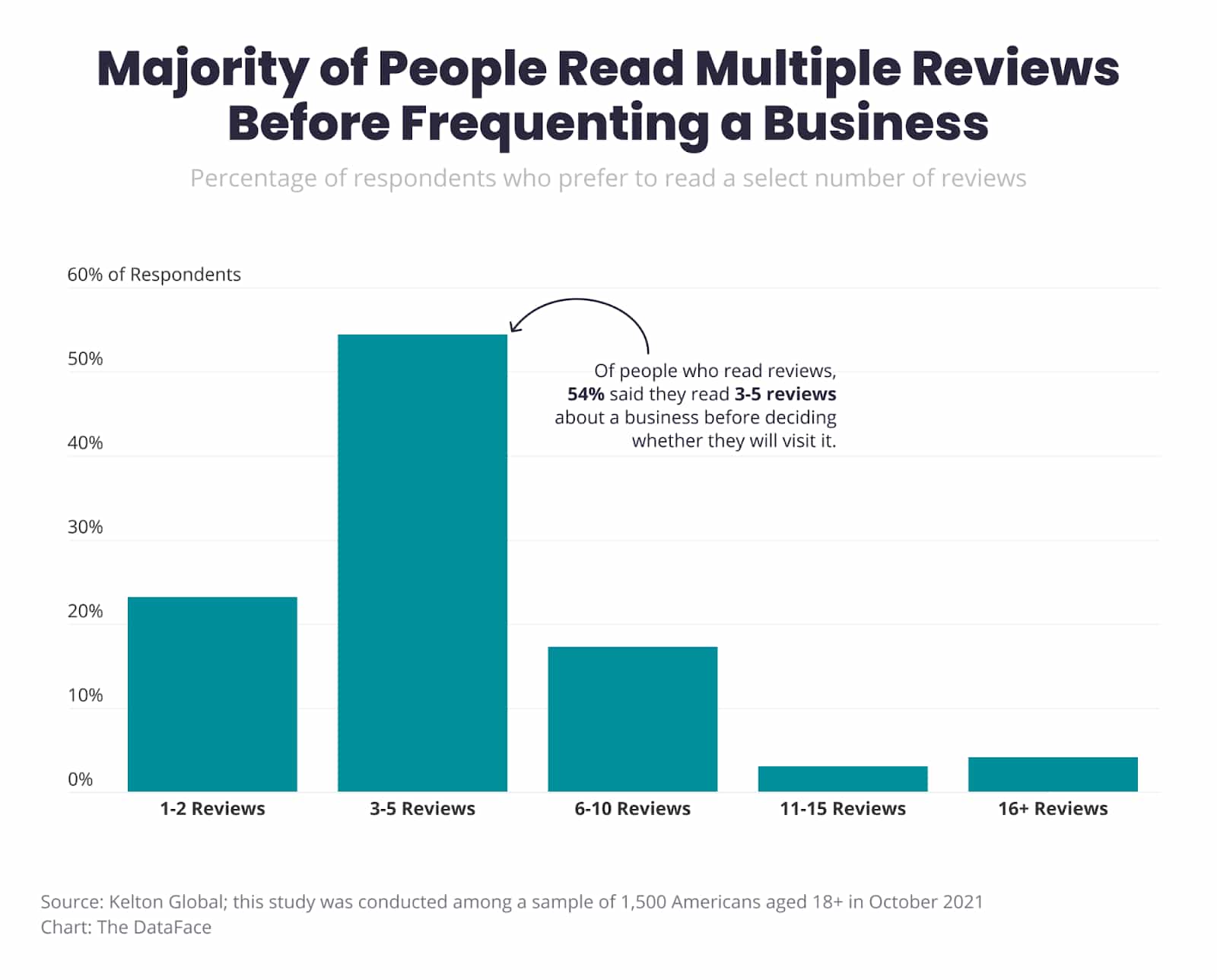
A new survey produced by Yelp and Kelton this week (n=1500) reveals that the consumer psychology around local business reviews is evolving. For example, 75 percent of U.S. respondents report that they’re reading more online reviews than ever before – a demand signal for trust and validation.
Meanwhile, 7 in 10 Americans report that it’s rare for them to visit a new business without checking reviews. In terms of quantity of reviews, most respondents (54 percent) report that they read 3-5 reviews before a new visit. But it’s not just about quantity… consumers signal more trust in quality.
Affinity for Authenticity
Unpacking that quality/quantity divide, U.S. consumers show growing scrutiny around authenticity. Specifically, 59 percent of respondents believe that a rating that isn’t accompanied by review text shouldn’t even be considered a “review.” This partially reflects Gen-Z’s affinity for authenticity.
In the same spirit, 90 percent of survey respondents say they’re more likely to trust reviews that include text. Yelp takes this opportunity to point out that it has always required that reviews include qualitative text. In fact, its average review length measured last year was about 500 words.
Yelp also contrasts this positioning with online channels that frequently provide reviews that have ratings but no text. The company specifically points to Google as one such channel. It’s no secret that Yelp has an ongoing disdain for many of Google’s practices in reviews, and local search in general.
Making matters more challenging, SEO thought leader Joy Hawkins has argued that these one-star ratings with no text are the hardest type of review to get Google to remove. That’s simply because there is so little qualitative evidence in the review itself to indicate any violation of guidelines.

Surface Area
Backing up, part of us thinks that an increasingly-scrutinizing eye towards reviews stems from the broader uncertainty in the age of misinformation. Consumers are more wary of digital information (rightly so), so their guards are up. This makes them look more carefully for signs of authenticity.
This could be one explanation for consumers’ stated trust in longer-form reviews. Indeed, a longer and more thoughtful review is harder to fake. It also provides additional surface area to detect evidence of review fraud, such as glowing language… or overly critical language from competitors or scam artists.
The latter has become a growing issue. For example, Yelp reports that in restaurant-heavy cities like San Francisco, Chicago, and New York, a new flavor of extortion is emerging. Restaurants are getting a wave of one-star ratings with no review text, along with threats of more such reviews unless they pay up.
One takeaway from all of the above is that consumer behavior around reviews, and local search in general, is influenced by evolving societal factors. This could be a good thing in that consumers have a more discerning eye, while also being a negative reflection on the state of digital content and culture.
We’ll keep watching carefully as the technology, culture, and local commerce evolve in step…