
AI has taken up a lot of the bandwidth in SMB marketing. But almost paradoxically, the swift adoption of AI on both the marketing and buying side of the purchase has made “old school” digital marketing strategies even more important for earning visibility and traffic.
But while marketing fundamentals like Google Ads and business listings take on new utility in the AI SMB marketing era, there’s a growing lack of focus in executing them well.
We’ve been tracking this trend through several data studies and marketing practitioner surveys.
The results show that there are a few recurring gaps in many SMB marketing strategies. And they present marketers who can react quickly with some low-lift opportunities to gain ground against their competitors.
Traditional tactics have renewed importance
Foundational digital marketing strategies are becoming even more influential for growth as AI adoption grows.
For example, look at how Google Ads—one of the longest-standing and proven digital SMB marketing strategies—is helping SMBs replace the traffic lost to AI Overviews. Some estimates say organic traffic has declined by over 40% since AIOs first appeared in SERPs. Meanwhile, click share is booming for paid search ads as brands look for alternative ways to reach Google’s enormous user base.
In another example, GEO is motivating more brands to refocus on digital PR. AirOps recent State of AI Search report found that 85% of brand mentions in AI search answers come from third-party sites. Meaning, if you want your website cited by AI, you’ll need to first be cited in review sites, online forums, and by other trustworthy outlets across the web.
And the art of creative copywriting is at the nascent edge of a Renaissance. Generative AI tools caused a glut of mediocre content to flood the online field. Consumers aren’t buying it, though. Ads labeled as AI-generated perform worse than those believed to be created by humans. The year-over-year sentiment shift continues to put AI copy further out of favor, with younger generations leading the anti-AI ad charge. Brands are starting to respond by bringing human ingenuity back into the copywriting mix as a way to stand out and bolster trustworthiness.
SMBs have gaps in foundational local marketing channels
Even as the importance and utility of foundational digital SMB marketing tactics increase, we’ve found significant gaps in their execution. Through our surveys and data analysis, we’ve identified three specific areas of concern.
Local listings are lacking
Online directory listings offer local businesses a free and powerful forum to influence human and AI opinions. We recently reviewed a random sample of 100 home service business listings and found missed opportunities in most of them.
A big finding was that only 15% of those listings had complete and correct information. That means when people searched for a plumber, electrician, or handyman, 85% of those businesses missed opportunities to convert business with fully optimized listings. Or, even worse, they presented incorrect information that possibly frustrated would-be buyers and confused AI search systems.
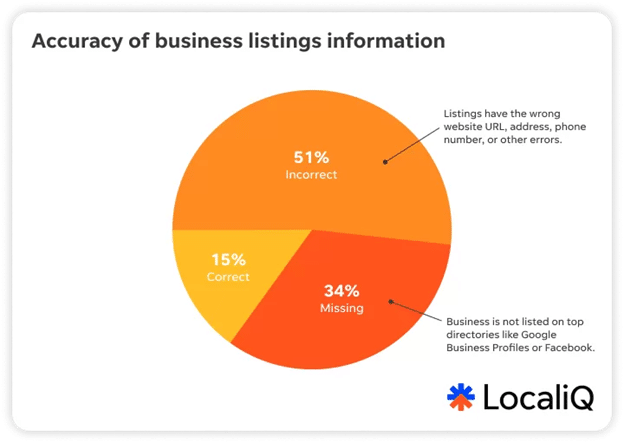
Additionally, while almost every business had a presence in a Google Business Profile, most were completely absent from Facebook and other listing directories.
Across the representative sample, no business had complete and correct information in all of the 20 directories we reviewed in the study.
SMBs miss important opportunities in Google Ads
In another study of over 15,000 Google Ads accounts, we saw that, on average, most accounts were wasting over $1,000 per month.
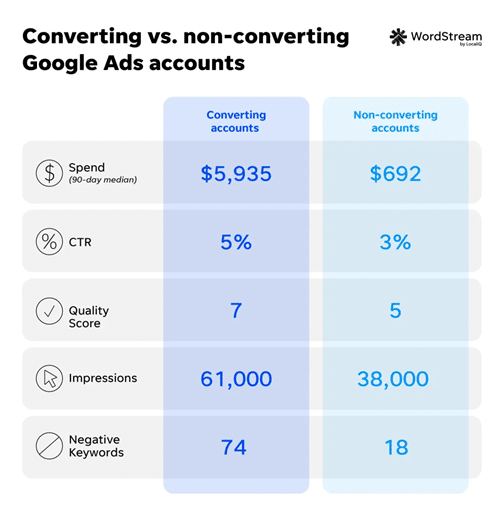
One notable missed opportunity was the use of negative keywords. Negative keywords help make sure your ads don’t show in irrelevant searches and reduce placement overlap across campaigns. Overall, accounts that used negative keywords saw an almost 300% increase in conversion efficiency compared to accounts that didn’t use them. Yet, 25% of businesses didn’t use a single negative keyword.
Another interesting find is that spending more does not always equal getting more in Google Ads. Some brands may overcompensate for poor conversions by pouring more money into ads. In our study, a solid account structure, higher Quality Score, and the use of negative keywords correlated more with higher conversion rates than bigger ad spends.
A lot of ad copy isn’t optimized
Ad copy is super easy to write now with the aid of generative AI tools. But speed doesn’t often equal performance. We analyzed copy variations from over 180 Google Ads—including 1,750 headlines and 550 descriptions—to see what led to the highest Google Ad Ranks.
Power words like “now,” “free,” and “trusted” were heavily represented in the highest-ranked Google Ads, yet they only appeared in 15% of the total population of headlines and descriptions.
The right call to action will increase click-through and conversion rates dramatically, sometimes by 200% or more. In our study, just 15% of Google Ads headlines had a clear CTA.
We also saw that the use of Google’s Dynamic Keyword Insertion feature didn’t correlate with success. Only 12 out of 180 top-ranked ads used it. In theory, you’d improve ad relevance by automatically including keywords tailored to each search. In practice, solid copywriting fundamentals moved the needle much more.
There are quick wins for SMBs who know what to look for
The race to leverage AI for a competitive edge is on, but there are valuable returns available for brands that simply shore up time-tested tactics.
Here are some of the biggest and easiest gaps you can exploit based on our research.
Focus on local SEO
Despite the drop in organic clicks, local SEO is still a reliable source of new customers, especially for searches with a local intent. Plus, many local SEO tactics also increase visibility in AI search. To win here:
- Claim and optimize your Google Business Profiles: Spend extra time here since GBPs are so influential in overall online presence. Keep information up to date, create a profile for each location, and make use of features like the FAQ and Posts.
- Verify hours and add images: Hours of operation and images were the most commonly missed information in directory listings. Keeping these solid is a quick competitive edge.
- Focus on reviews: Reviews are one of the most powerful trust signals for buyers, search algorithms, and AI systems. Get more of them and reply as often as possible.
- Use tools to make listings manageable: There are dozens of online directories. Scale listings management by using tools like LocaliQ’s Free Listings Grader.
Audit your Google Ads
Google Ads is one of the most profitable paid advertising strategies. It’s also a viable way to replace organic traffic lost to AI search. For more effective Google Ads:
- Use negative keywords: Routinely research and update your negative keyword list to reduce wasted spend on irrelevant queries.
- Update your Google Ads account: Businesses with busier accounts had higher conversions. Use more campaigns separated by goals, locations, or services. Add more ad groups tightly aligned with keywords, ads, and landing pages.
- Aim for a Quality Score of seven or higher: We found a Google Ads Quality Score of seven to be the rarified air of high-performing Google Ads. Tighten up your targeting and ad relevance to bump up your score.
Optimize your marketing copy
This is a low-cost, low-lift tactic that can improve performance on every marketing channel. To create high-converting copy:
- Use lots of power and emotion words: Try substituting “effortless” for “easy,” “proven” for “established,” and “ignite” for “start.”
- Add specificity with numbers: About 25% of the highly ranked ads we reviewed included numerals in the headline or description. Numbers add credibility and stand out in a sea of text. Saying you have “Over 100 years of experience” is better than saying you’re experienced.
- Focus on value words in your CTAs: Good calls to action tell people what to do. Great CTAs tell them why they should do it. “Free” was the most common value word in our group of successful ads. “Get your free copy” will generate more interest than “Click here.”
Marketing gaps create opportunity
AI is dramatically changing consumer behavior and SMB marketing workflows. It’s easy to be distracted when talk of GEO and generative LLMs takes up most of the oxygen in marketing discussions.
Our research shows that there are opportunities for the SMBs to revisit marketing fundamentals. Simply completing your business listings can put you ahead of 85% of the competition. As the AI race accelerates, the winners will be those who stay on top of the changes and remain focused on the basics.