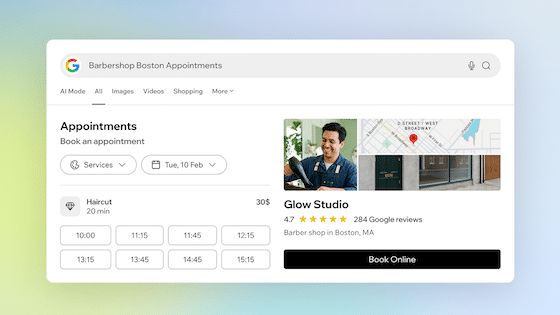

The way that businesses think about physical and virtual spaces was evolving long before Covid. But the pandemic has made the notion of a hybrid customer experience more critical to business success.
So what is a hybrid customer experience? It’s when a business offers customers a combination of ways to interact with them across physical and digital channels. This can range from providing more ways to purchase goods and services online to offering more contactless and digital experiences in physical stores. It also involves things like using social media more effectively to establish and nurture customer relationships.
And of course, having the ability to track these experiences across physical and digital challenges and make sense of them in a unified way is a major challenge. And It has become a lot more important for location-based companies to figure that out.
“The global pandemic has been a catalyst for advancements in the way consumers shop. In the blink of an eye, the hybrid consumer journey went from a ‘nice to have’ to an absolute imperative,” said Florian Hübner, Uberall CEO & Founder.
“Businesses leading the way in hybrid customer experience recognize it as a company-wide initiative. They understand they need to deliver seamless, connected, and personalized experiences that set them apart from the competition.”
Uberall wanted to understand how location-dependent businesses were thinking about this notion of hybrid CX. So it commissioned Forrester to do a study.
Key Findings
Forrester surveyed more than 200 decision-makers at companies with at least 150 locations. And in industries that historically have relied heavily on physical locations to interact with customers. Think restaurants, financial services, retail, healthcare. The survey spanned the U.S., France, Germany, and the U.K.
Notably, the study found that most businesses feel they have a lot more work to do in delivering a satisfying hybrid experience. In fact, 69% of respondents said they felt their hybrid CX game was just average or worse.
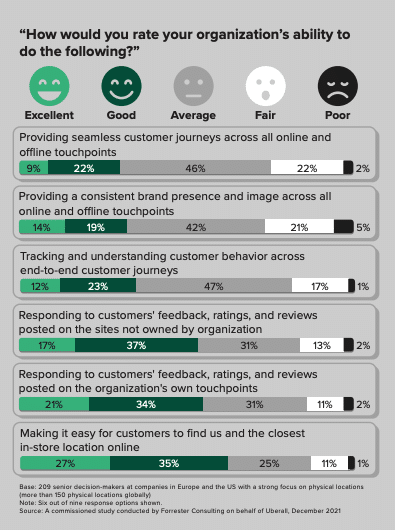
Here are some more interesting tidbits from the survey.
Changing priorities. Most of the companies Forrester interviewed have shifted their priorities dramatically since the pandemic. For example, 73% of respondents said building digital capabilities in physical stores is more or significantly more important than before Covid.
And 74% of respondents said connecting with customers via social media is more important than before. This all suggests that Covid was a significant wake-up call on how the world is changing.

Sophisticated Marketing Methods Lag. The Forrester report found that fewer than half of respondents engaged in marketing practices associated with a better grip on delivery hybrid CX. And remember, this survey is focused on larger enterprises, not SMBs.
For example, while 51% do local SEO, and 49% push out social media content, only 32% engage in social listening. And only 41% do customer journey data analytics.
Siloed Approach. The report also suggests that companies using stand-alone vs integrated solutions have a harder time connecting the dots and delivering optimal hybrid CX.
For example, the study found that “more than 60% of organizations struggle to get a holistic view on end-to-end customer journeys and to connect data across multiple systems.”