Earlier this month, Apple surprised the world by revealing that it will soon enable every iPhone to accept payments. This democratizes payment acceptance by lessening the need for specialized hardware like a POS terminal or Square dongle. Every iPhone is now a point of sale (POS).
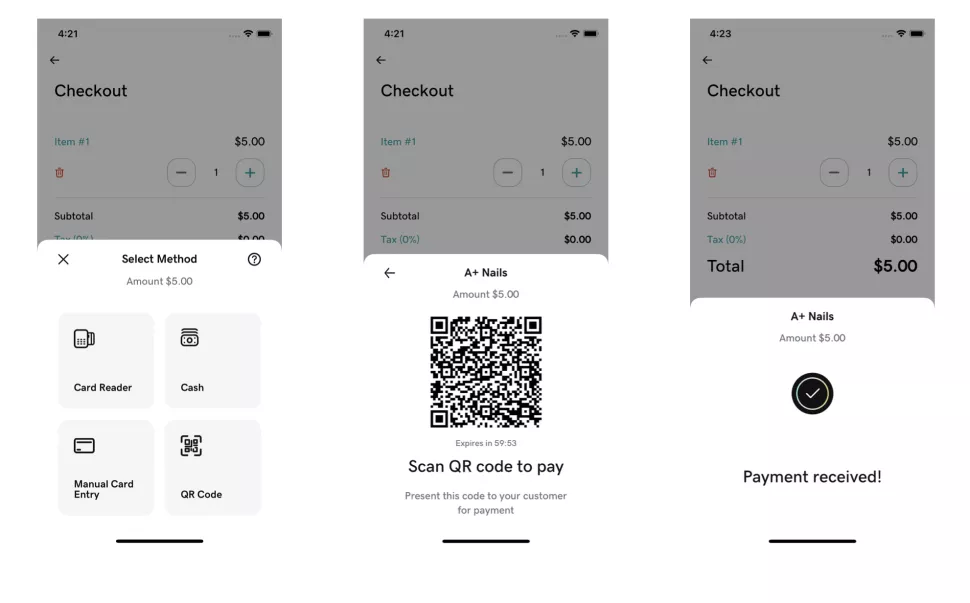
Now, GoDaddy has announced something similar. The company announced it will expand its existing payment features to let users essentially turn their smartphones into payment terminals. This will utilize QR codes to signal transaction details from one phone to another.
Like Apple’s approach, this eschews specialized hardware, thus lowering friction for accepting mobile payments. As we examined after Apple’s big reveal, smartphones have long been equipped to make payments thanks to tools like Apple Pay. Accepting payments is a different matter.
Arms Race
So how does GoDaddy’s mobile payment play work? Its Payment app now utilizes QR codes as a way for devices to communicate and register transactions, as noted. This is a workaround, given that GoDaddy doesn’t have control over device hardware as Apple does (more on that in a bit).
One user (the seller) will generate transaction details using GoDaddy’s standard commerce functionality. That will then produce a QR code that displays on their mobile device. A second user (the buyer) will then scan that code to be brought to a web-based checkout page.
GoDaddy has some of these pieces already in place, given the eCommerce tools it increasingly offers to its users to enhance its core website offering. This has been accelerated in the eCommerce-heavy Covid era during which online shopping has been tacked on to everything.
Beyond Covid, website builders have been in an arms race for feature expansion, including various flavors of transactional functionality. As we examined in a recent Localogy report, this works towards revenue diversification and customer retention amidst a maturing core product.
For GoDaddy, accepting payments is just the latest move in this broader evolution. And it could be well-timed given that its base of SMB advertisers is gradually returning to physical-world transactions. Moreover, mobile payments may shine in the post-Covid era for being touchless.
Seconds Matter
Back to Apple’s advantages in its mobile payment play, it has vertical integration – an advantage that’s been a core part of its DNA for the past 40+ years. It controls the hardware, OS and app layers, which engenders a better user experience in the interplay of software, sensors and silicon.
One recent example of this is the fast-pairing between Airpods and iPhone. There’s much less fumbling around with Bluetooth settings than traditionally seen in pairing external audio devices. This is one of the less-discussed drivers of AirPods’ user experience and runaway success.
In a payments context, Apple can do similar. With just an NFC-based phone tap, it can activate Apple Pay to checkout at Walgreens… or let SMBs and individuals accept payments. With physical world payments (a.k.a. proximity payments) it’s all about reducing friction… so seconds matter.
GoDaddy doesn’t have those advantages as an app that operates on Apple’s ecosystem. So it was forced to get clever with the QR-code-based approach. It’s a good workaround but we’ll see if it’s enough. It could resonate with existing GoDaddy customers looking to sell things IRL.