

At the 2016 Place Conference, Google’s Chandu Thota said that pure location data accuracy – simple lat-long coordinates – is overrated. The argument was that understanding the environment of a place is more important as it allows for the delivery of information that is contextually relevant and therefore more useful.
While the logic is hard to argue, many, especially those focused on indoor location tactics, find location accuracy to be extremely important. According to a new IndoorAtlas study, 98% of respondents stated that sub-two meter (6.5 feet) accuracy is important for proximity marketing, way-finding and search.
IndoorAtlas commissioned an independent study that interviewed 301 decision makers who are responsible for the development and strategy of location-based applications. The study spanned the US, UK, Asia (Singapore and Hong Kong) and Australia and all respondents were from organizations with at least 250 employees.
In alignment with the study, Aisle411 and Philips Lighting were equally interested in location accuracy at Place Conference, reinforcing the importance of accuracy for indoor environments. Aisle411 CEO Nathan Pettyjohn talked about how in retail environments, inches separate products and accuracy is critical, adding that every shelf is like a URL for the real world.
The study went on to look at how the indoor positioning systems (IPS) space is on the rise; 38% have already implemented an IPS and the rest have plans to do so within two years. On average each business in the study will deploy IPS in 53 indoor venues, and for existing deployments the most common tech methods are Wi-Fi (47%), beacons (26%) and geomagnetic (17%).
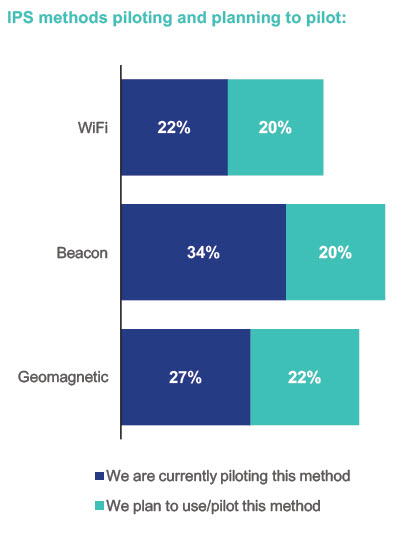
While Wi-Fi is currently the common deployment method, pilot programs and planned pilots are pointing to an embrace of the other technologies. As seen above, beacons and geomagnetic integrations are capturing more share of pilot programs. The cause for the shift in tech isn’t clear, however accurate indoor location (like outside location) will likely require multiple technologies used in tandem.
For many, indoor marketing is commonly seen as a means to improve or enhance the customer experience, but respondents saw these tactics as revenue generating. Attracting customers (55%), increasing sales (55%), usability of venues (48%) and the customer experience (47%) were the top reasons for deploying IPS, with brand awareness (42%) and customer loyalty (41%) rounding out the list.
The indoor positioning space appears to be in-line with the growing interest in location tactics. Though some may debate the importance of location accuracy, those engaged in indoor marketing are in agreement that it is important.