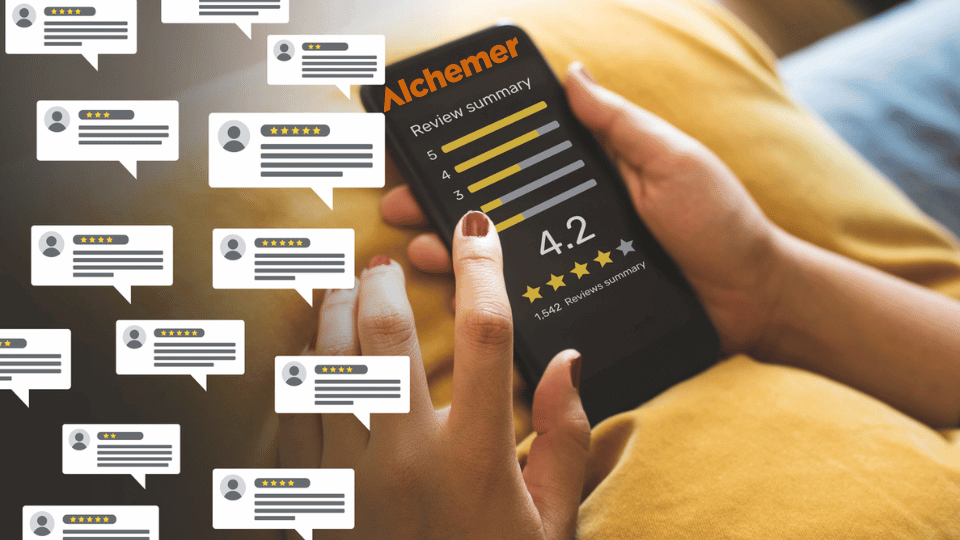
Ask any local marketer where reviews sit on their priority list and you’ll get the same answer: critical. Most brands got that memo years ago — they’re responding, and they know the stakes. The harder question is how to keep up with the volume without burning out the team or handing the keys to a tool they don’t fully trust.
It’s a math problem. A regional brand with 50 locations and a modest review volume is looking at hundreds of new reviews a week across Google, Yelp, Tripadvisor, Facebook, and whatever industry-specific platforms apply. Multiply that for a national footprint, and the review management backlog feels permanent.
Meanwhile, the clock keeps ticking. Customers expect a reply within 24 hours, and the platforms themselves quietly reward brands that deliver. Local search rankings, map visibility, and the trust signals shaping a customer’s first click all favor brands that consistently respond to reviews.
So most local marketers have already reached the obvious conclusion: AI has to be part of the review management answer. The real question isn’t whether to use it — it’s how to use it confidently. And confidence comes from one thing: keeping humans in the loop on the decisions that matter. That means deciding upfront which reviews AI should handle, which ones belong to people, and how you’ll know the review management system is working. Draw that line well, and AI stops being a risk to manage and starts being the growth lever it should be.
Where AI fits and where it doesn’t
The instinct to use AI to address the volume problem is correct. The instinct to throw it at the whole problem isn’t.
Here’s the line I’d encourage local marketers to draw. AI is excellent at the responses where a human’s incremental judgment adds the least: the four- and five-star reviews with no written comment, the routine “thank-you”, the high-volume positive feedback that follows a predictable pattern. A human responding to a no-text five-star review is just typing the same gracious sentence they typed yesterday. There’s no judgment being applied, no risk being weighed, no nuance being interpreted. Automating those is pure upside.
AI is less suited, and this is where local brands get burned, to the reviews that carry legal exposure, brand risk, or genuine customer pain. A review that alleges a health code violation, names an employee, mentions an injury, or hints at discrimination is not a place to deploy a language model unsupervised. Those reviews need a human, and ideally a human with a legal review process behind them.
The practical answer is rules. Define which reviews the AI is allowed to touch — by star rating, by platform, by presence of text, by risk signals — and exclude everything else. The teams getting this right aren’t choosing between review management automation and human judgment. They’re choosing where to apply each.
Protecting your voice across hundreds of locations
The other concern I hear from local marketers is maintaining brand voice. A national brand with hundreds of locations has spent years building a recognizable tone. The fear is that AI will flatten it into generic SaaS-speak — every response signing off with “we appreciate your feedback” in a way that sounds like nobody actually wrote it.
This is a solvable problem, and it’s worth understanding how. Modern AI response tools learn from your existing responses and the phrases your team already uses, the sign-offs, the way you handle apologies, the contact number you include when something goes wrong. The longer the system runs, the more it sounds like you.
For local marketers, this has a useful implication: voice consistency across locations may actually be easier with AI than without. A human team responding to thousands of reviews across hundreds of locations will drift. Different regional managers will have different styles. AI trained on the brand’s best responses pulls everyone toward the same center.
How to get started
If you’re a local marketer evaluating this category, my advice is to start narrow and expand.
Begin with full review management automation only on the safest segment — four- and five-star reviews with no text. Watch the responses for a week. Make sure your voice is coming through. Then widen the aperture: add text-included positive reviews, add four-star reviews with text, work your way toward the harder cases. Keep the high-risk segments human-reviewed indefinitely.
The brands that get this right won’t be the ones that automated review management the fastest. They’ll be the ones that drew the line carefully, kept the guardrails honest, and let AI do the work it’s genuinely good at — so their human teams could focus on other critical priorities.
The 24-hour clock isn’t going to slow down. The brands that respond consistently will keep winning. The question is whether you’re going to staff your way there or build a smarter system with guardrails. For most multi-location brands, the answer is some of both.
Alchemer’s AI Auto-Responder is one example of how this kind of guardrailed automation can work in practice. The tool lets teams set rules by star rating, platform, and review content, integrates risk monitoring to keep high-stakes reviews in human hands, and learns brand voice from previous responses over time. In production, 92% of its AI-generated responses are accepted by users without edits — a useful signal that careful guardrails and brand-voice learning hold up at scale.