
Local reputation is no longer a static score, it’s a live signal. In 2026, visibility in the Local Pack is driven by how consistently you generate and engage with reviews, not just how highly you’re rated.
Let’s be real for a second: Having a 4.8-star rating used to be the finish line. In 2026, it’s barely the entry fee.
We’ve spent a lot of time hearing about the “shifting sands” of the local SERP, but if there is one engine that consistently powers visibility in the Local Pack, it’s your review profile. Unfortunately, most businesses are looking at the wrong numbers. They’re staring at their total review count like a trophy case, while their competitors are passing them by in the fast lane.
The game has moved from volume (how many you have) to velocity (how fast you’re getting them). If your last five-star review is from three months ago and your competitor has had 5 reviews in the last week, Google’s algorithm views your business reputation as stagnant and is likely to promote a business with more consistent recent reviews above your own.
The New Math: Why Consistency is the Core Ranking Signal

To win in a high-stakes local market—whether you’re a DUI attorney or an HVAC specialist—you have to stop looking at your review strategy as a “project” you just need to “finish” and start seeing them as a pulse you maintain. In 2026, the weight given to the review portion of Google’s local algorithm is essentially a “legitimacy validator”; it’s looking for the consistency of the signal.
If you want to dominate the Local Pack, you need to master these three metrics through a lens of non-stop momentum:
- Frequency (The “Steady Drip”): This is where most businesses fail. They run a contest, get 50 reviews in three weeks, and then go dark for six months. To Google, that looks like a manipulated spike. You are much better off getting five reviews a month, every single month. Consistency proves you are a living, breathing business that provides a reliable experience time after time.
- Velocity (The Growth Curve): Your speed relative to the neighborhood. Velocity isn’t about your total number; it’s about the rate of acquisition. If the “market leader” in your city is pulling in 10 reviews a month and you’re only pulling in two, your relevance is shrinking. You need to match or exceed the market velocity to prove you’re the trending choice.
- Recency (The “Right Now” Factor): This is the ultimate trust builder. A “Best of 2023” sticker is a participation trophy in 2026. If a homeowner has a flooded basement or a defendant has a court date tomorrow, they don’t care what you did two years ago. They want to see a review from last Tuesday. Recency proves your service standards haven’t slipped.
The takeaway? The key tactic to tie all of this to your local market is to make sure you’re watching what the competition is doing. How fast are they growing their reviews? Faster or slower than you? Are they already ahead of you in review count, and they’re growing their reviews faster? Is their average above or below yours. Adjusting your frequency for your market is the key here. We cannot give you a number to chase – that’s going to be different for every market.

If you’re not Hansen Super Techs in the example above, what tactics would you implement to increase your review volume and frequency to compete?
Reputation as an Active Conversion Asset (Not a Passive Bucket)
One of the biggest mistakes I see is the “Engagement Gap.” You get a review, you feel good about it, and you move on. That is a massive missed opportunity for both SEO and conversion.
If you participated in or read the AMA on the r/localsearch Reddit community with Claudia Tomina, you can see the takeaway is clear: local review strategy isn’t something you “set and forget.” It’s an active asset that requires professional management and a high level of engagement to truly move the needle.
Replying to reviews isn’t just about being polite; it’s about signaling business “health” to both the algorithm and the human who is searching for help. When you respond to a review, you’re signaling that your business is active, attentive, and operational. High engagement—actually closing the loop with your customers—is what builds the “trust bridge” necessary for higher lead conversion. People don’t necessarily just want the highest-rated pro; they want the one who is clearly listening and involved in their own business.
Don’t just post a generic “thanks!”; use the reply to show you’re a real person who cares about the specific outcome of that job. That’s how you turn a review profile into a conversion machine.
The “1-Star Opportunity”: Turning Negatives into Sales
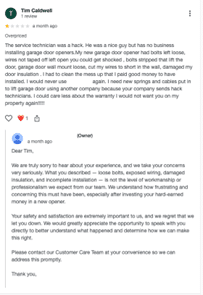 There is a lot of apprehension about the dreaded 1-star review, but, handled correctly, it can actually be your best sales tool. Research from our team at Sterling Sky shows that consumers trust a business more when they see a mix of ratings, provided the negatives are handled gracefully.
This goes back to that old P.T. Barnum quote – “There’s no such thing as bad publicity.” Take a negative review as an opportunity to engage, learn, improve, and show a future client that you care about your customer relationships.
Your “Bad” Review Strategy:
- Pick up the phone: Before you vent your frustrations in a public reply on Google (for the whole world to see), call the client. A human conversation can often turn a 1-star review into a 5-star “update” about how great your customer service is.
- Write for the “Future Customer”: When you do reply publicly, remember you aren’t just talking to the angry person—you’re talking to the 500 people who will read that reply later. Show them your process for fixing mistakes.
Your 2026 Review Strategy Blueprint
Stop treating reviews as a passive byproduct of your business. Make them a KPI. Audit your “Velocity Gap” by looking at the top three players in your local pack. If they are outpacing you in new reviews per month, that is your primary target.
Automate the ask using a helpful tool like Service Titan, GatherUp, or PinParrot – then stagger your requests to ensure a steady drip, and commit to a 24-hour reply rule. In the 2026 local landscape, the most consistent and engaged brand isn’t just winning the algorithm—they’re winning the trust of the neighborhood.