After much speculation and handwringing in the tech press – including our own coverage – the anticipated moment is here: ads appearing in ChatGPT. The timing is notable, given Anthropic’s much-hyped Super Bowl ad that bemoaned ads in AI engines – a not-so-subtle swipe at OpenAI’s ad drop.
The whole thing also comes as a surprise to many AI market-watchers, given some of the past comments from Sam Altman that likewise deride the concept. As recently as October 2024, he said that he found advertising in AI chatbots “uniquely unsettling” and “a last resort for us as a business model.”
But here we are, no doubt due to the pressure on OpenAI to boost monetization to live up to its loud and large CapEx spending commitments. That’s combined with usage-growth deceleration and “Code Red” market-share gains by competitors like Google Gemini, prompting OpenAI to accelerate its path to ads.
But beyond all of those well-understood shifting market factors, what do these ads look like? What advertisers have signed up for the program? And what are strategic drivers and trajectory for OpenAI? Though these factors will evolve quickly, let’s take a look at the snapshot of ChatGPT ads today.
Flavors & Formats
Starting at a high level, ChatGPT is preempting its move into ads with some guarantees – many of which appear to be fulfilled in its initial ad formats. Those guarantees include a commitment to keep ads or brand relationships from influencing the core logic of organic answers. Ad units will be kept separate.
As for the flavors and formats that it’s rolling out, they’ll be included for all ChatGPT users except for subscribers of the $200/month Pro plan. Here are a few of those formats so far:
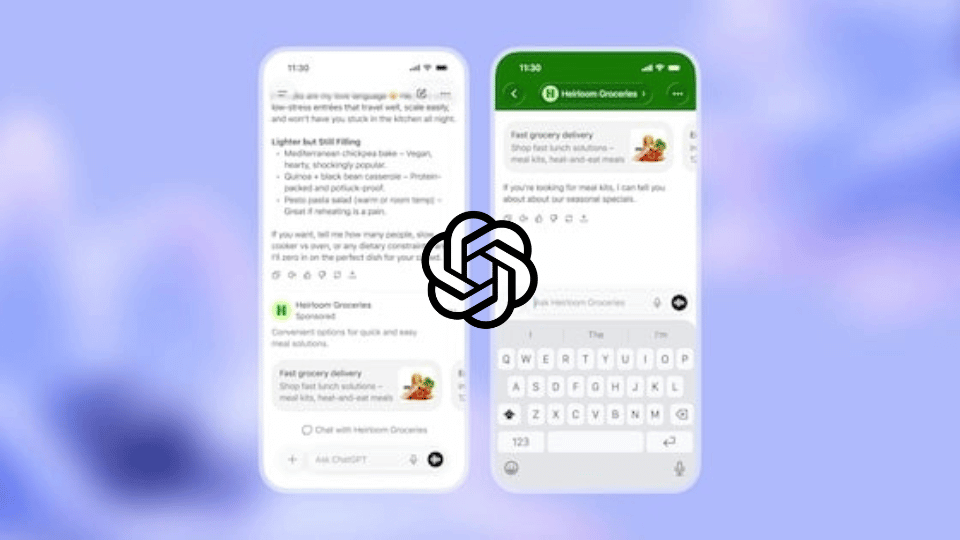
- Sponsored Recommendation box: Ads appear below the organic response in a tinted box that’s labeled as sponsored.
- Contextual links: These are more atomized and integrated ad units. They take the form of citations that are in or near organic answers. Though they’re infused closer to the organic content (such as a link next to a brand name that happens to be mentioned in the organic answer), they’re labeled as sponsored to maintain a church/state separation.
- Bazaar Carousel: In the case of shopping-related queries, OpenAI is testing a carousel of products that let users scroll horizontally without leaving the chat. Like the above, and in all cases of ads, OpenAI specifies that sponsorship is always clearly labeled as such.
As for the advertisers signed up initially, they include Adobe, Audible, Target, Williams-Sonoma, Ford, Mazda, Mrs. Meyer’s, and luxury watchmaker Audemars Piguet. One thing that jumps out from this list is its household names, which may be an effort to further legitimize the effort with blue-chip brands.
Things Change
Stepping back, none of this is surprising, though segments of the tech press have feigned surprise. Though Sam Altman has lamented the integrity-degrading possibilities of ads, things change… especially in the fast-moving AI realm. Among other things, OpenAI has billions in CapEx commitments to fund.
As noted, other things changed for OpenAI, such as declining growth rates for ChatGPT. With less astronomical – or at least decelerating – subscription revenue, markets have become uncertain about its ability to be profitable… and markets hate uncertainty. A new revenue stream is meant to ease that.
Hanging over all the above are rumors of a potential IPO. If that’s the case, it’s not surprising that OpenAI would need to build a stronger business case to take on the road. Ad revenue at this stage solidifies its model and leaves uncertainty off the table for prospective underwriters and public-market investors.
So all of that is well and good. One thing that rubs us the wrong way is how it’s trying to turn its ad play into an altruistic endeavor that “benefits all of humanity”… to the point of evoking WeWork vibes. But it doesn’t matter what we think… the market will speak, and we’ll be listening closely to what it says.