You may have noticed that Apple Maps continues to introduce new features and functionality. And it’s primed to do so, given the installed base of 2 billion+ iOS devices, along with Apple’s classic vertical integration and continuity features between its first-party apps.
Recent examples include offline maps, which let you download areas of the map to access turn-by-turn navigation and other features before entering low-connection areas, or roaming. This is well-suited for international travel, such as downloading a map of Paris to guide your sightseeing while away from WiFi or cell service.
Beyond the user-facing side of things, there’s also been a sizable development in business-facing functions for Apple. Specifically, Apple Business Connect continues to evolve as a self-serve tool for business listings, which resembles Google’s model for Google Business Profiles (GPB).
This essentially means that Apple, in addition to maintaining its own places data, is allowing businesses to add and customize their profiles, which are in turn displayed across Apple apps including Wallet, Siri, and others. That includes the standard set of business details like name, address, place (NAP) as well as photos, promotions, and other particulars (think: pet policies, kid friendly, or wheelchair accessible).
Taking Action
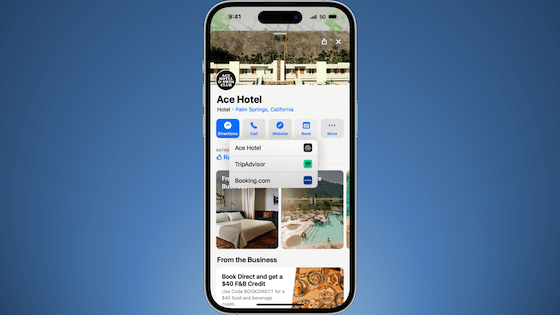
Going deeper into Apple Business Connect, businesses of all sizes can register and update their business information in the place card once they’re verified. Apple also recently added Custom Action Links to let businesses add a link to their website or preferred platform without an app, so users can make a hotel reservation or order food directly from the business’ place card in Apple Maps.
Much of the above takes place through a business-facing dashboard that offers much more control and customization than previously offered. That previous system resided in Apple Business Register, which allowed local businesses to request changes to how they were showing up on Apple Maps.
Apple Maps has also traditionally displayed information from third parties like Yelp, Foursquare, and TripAdvisor in the place card. In fact, Apple Maps has long relied on content and data from best-of-breed vertical partners, as opposed to Google’s approach to index the universe on its own.
To be clear, data partners like Yelp are still integrated into Apple Maps, including photos, reviews, menus, and ordering. But now, with an additional layer of self-serve listings management, Apple is hoping to improve its mapping accuracy and UX through the advantages of crowdsourcing.
Incentive Structure
What are those advantages? It’s mostly about scaling up efforts to keep listings accurate – pursuant to a better user experience. Google similarly incentivizes SMBs to manage their listings and business details in these ways by correlating such efforts to SEO benefits.
Apple’s incentive structure with Business Connect is different but carries similar weight. We’re talking about the gravitational pull of Apple’s pre-loaded position – and growing usage – on 2 billion+ devices. The sheer scale of this opportunity puts SMBs’ listings management efforts in a worthwhile light.
And when diving into the speculative psychology of local businesses, the dynamics vary between SMBs and multi-location brands. The latter’s listings management has become its own subsector, with companies ranging from SOCi to Yext and Uberall helping automate and centralize listings optimization.
And that’s where one of the biggest opportunities lies with Apple Business Connect. The presence of an additional and opportune local marketing tool elevates the value of these local listings specialists in the eyes of simplicity-minded local businesses. Many have already jumped on board and more will follow.