As part of the ritual of examining local commerce and SMB Saas strategies, Localogy goes right to the source: SMBs themselves. How do they feel about marketing and operational software? What features do they want? And how has their hunger changed in a pandemic? This is all a moving target.
Localogy’s Modern Commerce Monitor (MCM) answers these and other questions across the SMB SaaS product set, which we preview in this Benchmark Bytes series. And we recently entered a new chapter of this series, with highlights from the latest wave (8.0) of Modern Commerce Monitor.
After examining the varying degrees that SMBs utilize SaaS last week, we switch gears this week to examine the reasons they aren’t doing so. For those that aren’t unlocking their software’s full potential, why aren’t they? Time? resources? Lack of interest? This can be a key finding for SaaS vendors.
Data Dive
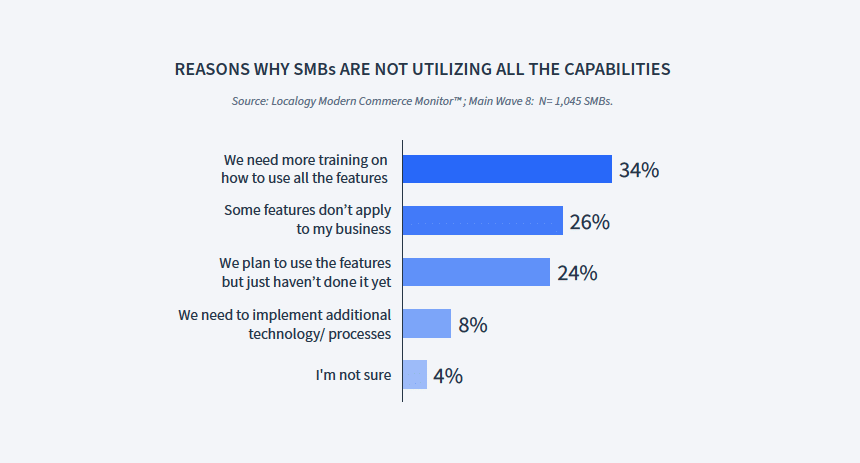
– Diving in, the biggest reason (34 percent) that SMBs don’t use the full capabilities of SaaS is that they feel they need more training before they can do so.
– This is good news for SaaS providers because the most prominent gating factor for SMBs is a solvable issue.
– It’s also good feedback for vendors because they can decide if it’s worthwhile to provide more explicit training and onboarding tools in their UX.
– The second biggest reason for underutilizing SaaS (26 percent) is that not all the features apply to a given business.
– This is a reasonable cause for underutilization… but it raises a more concerning question about whether the SaaS product in question is a good fit for that business.
– The next answer in order of prevalence is that SMBs haven’t used all the features yet… but plan to get around to it (24 percent).
– Like the lack of training excuse noted above, this response could be good news for SaaS vendors in that there’s hope of greater utilization as a function of time.
– Trailing further down the list is the feeling that additional technologies and processes are needed to get the full value out of a given SaaS tool (8 percent)
– This once again raises the question of whether or not a given SaaS tool is the right fit. In other words, if an SMB can’t utilize all of the features, their ROI comes into question, and therefore their retention likelihood…
[mepr-show rules=”41250″ unauth=”message”]
[/mepr-show]
Long-Tail Opportunity
Stepping back, SMB online marketing – as well as operational and fintech tools – continues to grow rapidly. SMB SaaS startups and online services providers are correspondingly thriving as it continues to grow as a leading subsector of the broader SaaS universe. There’s a long-tail opportunity at play.
Meanwhile, new SMB SaaS users could represent permanent adopters – a concept that accelerated in the Covid era as SMBs were forced into digital transformation. This sent them into the arms of SaaS providers (where many have stayed) to accomplish a range of marketing and operational functions.
We’ll return in the next installment to go deeper into Localogy original survey research. That will include SMB goals and success factors. Let us know what additional insights jump out at you from the above data, and stay tuned for more breakdowns in our Benchmark Bytes series.