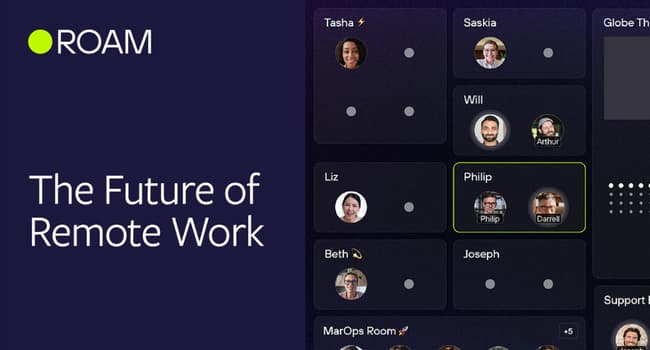
Yext Co-founder and former CEO Howard Lerman is out with a new startup that he’s been tinkering with for about a year called Roam. The company has a mission to provide what is essentially an operating system for the hybrid workplace.
Roam enters the fray with $40 million in its pocket, you know, to help it get off the ground. Lerman reportedly kicked in more than $10 million of his own money. He also teamed up with Silicon Valley VC Jules Maltz (IVP) to raise a Series A. It all adds up to $40 million.
Based on what we’ve learned from LinkedIn chatter, Ro.am has some notable individual investors. These include former Mono Solutions CEO Louise Lachman, SEO guru Andrew Shotland, and Fundera Co-founder Jared Hecht, among others. Hecht wrote this blog post explaining why he is super pumped to be investing in Ro.am.
“When Howard demoed Ro.am, I knew that I was witnessing what the future of work looked like for companies that operate out of an office, remotely, or a combination of the two,” Hecht writes in his post.
The Yext Mafia
Lerman has managed to lure a number of former Yexters to the Roam founding team. For example, his co-founder and CTO is former Yext CTO Tom Dixon. In fact, 10 of the 17 founding team members listed on the Roam website mention Yext in their bios, including Lerman.
So what is Roam? It is essentially a virtual office, which Lerman calls a “Cloud Headquarters.” Office workers sit in spaces within Ro.am and are visible on the platform when they are sitting at their virtual desks. Ro.am is built for “ad hoc” meetings among colleagues. This serendipity is the element many workers miss most from the old office.
Roam is also designed to facilitate hybrid work, so it can be used by teams regardless of whether they are working remotely or in the office.
The premise behind the platform seems to be that hybrid work is here to stay and enterprises are going to need the right software to operate in this new normal. Ro.am’s existence (and ample funding) seem to presume that your grandfather’s 9-5, Monday to Friday office is never coming back. We tend to agree.
9-5 Will Never Return
Last week, CNBC’s Andrew Ross Sorkin asked Lerman to explain why he thinks the working world ]needs Ro.am.
Much of the conversation involved how Lerman, via Roam, intends to fix what’s wrong with Zoom.
Here is the CNBC clip.

In the interview, Lerman didn’t resist the Zoom comparison. In fact, he leaned into why he thinks Zoom is not the right platform for the world of hybrid work.
“The big problem with Zoom,” Lerman told Ross-Sorkin, “is that things that should take two people five minutes to do today are now scheduled for five people on a 30-minute call next week.”
Is anyone really going to argue that this doesn’t at least feel true?
Meanwhile, on Ro.am, ad hoc meetings are the order of the day. And Lerman happily pointed out that the average Roam meeting is 8:34.
“Imagine if your whole work life was made up of 8-minute meetings instead of 30-minute meetings?” Lerman asked. Rhetorically, of course. But that didn’t prevent grumpy Joe Kernen from jumping in to argue that any day filled with meetings still sounds awful. Ok, Joe, meetings do suck. But short meetings suck a lot less than long ones.
Does Remote Work Still Suck?
Lerman isn’t the only entrepreneur to take a swing at disrupting Zoom. Crypto entrepreneur and South African Shark Tank panelist Vinny Lingham launched Waitroom this year as a Zoom alternative, particularly for business influencers who want to meet followers but not according to Zoom’s de facto 30-minute standard. More like five minutes a pop. We wrote about Waitroom back in March.
And while he was still running Yext, Lerman didn’t exactly embrace remote work. And least not immediately. Back in 2020, he rather famously said: “Remote work sucks”. And soon after we wrote an article where we asked him to elaborate.
Here is some of what he told us two years ago.
“Look, I think [remote work] is fine for certain situations. I don’t expect everyone to be back in the office. But I personally, and a lot of people I know, get energized from being around others. You can’t replicate the random and casual interactions you get [in the office on] Zoom. I’m just more creative when I’m around certain other people,” Lerman told Localogy in September 2020.
This critique of remote work (and implicitly of Zoom) really seems to have informed the creation of Roam. How can you re-introduce serendipity in a hybrid work world? Lerman and his team seem to think they’ve figured that out.