Let’s face it. For all the happy talk about silver linings, the pandemic has been a nightmare for most of us. But there is no denying that it has also been a giant fount of inspiration for innovators and disruptors all over the world.
One area where there was massive innovation in 2021 was in food tech. While many trends like ghost kitchens and virtual restaurants pre-dated the pandemic they were, you guessed it, accelerated by it.
But now we are looking ahead to the end of the pandemic. And Omicron notwithstanding, the end will eventually come. With luck in 2022. So it’s worth scanning the horizon and asking what the post-pandemic local food tech scene will look like.
Permanent Shift?
The data is clear that the use of food delivery apps skyrocketed during the pandemic. Well, of course it did. A study earlier in 2021 from the National Restaurant Association found that 60% of adults (and 71% of millennials) say they are using delivery apps more than before the pandemic. Probably the least surprising stat ever. What the study didn’t measure is intentions for use after the pandemic. But the truth is, depending on where you live, indoor dining is back. And it has been for a while. And yet it seems folks are still ordering chow from DoorDash at a nightly clip, despite all the gripes about the high cost.
Our view is the online food ecosystem is here to stay, and increasingly the operation of restaurants will be hybridized (now there’s a cringy neologism). By that, we mean restaurants will increasingly optimize their operations for both dine-in and delivery. And a new class of software will emerge that promises just that — a seamless OS for hybrid restaurant operations. One company that appears to be doing this is Dubai’s Grubtech.
Virtual restaurants, which are restaurant brands created exclusively for delivery, are certainly here to stay. However, we think these will emerge at least as much as offshoots of existing brick-and-mortar restaurants as from pure-play virtual dining operations. The list of established brick-and-mortar chains that have launched virtual offshoots includes Chick-fil-A, Outback Steakhouse, Applebee’s, Hooters, Dennys, Jack-in-the-Box, and others.
Of Course, TikTok
One clear signal that virtual restaurants are either here to stay (or have just completely jumped the shark) is the arrival of TikTok Kitchens. Yes, I too checked the calendar when I saw this news. But then, it’s still 2021. Noting is weird anymore.
The new TikTok Kitchens is a collaboration between Virtual Dining Concepts (founded in 2019 by Robert Earl, the Planet Hollywood guy), TikTok, and Grubhub.
The unique idea behind the TikTok Kitchen is kind of interesting. Instead of focusing on tacos or burgers or whatever, TikTok’s idea is to feature a constantly changing menu based on dishes that have gone viral on TikTok.
According to Earl, the virtual dining impresario, the short video platform was almost purpose-built for the concept. Consider this from the Restaurant Business story on the announcement.
“The question is, will consumers make the leap from the app to the restaurant? There is evidence to suggest that fast-growing TikTok—which hit 1 billion active worldwide users in September—has an influence on what people eat. A study by marketing agency MHG found that 36% of TikTok users had ordered from a restaurant after seeing a video about it on the app.”
We shall see if this translates into ordering from TikTok’s own food concept.
Who Wants a Pauly D’s Subs?
TikTok’s move really isn’t surprising. After all, the virtual dining space is already well integrated into celebrity and popular culture. For example, back in June, we wrote about comedian Geoge Lopez’s new virtual taco joint, George Lopez Tacos. (Is it just me or did this also make you think of the Michael Scott Paper Company?) Lopez’s partner is Nextbite, which has also given us “HotBox by Wiz” by Wiz Khalifa.
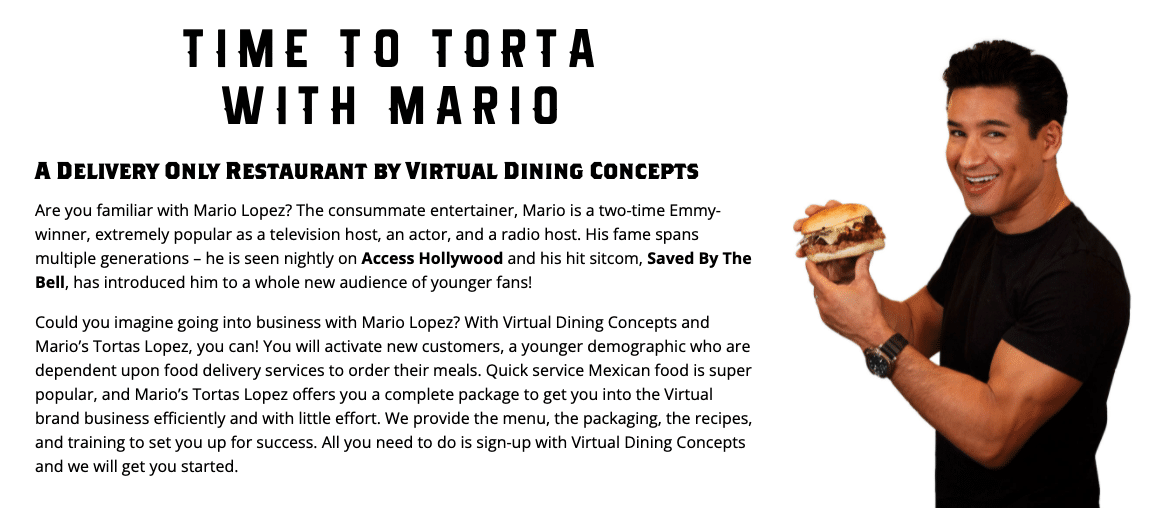
And Virtual Dining Concepts is deep into the celebrity virtual restaurant game as well. It has back virtual brands from the likes of Mariah Carey, Mario Lopez, and Jersey Shore thespian Pauly D.
The thing about virtual restaurants is they are relatively easy to launch, particularly when you hand the keys to a platform like Virtual Dining Concepts, Nextbite, or any of their many competitors. But you know what they say. Easy come easy go. We imagine the survival of celebrity virtual dining brands will be extremely low. If people are still noshing on Mario’s Tortas Lopez a year from now, I’ll eat my hat. Or on second thought, I’ll have a George Lopez taco instead.