
Forward Kitchens launched in 2019 as a Y Combinator cohort to create digital storefronts for restaurants to launch virtual food concepts. Now it has emerged from stealth with a $2.5 million seed round. Time to see if the dining world wants to buy what it’s selling. We think the odds are pretty good they will.
The San Francisco-based company is doing something interesting within the virtual dining space. Their solution allows an existing brick and mortar (or fully online) restaurant to go virtual and offer multiple food concepts, each with its own presence, integrated with delivery services.
So conceivable, an Italian restaurant working with Forward Kitchens could use some of its food prep capacity to create a mac-and-cheese virtual restaurant. And another still just for grilled cheese sandwiches, and so on. All this without having to register each individual concept with delivery aggregators. The image below from its website kind of says it all.
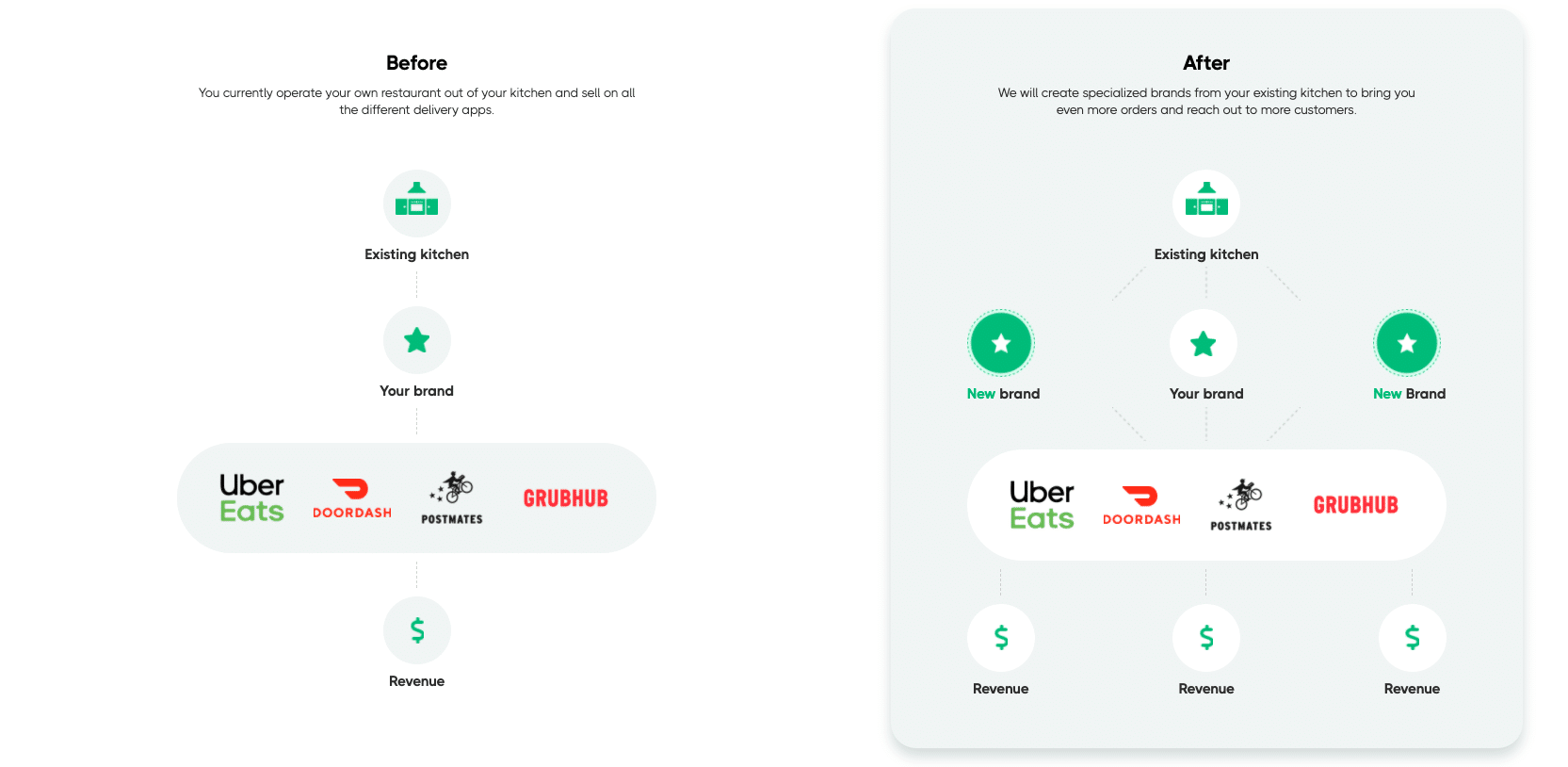
The elegance of the concept comes in its simplicity. An existing restaurant can almost immediately launch multiple virtual restaurants. This can substantially grow sales without adding cost. The only constraint is the capacity of the restaurant’s kitchen. The company indicates on its website that it also partners with cloud kitchens. We presume this enables it to work with 100% virtual dining brands as well.
The company’s seed round backers include Y Combinator, Floodgate, Slow Ventures, and SV Angel. Some angel investors also joined, including YC Managing Director Michael Seibel, Ram Shriram, and Thumbtack Co-founder Jonathan Swanson. Forward Kitchens is led by co-founder and CEO Raghav Poddar.
Elsewhere in FoodTech…
We found a few other stories of note related to the growing virtualization (if that’s a word) of local restaurants.
Ghost Kitchen Market to Grow at 12% Thru 2027
A new study projects the ghost kitchen space will grow at a 12% CAGR, reaching $71.4 billion by 2017. The report from Allied Market Research values the cloud kitchen space at $43.1 billion in 2019.
Here is some color on the forecast rationale, from the press release announcing the report. “The global cloud kitchen market is expected to witness significant growth owing to increase in demand for fast food among millennials and Gen Z. Moreover, the introduction of new advanced technology such as autonomous vehicles and drones has reduced the food delivery time, which has further augmented the growth of the market.”
We also believe this market will grow. But we have to call BS on the part about drones and autonomous cars. While these technologies will eventually matter, we are not aware of their widespread use in food delivery today. Nor do we see either replacing drivers en masse globally in the next handful of years. In much of the world, it will remain cheaper to field a fleet of boda bodas (scooter drivers) than a fleet of autonomous vehicles. And this will likely be true for years to come.
CloudKitchens Opens San Diego Collective
The highly secretive CloudKitchens, founded by ex-Uber bro Travis Kalanick, is launching a virtual food hub near San Diego’s cluster of universities. The location is likely a 9,000 square foot former music store. The idea behind these collectives is to house multiple local virtual restaurants in one space. And provide a tablet-based check-in and pickup station for delivery app drivers.
The new collective will be called the Aztex Food Hub. Some of the estimated 40 food concepts to be housed there include names like Cali Comfort Barbecue, Willie Wingz, and Blue Poke.
Are Robot Cloud Kitchens Next?
An article in the Robotics Business Review (great nightstand material by the way) is touting the robotics-enabled cloud kitchen as “the next big on-demand thing.” The article, written by Borders Books and Webvan founder Louis Borders, a man way more into robotics than I was aware, makes the case for a “robotic fulfillment system.”
Here is some of what he has to say.
“Robotics systems and their enabling technologies are becoming increasingly powerful, especially with developments in the last few years in the critical areas of machine vision, grasping and manipulation, materials, machine learning/deep learning, and more. The robotics technology available today is quite capable of making the Cloud Kitchen fulfillment system a reality.”
So I guess the only way to make the virtual restaurant space more soulless is to have robots do everything.