
The love-hate (mostly hate) relationship between restaurants and delivery aggregators isn’t showing much sign of abating. Even though in many municipalities, Covid-era caps on commissions remain in place.
Restaurants hate the aggregators for a few key reasons. The most obvious is cost. They pay a high commission on orders (even with commission caps), even for those that the customers pick up themselves. And the aggregators add fees onto delivery orders, essentially turning a $15 salad (already a crime) into a $30 salad.
The other reason restaurants resent the delivery apps is that the aggregators stand in the way of building a long-term relationship with the consumers ordering those grotesquely marked-up salads. If a consumer orders the salad from a local eatery on DoorDash, the consumer believes they are doing business with DoorDash. Not the local eatery.
A Nibble Here, A Nibble There Eats Away at Delivery App Dominance
Breaking the Aggregators’ Hold?
So when we came across a Singapore-based startup that claims it can solve problem No. 2 (losing customers relationships), we wanted to know more. And of course, solving problem No. 2 addresses problem No. 1 (killer commissions).
The company in question, Tablevibe, is part of the latest batch of startups accepted into the YCombinator incubator program.
The company, founded by ex-Googlers, initially (and pre-Covid) sought to digitize paper restaurant feedback forms. The idea was to improve response snd give restaurant owners a better response.
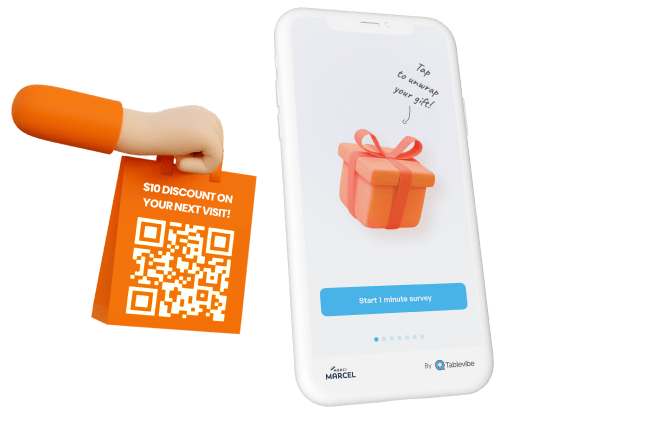
When Covid hit and restaurants pivoted to delivery, the company pivoted to a QR code sticker affixed to delivery packaging. The code offers customers an attractive discount on their next purchase (if they give feedback). But the catch is, they can only redeem the discount if they do business directly with the restaurant. No third-party apps allowed.
Notably, Tablevibe integrates with Google Reviews. So when a customer gives a high rating, they are prompted to share it publicly.
Tablevible is an elegantly simple idea. And it drives directly at a restaurant pain point (No. 2 as described above). Yet this feels like a solution that puts a dent in the problem, rather than solving it. Many of us are more motivated by time than money. So the motivation to fill out a survey and remain loyal to the local restaurant (and not DoorDash) feels insufficient.
This feels like a single arrow, not a quiver.
A White Tablecloth NFT
So while we’re discussing restaurants, let’s talk about NFTs. Thanks to a tweet from Gary Vee, we came across what appears to be the first restaurant using NFTs as its capital structure. I’ve been trying to find an excuse to talk about NFTs here, so this story will have to do.
its here! The first NFT restaurant https://t.co/4u1YURVe1F
— Gary Vaynerchuk (@garyvee) August 20, 2021
First, NFTs, or non-fungible tokens, are a blockchain-based method for certifying that a digital asset is unique and not replicable. Artists and others have used this method to create digital assets that are one of a kind, which has led to strange phenomena like very ordinary-looking pieces of digital art selling for tens of thousands of dollars.
So how does this apply to restaurants? The unnamed restaurant comes from VCR Group, of which Gary Vee is founder and chairman.
Dining at this NFT eatery will require membership. And memberships will be purchased as NFTs. These tokens will be digital assets that members can then trade on the open market if they choose.
Gary Vee talks more about it in this interview on CNBC.
NFTs have a novelty bubble vibe, largely based on some nutty NFT transactions. But the real value in NFTs is in fractional owners of unique assets. So this application is actually pretty interesting. As we say, to the point of it becoming a cliche, we’ll keep an eye on this.