

Recovery is in the air. We can all feel it just walking down the street or entering the grocery store. But beyond anecdotal evidence, how are local economies recovering? A few data points have crossed our desks over the past few weeks, which we’ve rounded up for the latest data dive on local economic recovery.
Recovery Index
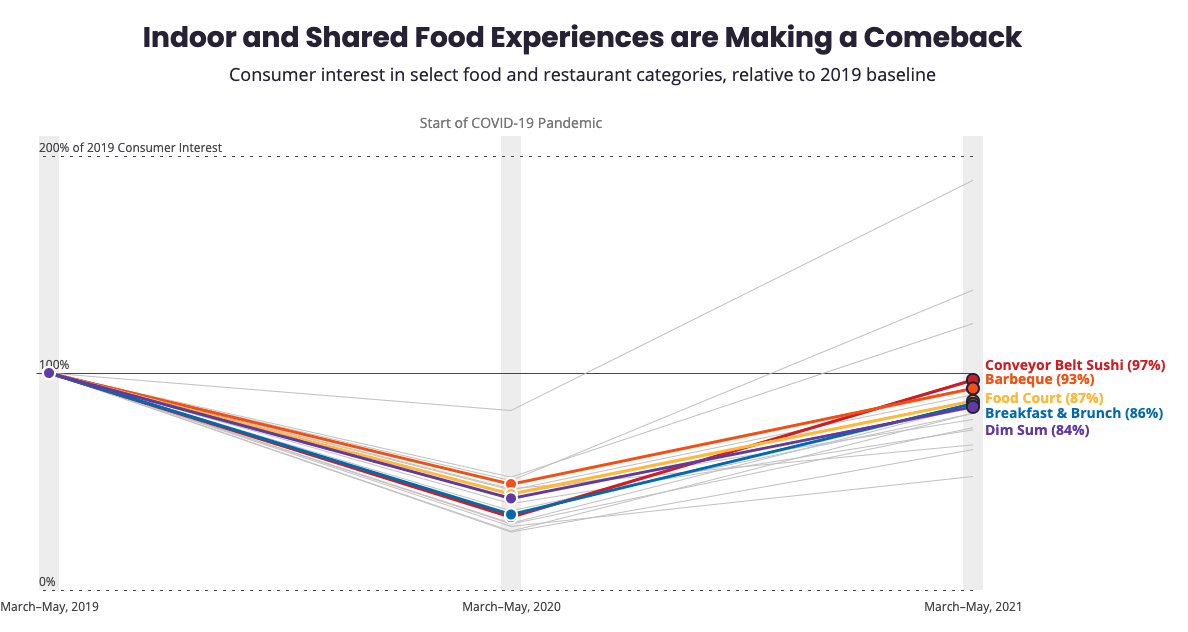
The first piece of evidence comes from Yelp, which reports that several local business categories have bounced back to near-pre-pandemic levels. Its study compared data from March through May 2021 with the same period in 2019. It measured various on-site engagement activities to extrapolate business levels.
Top findings from the report include:
— Restaurants have recovered to 86 percent of 2019 levels. Food businesses overall have recovered 92 percent.
— There’s noteworthy growth in “shared food experiences” including conveyor-belt sushi (97 percent), tappas (82 percent) hot pot (75 percent) dim sum (84 percent) and 52 percent recovery for buffets (can’t win em all.)
— Shopping has reached 92 percent of 2019 levels, including shoes (79 percent), jewelry (88 percent) and men’s, women’s & children’s clothing, each at 76 percent.
— Auto is the category with the greatest activity at 106 percent of 2019 levels. The subset of recreational vehicle dealers fare even better at 125 percent and motorcycle dealers at 125 percent.
— Home services are likewise doing well at 99 percent of pre-pandemic levels.
— Real estate agents are experiencing 104 percent of 2019 activity levels, given the state of the housing market, while mortgage brokers are at 105 percent and home inspectors are at 106 percent.
— Overall, areas with lower population density and fewer restrictions are seeing greater recovery.
“Consumer interest — measured by counting a few of the many actions people take to connect with businesses on Yelp: viewing business pages or posting photos or reviews — demonstrates how people are engaging with local businesses, in turn providing insight into how the economy is recovering,” Yelp wrote.
Telling Signs
More evidence evidence comes from Criteo which reports that U.S. brick-and-mortar sales have returned to pre-pandemic levels. In the U.S. specifically, sales have actually grown 8 percent. This measures May 2021 levels versus February 2020. This isn’t a period-over-period measurement but is still notable.
Meanwhile, Yotpo reports that 79 percent of U.S. consumers say they plan to shop more in the coming months (not suprising). Drilling down, 53 percent of survey respondents say they’ll use a combination of in-store and online shopping. 10 percent will shop primarily offline and 37 percent will shop primarily online.
But the biggest takeaway from Yotpo’s report is the increased interest in conversational commerce. Since June 2020, consumers who have signed up for message-based interactions with businesses increased 27 percent. This includes the ability to ask questions (up 31 percent), recieve deals (up 31 percent).
This is yet another area of Covid-driven transformation. Distancing and local lockdowns forced many consumers to pick up new transactional habits. One of those was to communicate with brands and businesses through messaging. Like many Covid-discovered habits, this consumer behavior could sustain long term.
We’ll be focusing on this very topic — the rise of conversational commerce — at Localogy 2021 in September in L.A.. Hope to see you there (IRL).