One of the fundamental sub-topics of the broader local commerce picture is mapping. Intertwined in local search and SEO, it’s central to the consumer shopping flow and, correspondingly, the local business marketing mix. But though it’s so foundational, it also continues to evolve at the pace of newer technologies.
The latest example is Google’s updates announced at its I/O conference. Highlights include new routing capabilities, updates to Live View AR navigation, new levels of mapping detail, and a new “area busyness” feature. These are all part of Google’s stated goal to integrate 100+ AI-fueled Maps features this year.
But Google isn’t alone in its mapping updates. Closely following Google I/O was Snap’s Partner Summit, during which it likewise elevated its mapping features. These build on Snap’s ongoing Mapping efforts that we continue to track. So after covering Google in Part I of this series, we now dive deeper on Snap.
Data Backbone
Among the many interlinking pieces at Snap, mapping is an ongoing initiative. The thought is that social interaction is tied to the real world to a large degree. So if Snap can add layers of social relevance based on where you are (opted-in of course), it can deepen user connections and engagement.
This was partly behind Snap’s 2017 acquisition of Placed, which it subsequently divested for other reasons. And its since shown ample intent to carry the social mapping baton farther. Among other signals, Snap’s Alex Dao told us as much during Localogy 20/20, with Snap Map being the central focus.
As background, Snap Map geo-tags users and their Snaps on a map interface. According to Dao, 200 million Snapchatters are out and about using Snap Map (it’s now up to 250 million). This also becomes an organic place for SMB promotion, which Snap has rolled out and continues to develop.
As further background, Snap’s mapping strategy relies largely on third parties. This makes it more like Apple Maps than Google Maps, the former building up its Mapping UX and data backbone through partnerships with best-of-breed vertical players like Yelp. Google prioritizes first-party data to a greater degree.
Layered In
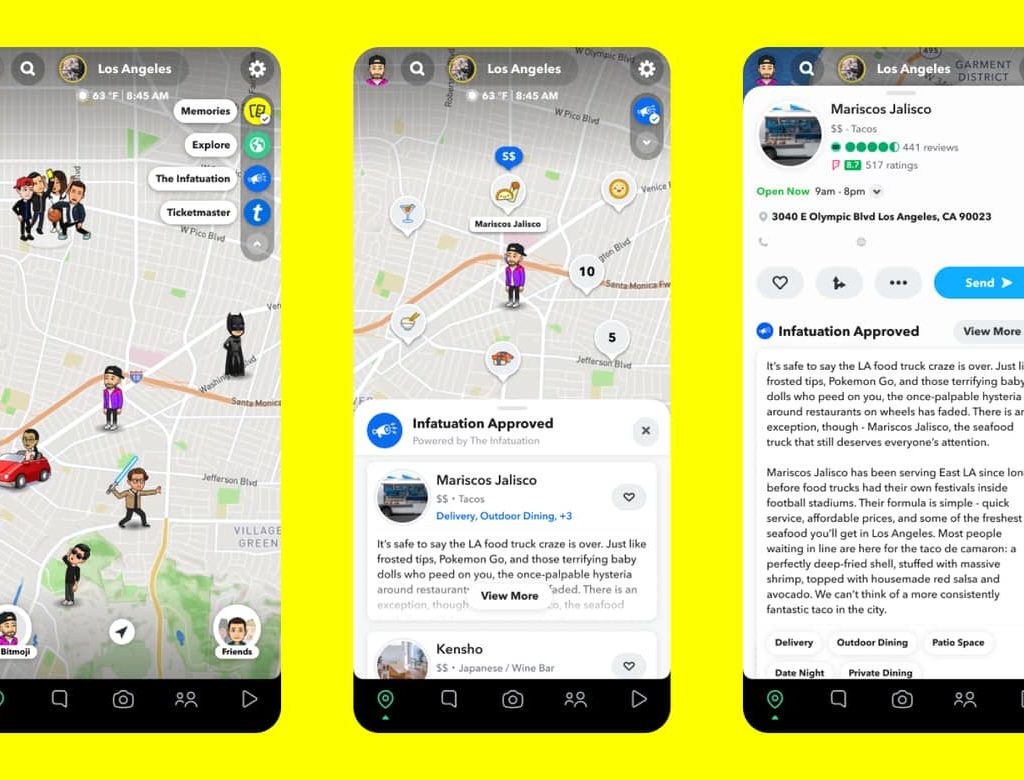
With that backdrop, what’s the latest from Snap Maps? The most significant of its latest round of updates is a structural enhancement known as “layers.” Think of this as different data sets in the map that you can toggle on and off, depending on your interests. Layers will develop around things like Sushi or Irish Pubs.
Layers will be initially seeded using Snap’s aforementioned partnering approach. It will acclimate users to layers through a featured set of new content from chosen vertical partners. For example, a Ticketmaster layer will highlight local events, while a layer from The Infatuation will signal local food items that are trending.
But the next likely play will be to distribute layers on a broader scale through APIs. This would let Snapchat scale up the creation of layers by crowdsourcing it to various startups. That would also broaden the use cases to several points of interest, which in turn boosts Snap Maps engagement and grows its user base.
The API approach would also let developers build their products into Snap Map — thus reaching the 250 million users noted above. This developer symbiosis is Snap’s playbook, seen in the way it scales lens development. This approach will likely drive its mapping evolution, and we’ll keep watching for signs.