As part of the ritual of examining local commerce and SMB Saas strategies, Localogy goes right to the source: SMBs themselves. How do they feel about marketing and operational software? What features do they want? And how has their hunger changed during a global pandemic that has hit local businesses hardest?
Localogy’s Modern Commerce Monitor (MCM) wave 6.1 answers these and other questions across the SMB SaaS product set, which we preview in this Benchmark Bytes series. After the last installment examined how SMB Saas frees up time for revenue-generating activities, we go one level deeper on reported value outcomes.
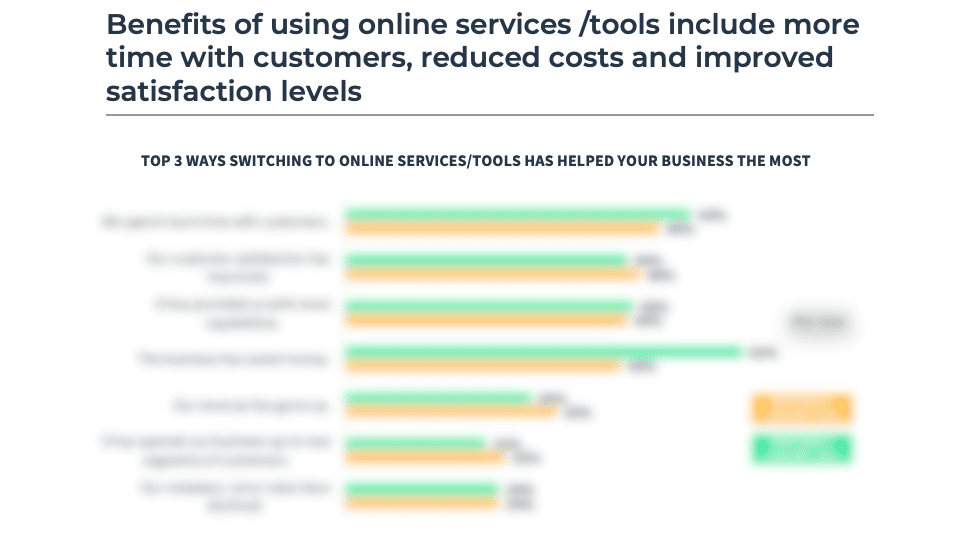
Specifically, among SMBs who have adopted online services for business operations, the greatest point of value ( with 62 percent of respondents) is saving money. That’s followed by having more time freed up to spend with customers (54 percent), more functionality and capabilities (45 percent).
Further down the list is greater customer satisfaction (44 percent), greater reported revenue (29 percent), fewer operational errors (24 percent) and expansion into new customer segments (22 percent). These data were gathered in January and February so they have some Covid-influence in terms of adoption drivers.
Localogy members can access full charts and SMB survey reports.
What Does it All Mean?
Going a bit deeper, a few things jump out at us:
— These reported value outcomes from SMB SaaS fall into three main categories or patterns: greater revenue, greater capabilities and lowering costs (including time).
— Among these three groupings, lowering cost and saving time clearly shows the greatest perceived value among SMBs, including being able to spend more time with customers.
— Greater capabilities is next on the list, including better customer satisfaction and broadening a given SMBs’ addressable market to new customer segments.
— Greater revenue is surprisingly last among these three main groupings, including the explicit sentiment that SMB SaaS has quantifiably increased revenue (29 percent).
— In fairness, revenue gains among 29 percent of respondents is meaningful (if lower than other categories) and is a testament to SMB SaaS’s tangible impact.
— It’s also worth noting that these SMB sentiments aren’t just the areas they value in an aspirational sense, but specific results they’re seeing from current software implementation.
— This can signal a few things for SMB SaaS providers: Demand signals for what SMBs value, and the degree to which current tools are working for them.
— SMB SaaS providers can double down on the value outcomes reported in these results (such as freeing up time for customer interaction) and work on improving the areas represented in lower scores (lessening operational errors).
Time to Shine
Stepping back, SMB online services adoption tracked by MCM continues to grow rapidly. SMB SaaS startups and online services providers are correspondingly thriving with exit velocity, funding, and public-market performance. SMB SaaS is becoming a leading subsector of the broader SaaS universe.
Meanwhile, new SMB SaaS users could represent permanent adopters — a concept that’s accelerated in the Covid era as SMBs are forced to boost their digital transformation. This sends them into the arms of SaaS providers to accomplish a range of operational and marketing functions.
We’ll return in the next installment to go deeper on other areas of SMB technology adoption. That will include the types of SMB SaaS software that resonate most. Let us know what additional insights jump out at you from the above data, and stay tuned for more breakdowns in our Benchmark Bytes series.