
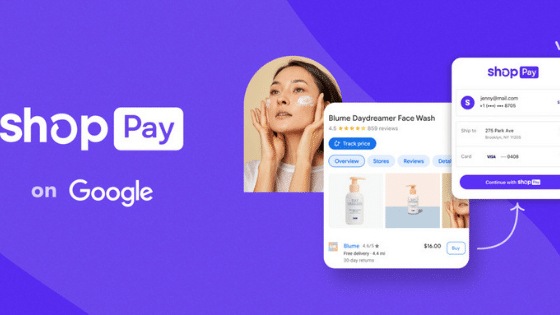
Announcements yesterday from Google and Shopify signal a new integration environment making it easier for consumers to shop on Google. More broadly, the announcements signal Google’s deepening interest in being an eCommerce player. This all comes in the wake of the explosive growth in online shopping during the pandemic.
Following up on the integration announced at the recent Google I/O event, Shopify announced yesterday that consumers will soon be able to make purchases on Google from a Shopify merchant using its Shop Pay online checkout tool.
Later this year Shopify merchants who enable “Buy on Google” will be able to provide Shop Pay as a checkout option.
“We’ve been partners with Google since 2012, and this expansion of our partnership is yet another reinforcement of Shopify and Google’s shared vision of commerce—that by putting the merchant first, everyone wins,” said Kaz Nejatian, Shopify’s VP, Merchant Services.
“Shop Pay is a great example of how we’re doing that. It’s 70% faster than a typical checkout. And that means fewer abandoned carts for merchants and a stellar checkout experience for consumers. Shop Pay has helped consumers track nearly half a billion orders, and we’re excited to bring that functionality to merchants and consumers on Google.”
🎉some news🎉
Shop Pay just keeps getting better. Today, we’re announcing that shoppers can soon buy on @Google from a @Shopify merchant using Shop Pay — our super-fast, one-tap checkout.
Find out more👇https://t.co/cG1mhYip2A pic.twitter.com/Hq9rt5wJzX
— Shop (@shop) May 27, 2021
An Open Ecosystem
Meanwhile, Google announced yesterday that it will also be doing similar integrations with WooCommerce, GoDaddy, and Square.
“This open ecosystem approach means that retailers will have even more ways to get discovered across Google, and shoppers will have even more choice,” wrote Bill Ready, Google’s President of Commerce, Payments & NBU.
“As this generational shift to e-commerce accelerates, having a digital presence is just the minimum. It’s now imperative for you as a retailer to stand out and speak directly to your customers.”
New Tools for Merchants and Brands
Google also unveiled a new set of tools to help merchants promote their brands on Google. These include a feature that allows businesses to feature identity attributes (e.g., black-owned or woman-owned businesses).
It also will roll out two AR-based tools. One for trying on make-up (see below) and another for apparel. Google says 90% of shoppers are spending more or the same on beauty products online than before the pandemic. 
Google is also rolling out features that make it easier to integrate loyalty programs and brand promotions.
“These are just a few examples of how we’re innovating to help you differentiate and make a deeper connection with consumers shopping across Google channels billions of times each day,” Google’s Ready wrote.
These announcements fit with Google’s general pattern in recent years. And that pattern has been to create an environment where everything happens within the Google environments. Whether it’s finding the answer to a question, booking a restaurant table, or ordering food for delivery. All of this once required jumping off of Google to someone else’s website. Now all of these tasks can be completed without leaving Google. It looks like this is increasingly the case for eCommerce as well.
Yet Shopify, WooCommerce, and other integration partners benefit as well by making it easier for their customers to benefit from Google traffic.