
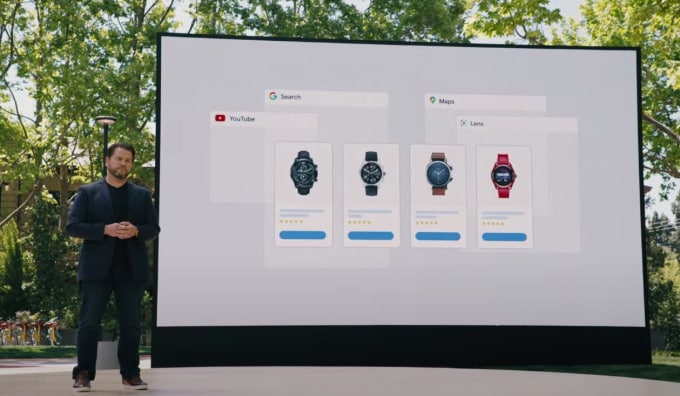
During yesterday’s Google I/O keynote, a notable announcement was hidden in the procession of software and gadgetry news. Google is partnering with Shopify to integrate the product listings of its many merchants. By integration, we mean that listings will be distributed across Google properties like search and shopping.
This will be available for free to 1.7 million Shopify merchants who opt-in. That essentially requires a few clicks to confirm participation, which is mostly a no-brainer for merchants who take the time to do it. The incremental reach they can achieve by doing this includes Google’s one-billion daily “shopping journeys.”
More specifically, this figure counts product-based searches across Search Maps, Images, Lens, and YouTube. Always on-brand, Google refers to this network as its “Shopping Graph.” These are the endpoints that draw upon a common set of data for images, pricing, reviews and other product listings info (sound familiar?).
Shopping Destination
Similar to the knowledge graph’s unifying function across Google properties, the shopping graph will reach across the places where product-based content is served. For example, if products show up in Google photos, Google’s object-recognition AI will kick in and suggest options to browse & buy similar items.
The same integrations and cross-channel functionality will be present in YouTube, which is increasingly becoming a shopping engine. That stems from the growing YouTube use case for product reviews and how-to videos. With greater shopping graph integration, those videos become more shoppable.
These integrations follow similar moves by social apps to make their content more transactional and shoppable through buy buttons. This trend has been underway for years at Facebook and has accelerated with Instagram’s natural product-discovery use case (especially in fashion). Now TikTok is doing similar.
But to amplify all of the above, Google needs to boost its various properties in users’ minds as a place to shop. This gets back to the network effects noted above. With more content and listings in its Shopping Graph, Google can accelerate its network effect and become more of a shopping destination.
Classic Google
That brings us back to the Shopify partnership. Google has stopped treating shopping listings as a revenue center, instead shooting for listings growth. By having more listings, it knows it can reach a network effect faster and attract more users and query volume, which it monetizes in other ways (classic Google).
Evidence for this approach can be seen in Google’s recent moves. For the above reasons, and to meet the moment for 2020’s eCommerce inflections — Google last year made it free for merchants to sell products. And it worked: this move drove an 80 percent increase in merchants selling on Google properties.
In that way, leaning into free listings also cultivates Google’s paid advertiser pipeline. In other words, merchants who witness the value in Google distribution through these free listings — including those from the new Shopify deal — could decide to double down and upgrade to paid campaigns at some point.
As for what Shopify gets out of the deal, this sweetens its value proposition to new and existing merchants. By offering more distribution scale, it can boost sales and retention. In fact, this was the same thing that drove its distribution partnerships with Walmart, as we’ve examined. Expect more deals like this.