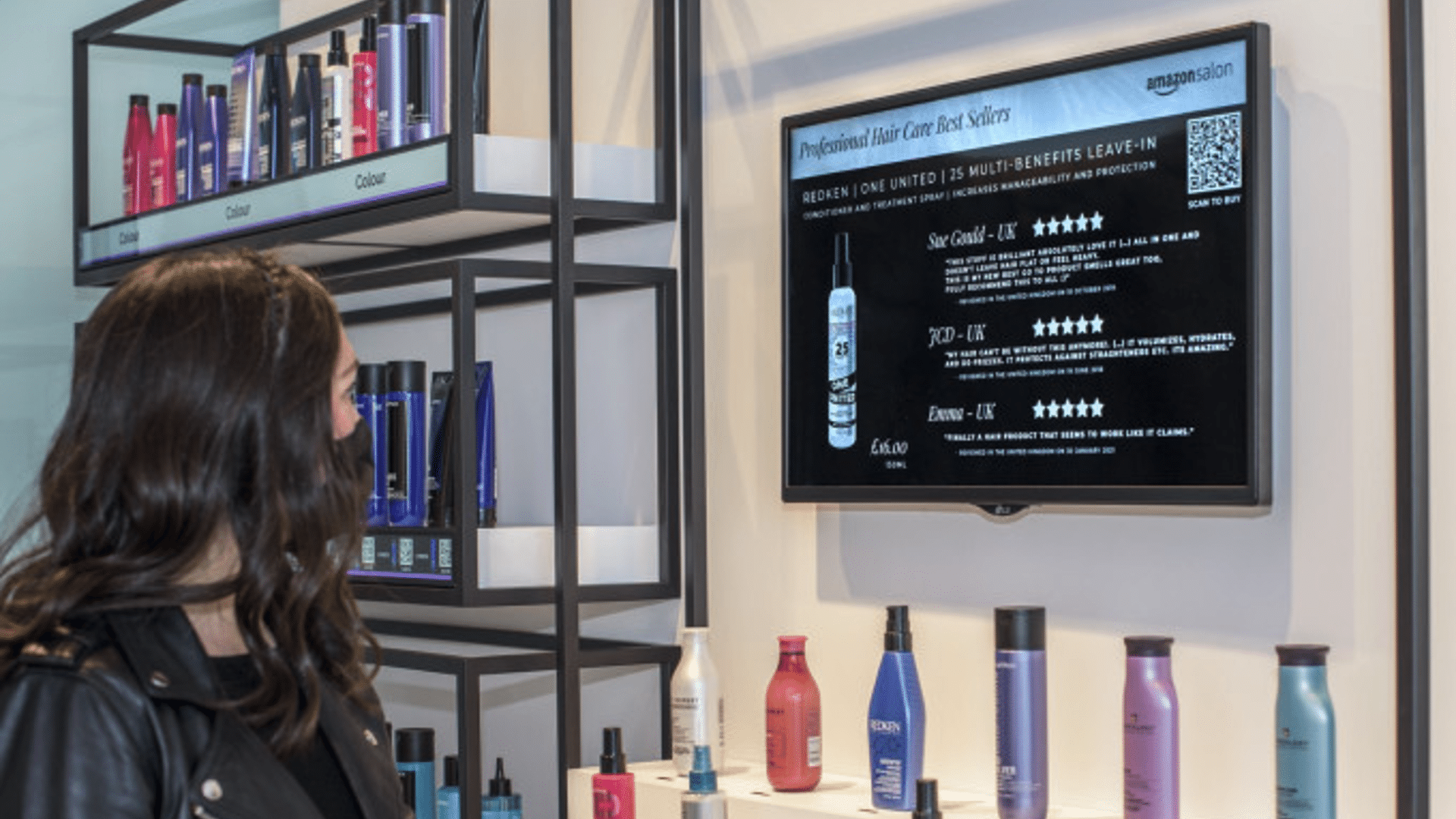
As you may have heard, Amazon this week announced that it’s opening a tech-fueled salon. Occupying 1,500+ square feet on Brushfield Street in London’s Spitalfields, it will serve as a test-bed for Amazon’s “Point and Learn,” technology. As it sounds, this technology reveals information when shoppers point at a given product.
Based on augmented reality, Point & Learn employs optical and motion sensors to detect when a shopper points at. Information is then invoked through various media, including flat panel displays that flank the product, or audio messaging. Consumers can then scan attached QR codes to order items on Amazon.
Doubling down on AR, the salon will feature Amazon Look-esque smart mirrors that let shoppers virtually try on various cosmetics for a more informed purchase. This has been a leading AR use case — especially during retail lockdowns — to guide eCommerce purchases in a product category that usually requires IRL try-ons.

Trojan Horse
Anyone following Amazon’s moves over the past few years can quickly detect that it isn’t interested in getting into the Salon business. This is purely an experimental play to observe and refine the above technologies and how they interact in physical spaces. And that’s part of Amazon’s broader “retail-as-a-service” (RaaS) play.
As background, I made a prediction about two years ago that Amazon Go Stores were a trojan horse for a broader RaaS play. This positions them as more of a testbed for digital infusions that can streamline physical retail. That turned out to be the case given Amazon’s “just walk out” technology being rolled out as a service.
More evidence of the RaaS approach comes from the Amazon One palm-reading POS payments that will speed up transactions at grocery stores. Just this week, Amazon announced it’s rolling this out to a handful of Whole Foods in the Seattle area. Speaking of Whole Foods, the acquisition further illustrates a broader RaaS play.
If you connect all these dots, they represent components of a RaaS engine that Amazon is developing as a business expansion move. And it fits the playbook: AWS was an internal tool that was tested and refined internally before being spun out as one of the most successful tech products of the past decade.
Market Timing
The timing for Amazon’s salon is notable. AR’s use in cosmetics is at a point where it could shift from early adopters to mainstream. And Amazon wants to see if it has legs to do this in physical retail installations. Point & Learn meanwhile comes as the retail world opens back up to potentially-apprehensive shoppers.
As we’ve examined, retailers in the post-Covid world may encounter demand signals for more touchless in-aisle interaction technologies. That will depend on several unknowns, such as consumers’ desire to get back to physical shopping, and medical guidance on transmission risks in public spaces.
If there is indeed demand for touchless technologies in retail environments, AR is a natural fit. It can overlay everything from product descriptions to brand spokespeople that come to life through your smartphone viewfinder. Beyond smartphones, AR will also live within store installations like Point & Learn.
Speaking of which, there’s a movement in the AR world to widen definitions beyond graphical overlays on the physical world. AR should rather involve any fusion of the physical and digital — everything from Zoom backgrounds to situationally-aware audio from your Airpods. Point & Learn fits that broadening AR scope.
We’ll pause there and pick things up next week in Part II of this series with a look at the Amazon One transactional palm reader.