The customer journey continues to evolve to encompass a greater number of marketing touchpoints, devices, and choices. Location data is acting as the common thread for marketing to measure how customers are engaging across channels, including TV, display, email, social media and in-store. Despite the relative “newness” of location-based marketing, the journey for location data as a brand asset itself has been a long one already.
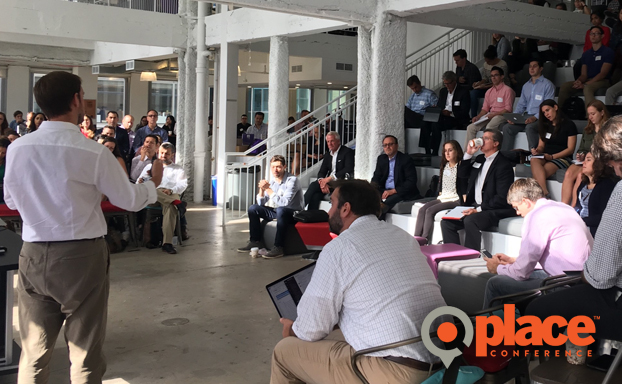
PlaceIQ CEO Duncan McCall took to the stage at the LSA Place Conference yesterday and today at a Location Analytics Workshop for New York agencies to detail the significant changes in use cases for location data by brands and media agencies in recent years.
McCall focused on 4 key stages of location data’s evolution:
- Proximity marketing: In the beginning, advertisers used foreground and bidstream data to deliver ads to nearby consumers. (Ex: Receiving an ad with a coupon for a free coffee at McDonalds if you walked within 1 mile of a specific location)
- Audiences: The idea of grouping consumers into audiences based on how frequently they visit a type of location, and serving relevant ads. (Those who frequent McDonalds and Burger King are grouped into a ‘QSR’ audience and receive ads for lunch deals)
- Attribution: The evolution of location to accurately measure the effect that advertising has on in-store locations. (Did a QSR’s ad for lunch deals actually drive people into stores to eat? And if so, how frequently?)
- Advanced analytic and insights: Where brands and agencies are seeing the most value today is using location to better understand consumer audiences and inform end-to-end business decisions. (What can we learn about audiences that visit QSRs and how can we inform decisions about advertising, promotions, even menu items with it?)
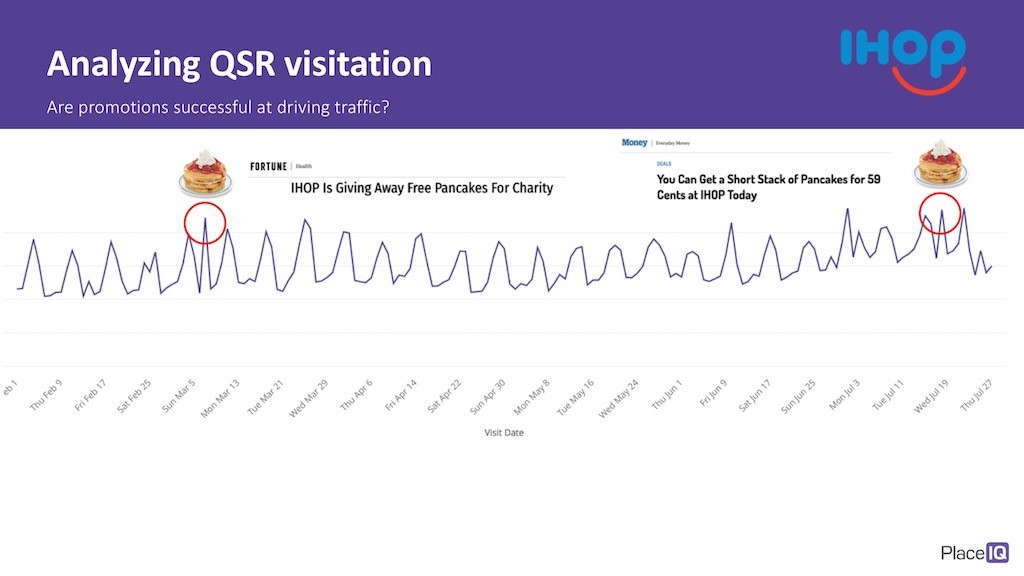
McCall cited several examples to demonstrate the versatility of location data, using the company’s LandMark offering, and its ability to help brands understand customer engagement. In one recently published example, the tech company clearly demonstrated the effect of QSR promotions, such as IHOP’s Free Pancake Day, on getting diners into stores.
The key takeaway was that understanding a visitation spike was only the beginning for gathering insight. QSR brands are increasingly using LandMark to understand how they’re capturing ‘share of visit’ from competitors during promotions and the DMAs that are over or under-performing, to optimize future campaigns towards specific brand goals.
In other example of the versatility of LandMark data, PlaceIQ recently published insights tied to tourism and hotel visitation as a result of the 2017 eclipse, as well as insights into the affect of Amazon/Whole Foods’ lower prices on longer-term visitation.
The rest of McCall’s session focused on location data’s role as an omni-channel enabler, using a real-world case study and new industry data to validate its value.
According to a new study released by 451 Research, entitled State of Integrated Marketing 2017: Mapping the Journey to Success,” location data is the tech most valued by marketers, to modernize metrics and create a unified cross-channel experience. In this study of 200 senior marketers, 81% ranked it as the first or second most important element. In addition, one third said location-based audiences are the most compelling new factor for integrated marketing.
McCall closed with a case study to demonstrate how brands are going further with location data, citing an example from retailer Urban Outfitters as a noteworthy standout. While location data has been used traditionally as a tool to drive or measure offline purchases, this case study was a rare example of an innovative retailer doing the opposite: using real-world signals to boost online shopping. According to press coverage, the retailer saw a 75% conversion increase and 146 percent revenue growth from using offline signals vs. online only.