
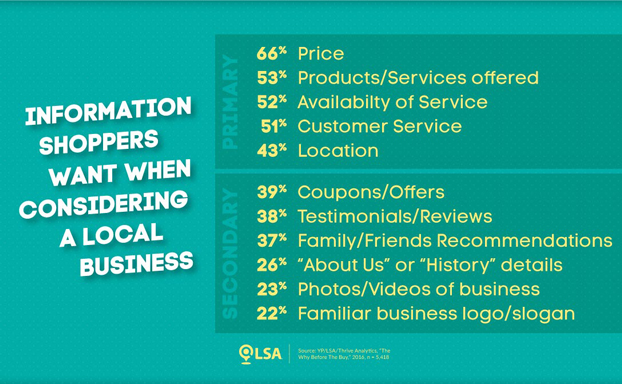
Data: 48% of Local Shoppers Said Secondary Biz Info Drove Decision to Buy

A majority of consumers utilize the Internet to research local purchases. That involves multiple sources and devices; however, a new study has identified the specific information or business data that are “primary” and “secondary” to consumer purchase research.

Primary information is fundamental to the purchase decision, such as price and products or services offered, in some cases location. Additional information, such as reviews and deals/offers, are also important in many purchase decisions but this content qualifies as secondary.

Interestingly, 48% of survey respondents said that secondary information caused them to select one business over another. Primary information helps businesses make the initial cut. But when shoppers have to choose among similar businesses, secondary info (enhanced data) then becomes critical.

The data comes from the YP, LSA and Thrive Analytics study titled, “The Why Before the Buy℠” which surveyed 5,418 U.S. adults on their past 90-day local shopping activities. To access the graphic above, click here.


Share Article...

Follow Us...

Stay ahead of the curve and get the latest on Local straight to your inbox.

By submitting this form, you agree to receive communications from Localogy. You can unsubscribe at any time.

Leave a Reply

Related Resources

ChatGPT Market Share Dips Below 50% As the AI Market Fragments

ChatGPT is like Netflix. It enjoyed an early mover advantage that gave it a natural market-share lead for a considerable period. But now, new blood is drawn to the market that it validated, and the room is suddenly a lot more crowded. And this phenomenon can be seen in AI’s shifting market shares.  

Flipping the Script: The API and AI Connectors are the New UI

Flipping the Script: The API is the New UI

As agentic AI permeates our digital domains and desktops, it could require a shift in the way that we interact with software. Connectors between AI engines like Claude Cowork and the various platforms that they unify and automate could mean that logging in as a SaaS subscriber is a thing of the past.