
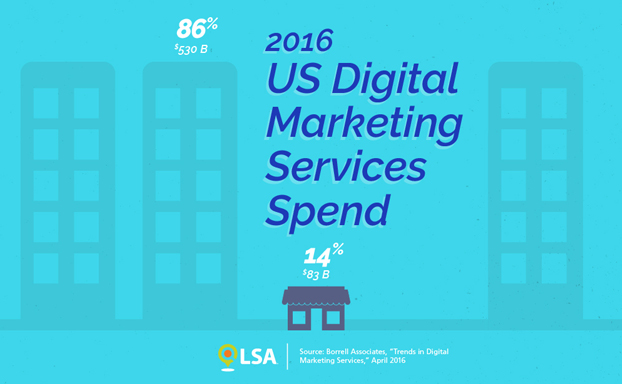
Roughly nine of every 10 businesses in the U.S. is an SMB, and more than half of the U.S. employee base works for one. However, when it comes to paying for digital marketing services, a new study finds that these SMBs are drastically out-spent by larger businesses/enterprises.
According to a new Borrell Associates study, SMBs will only account for 14% of the 2016 total U.S. spending on digital marketing services, which equates to about $83 billion. Larger businesses/enterprises account for the rest, making up roughly $530 billion in spend.
These digital marketing services are effectively anything other than advertising (website design, listings management, SEO, social media, etc.) and currently web-hosting and design are the number one and two spending categories; SEO is number three. However, by 2020, Borrell argues that SEO will be number one, followed by social media management and then web-hosting.
The data comes from a new report by Borrell Associates titled, “Trends in Digital Marketing Services” which was published April 2016. To access the graphic above, click here.