AI search may be creating a rare opening for SMBs to compete with brands that have far larger marketing budgets. Generative engine optimization (GEO) increasingly rewards local relevance, credibility, and specificity, changing what it takes to win in local discovery.
Large brands have bigger budgets and bigger teams, but AI search doesn’t reward size the way traditional rankings sometimes did.
Generative AI is answering local-intent questions that used to send people to a page of local results, and the businesses getting included aren’t necessarily the biggest names in their category. They’re the ones that have made themselves visible and credible across the specific sources AI trusts.
This is great news for small and mid-sized businesses, especially those that have traditionally struggled to outrank larger brands on Google Search and Maps.
Rather than favoring businesses with the most resources, AI models cite whoever shows up as accurate and relevant to a specific query and location. A national competitor with a generic regional landing page often loses that citation to a local business with a detailed, specific answer tied to a real neighborhood and a real service area. Scale doesn’t automatically win here. Specificity does.
You Can’t Optimize What You Can’t Measure
The hardest part of GEO for local SMBs is that most of them have no idea whether they’re actually showing up in AI-generated answers, how they’re being described when they do, or which sources are driving a competitor’s visibility instead of theirs. Without that data, GEO revolves largely around guesswork: spot-checking AI platforms for mentions, then publishing more content and hoping it helps, with no way to confirm it moved the needle.
This is where a dedicated GEO platform comes in. Instead of manually typing queries into ChatGPT or Gemini and hoping to catch a mention, the right tool tracks that visibility systematically, across platforms and locations, and shows exactly what to fix and where to fix it.
A Five-Step Approach That Fits SMB Resources
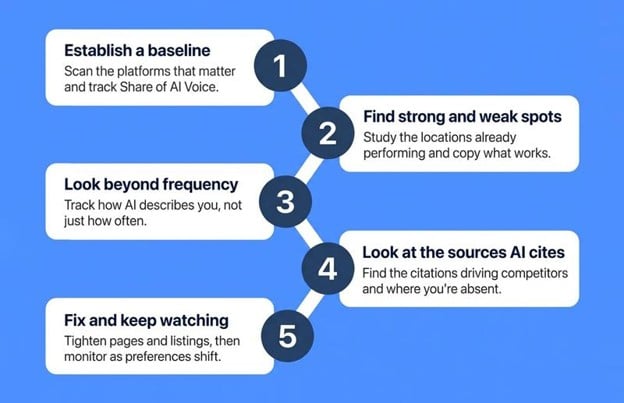
1. Establish a baseline
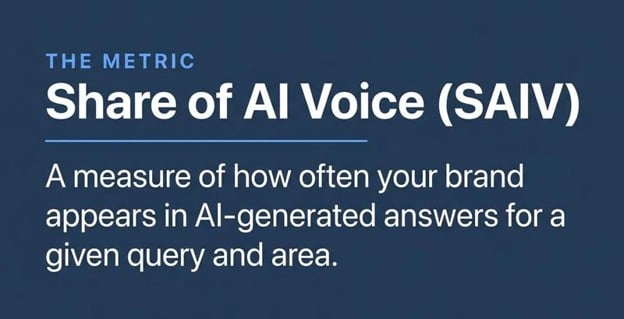
Run AI visibility scans across the major platforms, especially Google AI Overviews, AI Mode, Gemini, and ChatGPT, for queries that matter to your business. The core metric to track is Share of AI Voice, a measure of how often your brand appears in AI-generated answers for a given query and area. Without a number to start from, there’s no way to know if later changes are working.
2. Find your strong and weak spots
If you operate more than one location, visibility is almost never perfectly even. Some locations will already be performing well. Study those first. Whatever is driving that visibility, whether it’s stronger content, a more complete directory profile, or a steady flow of reviews, is a model you can apply to the locations that are lagging.
3. Look beyond frequency to sentiment
Showing up in an AI-generated answer isn’t automatically a win. AI platforms can mention a business in a neutral or even unflattering context, next to a comparison that favors a competitor, or framed around a limitation rather than a strength.
A business appearing constantly but described in lukewarm language isn’t getting the same value as one AI is actively recommending. Understanding how your brand is being talked about, not just how often, is what turns local visibility data into an actual growth lever.
4. Look at the sources AI is actually citing
This is the step that separates GEO from ordinary SEO work. Generative AI pulls from specific sources when generating an answer, and seeing that list for both your business and your competitors is crucial.
You might find AI consistently cites a local business journal or a niche directory for your category and you simply aren’t listed there. That gap is a concrete, fixable target instead of a vague sense that “content needs work.” Local Falcon’s AI visibility reports surface exactly this kind of source-level detail, showing which citations are driving a competitor’s mentions and where your own brand is absent.
5. Fix the presence on the sources that matter
Once the gaps are visible, the work becomes targeted. That usually means tightening up location-specific pages with real detail instead of templated copy, keeping Google Business Profile and directory listings current, building a steady cadence of recent, detailed reviews, and pursuing earned coverage from local publications your competitors are already being cited from. Community mentions on places like Reddit or local forums matter too, though those come from genuine engagement rather than something you can manufacture directly.
Keep watching and adjust. AI source preferences move. A platform update, a new competitor, or a change in how a model handles local queries can shift your visibility without any change on your end. Scheduled tracking catches those movements early enough to respond, rather than finding out three months later that visibility quietly dropped.
Where SMBs Have the Edge
Large organizations move slowly through layers of approval before a page gets updated or a listing gets corrected. A small business can fix a directory profile or update a location page the same day, or act on a source gap the moment it’s identified rather than routing it through a marketing committee. In an environment where AI source preferences update continuously rather than on a monthly cycle, that speed matters more than budget size.
GEO isn’t a separate discipline bolted onto local marketing. It relies on many of the same fundamentals, applied based on different measurements and a clear view of which sources actually influence what AI says about you. SMBs that track that data and act on it are positioned to compete with brands many times their size.