
The holy grail of SMB SaaS is to be an all-in-one (AIO) provider. Spanning several SMB functions – from marketing to operations – AIO providers can gain ARPU and lower churn. The latter happens as they’re embedded deep into critical operations such as payroll and point-of-sale payments.
Though these advantages are clear on the provider end, there’s an ongoing debate about the merits on the SMB end. Though AIO software offers local businesses one-stop-shop convenience and unified dashboards, the alternative is freedom to choose a customized mix of best-of-breed point solutions.
When weighing those pros and cons, the past couple of years have tipped the scales in favor of all-in-one approaches. Why? because cross-functional software capabilities break down silos that hold SMB operational data. And that unlocks the latest golden goose in local business marketing: AI model training.
Put another way, the preexisting AIO movement has been accelerated by the rise of AI. SaaS players can meanwhile lean into the narrative that running several functions for local businesses lets them federate data… and therefore empower AI to work better on their behalf. In that way, AIO piggybacks on AI buzz.
Surface Area
But it’s not just about sales messaging. A broader and unified software surface area for a given business can genuinely elevate AI model training. One example came up last week: Vendasta’s developing suite of AI employees taps into its embedded positioning in SMB inboxes to mimic the “voice” of the business.
Yelp has likewise leaned into federated data from AIO positioning. Over the past decade, it has built and bought its way towards more operational support for local businesses. Previously focused on SMB customer acquisition, it has expanded into areas such as reservation and appointment booking.
Though many of these moves predate the recent rise of AI – and were done more to diversify revenue and gain stickiness among SMBs – more comprehensive and federated SMB data has been a valuable byproduct. Other more recent moves were expressly AI-driven, such as Yelp’s Hatch acquisition.
SOCi is another exemplar at this intersection of AI and AIO. As we examined last week, the company is training agentic models to respond to business reviews – alleviating a longstanding local business pain point. It trains agents on multi-location brand guidelines, then deploys agents per location to execute.
Gravitational Pull
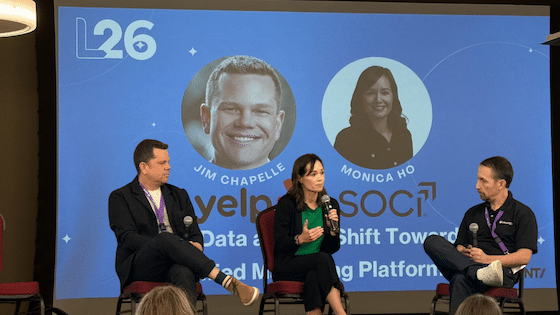
Synthesizing these examples, we had all the above companies on stage last week at L26 in Houston. Two of the three – Yelp and SOCi – were on stage at the same time to tackle this topic of AI’s impact on AIO software. Each agreed that AI is driving the AIO movement by giving it new meaning and incentive.
Backing up for context, Yelp and SOCi work together on a few levels. On one level, SOCi uses Yelp’s API to bring reviews management into its platform for multi-location brands. This integration feeds SOCi’s growth as an AIO platform, while increasing Yelp’s own distribution and local-business touchpoints.
Drilling down on that last part, when a platform deploys Yelp’s API, it distributes Yelp to more businesses. And beyond valuable platform engagement, Yelp gets something else: data. Through integrations in places like SOCI, Yelp gets more local business content, such as review responses and SMB analytics.
That’s all to say that the move towards AIO doesn’t have to be through the development of a single platform. It can happen through partnerships, API integrations, and other ways to federate data and break down silos. Given the gravitational pull towards agentic AI, expect to see a lot more of this.