
For multi-location brands, local visibility has always been a balancing act. One under-optimized Google Business Profile or a missing directory listing can mean the difference between a location being discovered or overlooked by potential customers. But in the AI search era, the cost of inconsistency is even greater.
Where once inconsistencies mainly affected local rankings in Google Search or Maps, today they can also influence how — or even if — your business appears in AI-generated summaries and recommendations.
As large language models (LLMs) increasingly shape how consumers discover local products and services, inconsistent branding and local SEO practices across locations can undermine your local visibility more than ever.
The Longstanding Problem of Inconsistent Local Presence
Multi-location brands have always struggled with maintaining consistent local data. Each location typically has its own hours, contact details, and possibly even service offerings, while sharing core brand assets like logos, messaging, and tone of voice.
Over time, natural variations emerge — maybe one location updates its service offerings or hours on the website but not on Google, or another uses an outdated business description across listings and social profiles.
Traditionally, these inconsistencies confused Google and other search engines that depend on structured data to verify a business’s legitimacy and relevance. Some locations ranked well in local search while others lagged behind, even when they offered identical products or services.
Ultimately, inconsistent multi-location data fragments your online identity, preventing algorithms from confidently connecting each location to the parent brand — and in a world where trust equals visibility, that’s a serious problem.
AI Search Raises the Stakes
Now, the rise of AI search has raised the stakes even higher. Unlike traditional search engines, which primarily index web pages and listings, AI assistants generate answers and summaries based on patterns and relationships across multiple data sources, including your website, directories, social media, and reviews.
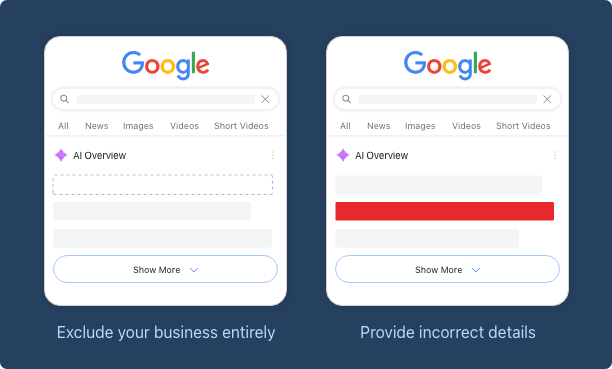
When information about your locations doesn’t line up, AI models may:
- Exclude your business entirely from AI-generated summaries (like Google’s AI Overviews) because the data doesn’t seem trustworthy or consistent.
- Provide incorrect details (such as an outdated address, old logo, or inaccurate description) that confuse potential customers and weaken brand perception.
In other words, inconsistent information doesn’t just hurt rankings anymore. It can directly reduce your share of AI voice — how frequently your business is mentioned or recommended in AI-generated answers.
For multi-location brands competing in various local markets, that’s a visibility gap that compounds quickly. If AI tools don’t see your business as unified and credible, they’ll surface competitors that appear more consistent and better defined.
Where Inconsistency Creeps In
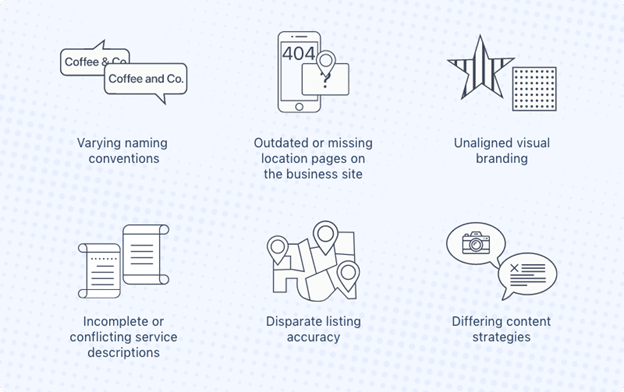
Even well-managed brands can unintentionally introduce inconsistency across locations. Common culprits include:
- Varying naming conventions
- Outdated or missing location pages on the business site
- Unaligned visual branding
- Incomplete or conflicting service descriptions
- Disparate listing accuracy
- Differing content strategies
Each small inconsistency weakens the data connections that search engines and AI models rely on to understand your brand. When multiplied across locations and platforms, these discrepancies can create significant blind spots.
How AI Interprets (And Misinterprets) Your Brand
AI models don’t simply “look up” your business — they interpret it. They cross-reference multiple sources to confirm facts and form associations. If one location’s online footprint doesn’t match the others, the AI may treat it as a separate entity altogether or deprioritize it in recommendations.
Even minor branding differences can affect how your business is perceived and categorized by LLMs, influencing both visibility and accuracy in AI-generated results.
Consistency Builds Trust (For Both Humans and Machines)
To succeed in both traditional and AI-driven local search, multi-location businesses need to think of brand consistency as a form of SEO hygiene. Consistent information across all touchpoints, from business listings and websites to reviews and social media, reinforces brand credibility and helps search engines and AI tools interpret your business accurately. This consistency builds a single source of truth that humans and machines alike can trust.
The Role of Local Rank Tracking and AI Visibility Intelligence
Historically, local marketers have relied on Google-centric rank tracking data to monitor visibility. But as AI becomes an increasingly active participant in local discovery, traditional rankings tell only part of the story.
Monitoring both traditional and AI search visibility can help multi-location businesses catch inconsistencies before they cause lasting damage. If one location starts disappearing from AI summaries or seeing drops in local pack performance, it’s a sign something in its data, content, or reputation may be misaligned.
Analyzing performance data for traditional local rankings and AI search visibility helps brands quickly identify which locations need attention and take corrective action. This ensures that all locations share a consistent and optimized presence, preserving brand authority and improving visibility across all search channels.
The Bottom Line
The fundamentals of local SEO haven’t disappeared, and ensuring consistent business information across locations has always been a local SEO best practice. But in the AI era, maintaining brand consistency across every location is essential to making sure your brand is present in AI conversations.
Inconsistent information confuses not only traditional search engine algorithms, but also the AI models now shaping how consumers find and evaluate local businesses. Investing in consistent branding, citations, and visibility monitoring helps multi-location organizations safeguard their digital presence, protect their reputation, and ensure that every location earns its fair share of local visibility — no matter how the search ecosystem continues to evolve.