

Google over the years has experimented with various ways to call local businesses for you. That includes the ill-fated Duplex, as well as its more recent tool that offers to call airlines and wait on hold for you. Now it’s back to the well with its latest feature that’s purpose-built and well-timed for the AI era.
Known as “Ask for Me” when it was first released in January in beta (for Search Labs users), the tool is now available widely. So what does it do? Its main selling point is its ability to call local businesses on your behalf – everything from sushi bars to trampoline parks – to ask qualifying questions.
The idea is to offload rote and time-consuming consumer research. This includes factors like when a business is open, if a given product is in stock, and how much it costs. These are not only tedious tasks that users generally don’t like doing, but also the ones that AI is halfway decent at these days.
This is the latest in Google’s blitz of AI capabilities that are being integrated throughout its orbiting products. And like many of those other features, the proposition to users is to save time or streamline the traditional process of searching for things. In this case, it fits squarely into a local search use case.
Intent Signals
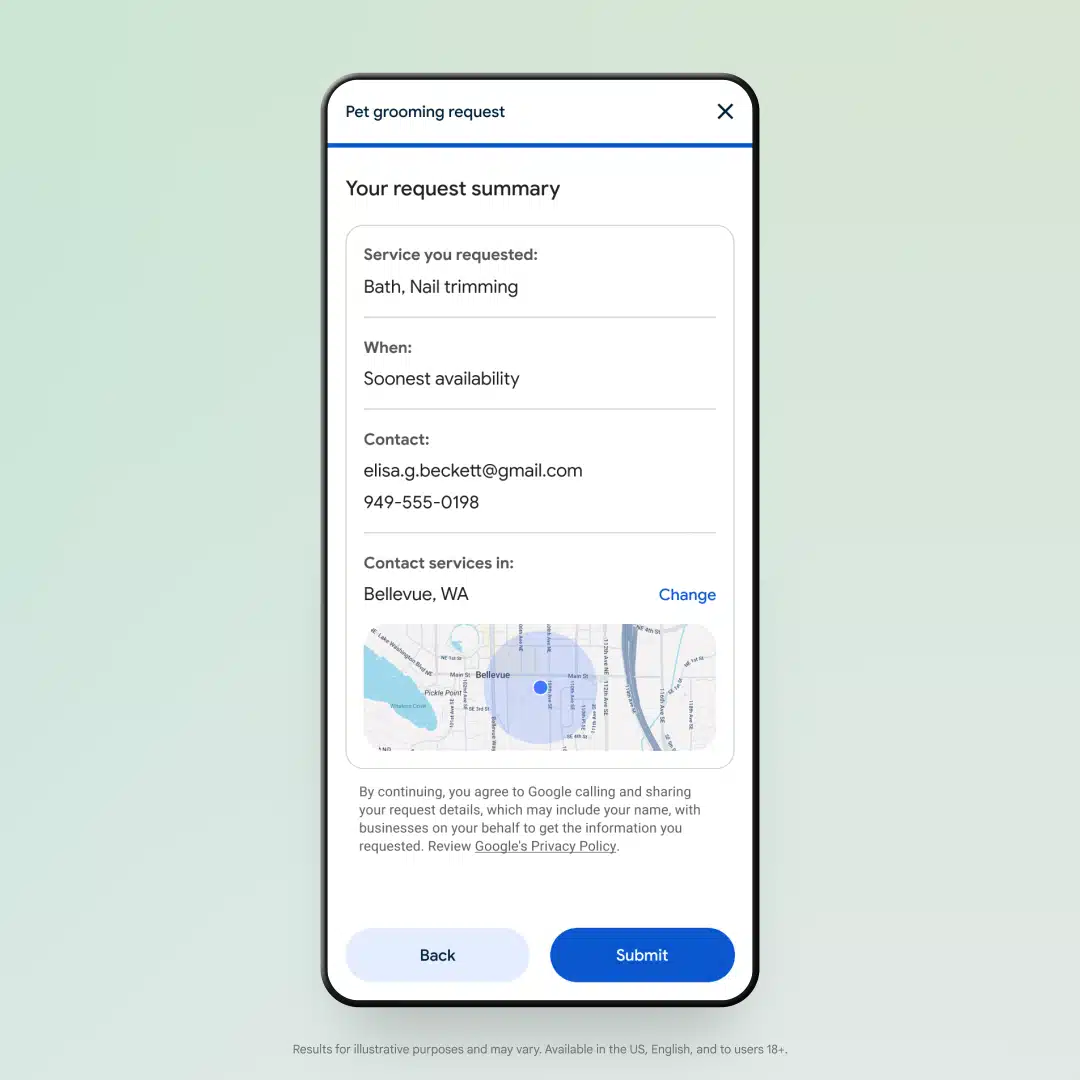
As for the feature’s UX, users get started with typical ‘near-me’ searches. In addition to regular SERP results, a new option will appear that says “have AI check pricing.” Users can then answer a few qualifying questions to zero in on other intent signals before Google launches a call to the business.
Notably, this is a bit different from the “ask for me” function noted above in Google’s January experiment. It no doubt learned from that and refined the UX a bit. Specifically, it has zeroed in on pricing and appointment-based queries rather than a more generalized and open-ended set of questions.
In either case, the outcome is similar, which is a summary that Google sends to the user with answers like pricing and availability. The latter could mean product pricing (if products) and appointment availability (if services). But several questions remain on how effective the automated agent will be.
For example, will it create confusion when SMBs are thrown by talking to a robot? Every call to a business begins by disclosing that it’s an automated system calling from Google. Will SMBs hang up or feel too busy, or confused to deal with it? What about when there’s a phone tree? Robots talking to robots?
Revisit the Well
Other questions include why Google is doing this. And does it lead to a monetization outcome? That’s unclear, but we can see a path towards monetization if Google can use this framework to sell warm leads in some way. This would likely entail calls that are channeled or prioritized to paying businesses.
That last part speaks to Google’s broader evolution. A high-stakes question often asked is how Google will monetize AI search (one answer) without cannibalizing paid search (many links). Yext CDO Christian Ward sees selling high-value leads or “offers” as a way to reconcile fewer ad slots. Quality over quantity.
In either case, back to the part about Google’s history with automated SMB calling, it’s been spotty. The most notorious example is the failed Duplex, as noted. But though it didn’t survive, Google clearly sees opportunity to revisit the well. And with its current AI blitz, now’s the logical time to wheel it back out.
Meanwhile, this is the latest in a string of AI products to come out of Search Labs, including the now-ubiquitous AI Summaries. As for timing and rollout, it’s starting to be activated in the U.S. for all search users, with higher usage limits for Google’s paid subscription tiers such as AI Pro and AI Ultra.