As you likely know, Google I/O took place this week. The annual developer conference had the standard slate of rapid-fire announcements from across the Googleverse. We plan to do a few deep dives on individual announcements, but until then we’re focusing on 3 quick takeaways to cap the week.
These are the announcements we filtered based on their relevance to the Localogy universe. They’re each grounded in some way in local commerce. And of course, a common theme that threads throughout is AI. In fact, Google should think about changing the name of its event to Google AI…
1. Conversational SERPs
Google has formally announced what it’s been building towards for several months: a generative-AI fueled results page. This involves a conversational AI module that will get prime placement in SERPs and seek to answer search queries. This positions AI ahead of Page Rank and “10 blue links.” A big move.
Going back further than the recent AI boom, Google has built towards this for years with SERP evolution that taps the knowledge graph to answer questions. So though Google has been late to the recent AI game, it’s better positioned than you think with the best image and text training sets on the planet.
In fact, its latency in the recent AI boom has much to do with waiting until market forces make it unavoidable to upend its classic search model. This will cause it to reshuffle but it will figure things out, despite some misguided refrains that it has shot itself in the foot. This is Google we’re talking about.
Also, a shoutout to Yext CDO Christian Ward who saw this coming long before the recent inflection in AI interest. Google’s trajectory has been pointing towards AI-fueled search for some time. And though it cannibalizes its SERP model, Google knows it has to do this… or have someone else eat its lunch.
We’ll be back with more on this topic, including expert input from our SEO friends…
2. Geospatial Creator
Building from Google’s work around geo-anchored 3D content, it’s unlocking these capabilities by allowing them to live elsewhere. Specifically, its new Geospatial Creator plugs into Unity so that artists and developers can build 3D animations that are anchored to physical places (see video below).
The 3D creation part is where Unity shines while the “anchored to physical places” is what Google brings to the table. Google has been working on this geospatial data for years, starting with Street View. These digital point clouds (similar to LiDAR) help devices “localize,” or know where they’re standing.
That localization is the first step toward devices being able to activate the right 3D digital content for geo-anchored AR experiences. We’re talking promotional animations in and around local storefronts, creative endeavors around public spaces, or architectural mockups of a new building project.
Back to generative AI, the next step could be to infuse all the above with intelligent 3D content that adds digital depth to the physical world. That could involve 3D animations that are generated on the fly via voice prompts, thus bringing an additional serendipitous kick to Google’s geospatial efforts.

3. Google Maps Immersive View
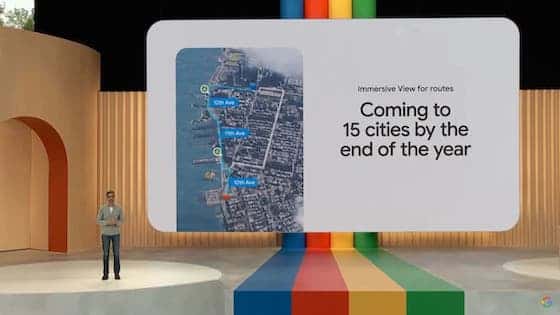
Google Maps’ Immersive View is expanding into routing and navigation. As background, Immersive View is an existing feature that makes Google Maps more dimensional and stylized. Rather than boring overhead maps with color coding and some topography, these maps look more like a video game.
These are available in high-traffic areas and traffic destinations so that travelers or students can check out worldwide locales with greater depth and color. With the expansion to routing – available by the end of the year in 15 cities – all these features are brought to you when you’re trying to get somewhere.
What’s the benefit? With a greater sense of realism in your routing and navigation, you can better mentally map 2D directions to 3D space. This lets users know they’re in the right place and anticipate things like traffic or hectic cityscapes – variables that don’t often come through in 2D mapping.
Google will even layer in weather data to give you a more realistic preview of the place you’re going. And all of this wouldn’t be complete without the theme of this article: AI. Immersive view uses computer vision and AI to stitch billions of Street View and aerial images and create a 3D model of the world.
Expect more on all of the above from Google, and more from us on these updates…